
Violet carpenter bee
Xylocopa violacea
Description
How to identify
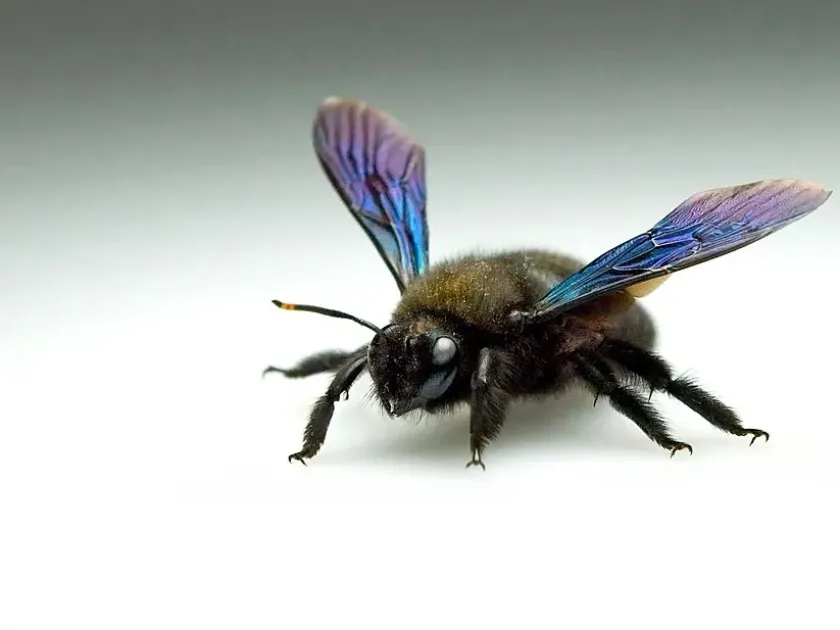
The violet carpenter bee (Xylocopa violacea) belongs to the family Apidae. It is one of the largest bees in Europe, measuring between 20 and 28 mm in length, easily recognized by its robust, dark appearance.
The body is deep black, but it exhibits a metallic violet or dark blue sheen when exposed to sunlight. Its wings are dark with a distinct iridescent glow, making it look quite similar to a large bumblebee.
Unlike honey bees, this species is solitary. Females possess strong, specialized mandibles that allow them to tunnel into sound or slightly decaying wood to create nesting galleries.
While the bee can look intimidating due to its size and loud buzzing, it is generally non-aggressive. It does not form colonies, as each female manages her own nesting process.
The life cycle is annual, with females emerging in spring after overwintering to begin the process of wood excavation and egg-laying for the next generation.
What it damages
The damage caused by the violet carpenter bee is purely mechanical. They bore cylindrical tunnels into wooden structures, such as posts, beams, porches, and wooden sheds.
A female creates a tunnel that can reach up to 30 cm in length, dividing it into individual cells with partitions made of sawdust and nectar. This process compromises the structural integrity of the wood.
If left unchecked for several years, multiple bees may inhabit the same structure, creating a network of tunnels that can significantly weaken beams and structural supports.
The resulting tunnels serve as entry points for moisture, rot, and fungi, which can degrade the wood much faster than the bee's physical activity alone would suggest.
The bees do not consume the wood for food; they merely discard the wood particles while drilling. However, the cumulative effect of their nesting can be destructive to older or untreated timber.
When it appears
The active season begins in early spring, typically April or May, when temperatures become warm enough for the overwintered females to emerge and start searching for suitable nesting sites.
During the spring and early summer, females spend significant time drilling and preparing their nests. This is when they are most active around wooden structures.
Larval development occurs inside the wooden galleries throughout the summer months. During this time, adult bees are less visible as they focus on provisioning cells and tending to the nest.
The new generation of adults typically emerges in late summer, usually August. They spend a short time foraging on flowers before seeking out protected sites for overwintering.
As autumn temperatures drop, the bees enter a dormant state within sheltered cracks or their existing wooden nests, completing their life cycle until the following spring.
Signs of infestation
The most prominent sign of an infestation is the presence of perfectly round entry holes, roughly 10–12 mm in diameter, found on the surface of wooden elements.
You may find small piles of sawdust or wood shavings directly beneath the holes, which are expelled by the female during the drilling process.
In quiet conditions, it is sometimes possible to hear a low, rasping or buzzing sound coming from inside the wood as the bee works on expanding its gallery.
Over time, evidence of wood decay or staining around the hole may appear, indicating that the tunnels are allowing water to penetrate the interior of the wood.
Observing large, dark bees hovering near wooden walls or fences on sunny days is a strong indication that the area is being used for nesting.
Control measures
Prevention is key; painting or varnishing wooden surfaces with high-quality oil-based products makes the wood less attractive and harder for the bees to penetrate.
Sealing holes with wood putty, caulk, or wooden dowels is an effective way to prevent bees from returning to the same nesting sites in subsequent years.
If an infestation is active, you can apply insecticide sprays or dusts directly into the entry holes during the spring season to target the bees as they enter and exit.
- Regular maintenance and inspection of outdoor wooden structures.
- Replacement of severely damaged wood that is structurally compromised.
- Using wire mesh to cover vulnerable, non-painted wooden areas.
In many regions, this bee species is protected or considered a rare pollinator. Therefore, it is advisable to prioritize exclusion and repelling methods over total eradication.
Taxonomy
- Latin name
- Xylocopa violacea
- Order
- Hymenoptera
- Family
- Apidae
- EPPO code
- XYOAVL
Discussion
No discussions yet — be the first.