
Horse fly-like carpenter bee
Xylocopa tabaniformis
Description
How to identify
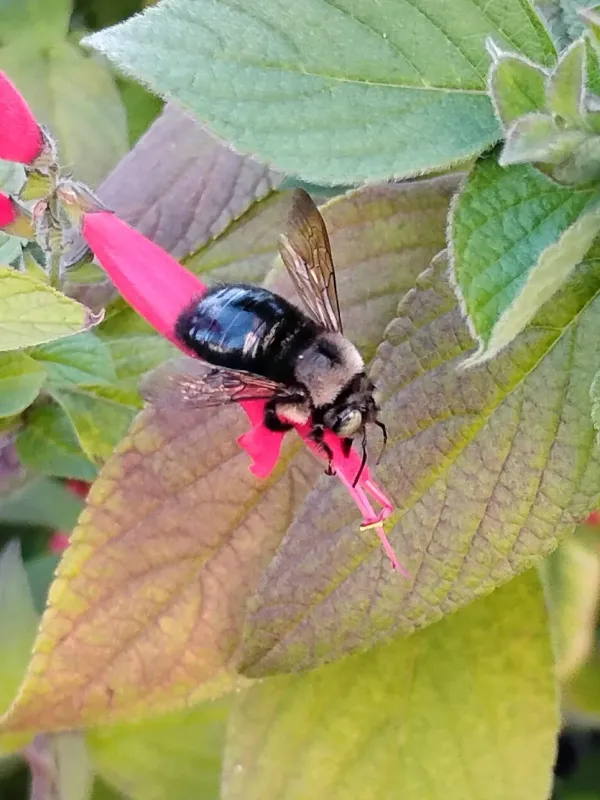
The carpenter bee (Xylocopa tabaniformis) belongs to the Apidae family and is a solitary insect known for its ability to excavate tunnels in wood. It resembles a large, metallic black bumblebee with dark, sometimes iridescent wings.
The insect possesses strong mandibles designed for drilling into wood. Adults typically range from 20 to 25 mm in length, making them robust flyers that are easily distinguishable by their size and behavior.
Unlike honey bees, they do not live in colonies. Females are responsible for nest construction, creating linear tunnels subdivided into cells using a mixture of wood shavings and secretions to nurture their offspring.
The life cycle encompasses four distinct stages: egg, larva, pupa, and adult. Each cell contains a pollen provision, which serves as food for the developing larva until it metamorphoses into an adult.
Males are often seen hovering around nest sites to protect the territory, while females focus on the labor-intensive task of excavating galleries within solid wood substrates.
What it damages
The primary damage caused by these insects involves structural timber. They prefer weathered, unpainted, or decaying wood, targeting both coniferous and deciduous tree species.
In orchards, they can inhabit weakened fruit trees, creating galleries that compromise the vascular system and structural strength of the trunk, eventually leading to tree decay or breakage.
Structural damage is also common in wooden outdoor structures, such as decks, pergolas, fences, and siding. Left untreated, these tunnels can weaken the wood over several seasons.
The excavation process often creates an entry point for water, fungi, and other opportunistic pests, which can accelerate the degradation of the timber significantly.
While a single gallery may not cause immediate collapse, the cumulative effect of multiple nests can result in significant economic damage to wooden garden features and ornamental trees.
When it appears
Activity begins in the spring when temperatures rise, signaling the emergence of overwintering females. They emerge from their tunnels to feed on early blossoms and scout for suitable nesting sites.
The reproductive cycle occurs throughout the summer months. This is the period when most excavating activity takes place, as females prepare cells for the next generation of larvae.
By late summer, the new generation of adults emerges. These young bees feed on nectar to build up sufficient energy reserves needed to survive the upcoming winter months.
Winter is spent in diapause, with adults sheltering inside protected tunnels or other cavities. Successful survival through the winter is highly dependent on finding a dry, sheltered location.
The exact timing of the season varies depending on local climate conditions, with warmer regions experiencing longer periods of insect activity and potentially multiple developmental stages.
Signs of infestation
The most prominent sign of an infestation is perfectly circular entry holes, roughly 10–12 mm in diameter, appearing on the surface of the wood. They look like they were made by a drill bit.
Piles of coarse sawdust or wood shavings, often found directly beneath the entry hole, are a strong indicator of active excavation occurring inside the timber.
Audible buzzing can often be heard near infested areas during warm, sunny days. This sound is generated by the vibration of the bees as they work inside their tunnels.
Yellowing leaves or premature die-back on specific limbs of a tree can indicate internal damage caused by the bee’s galleries, disrupting the flow of water and nutrients.
Seeing adult bees repeatedly hovering around wooden fences or posts during spring is a clear sign that they are actively selecting sites for nesting, suggesting the need for preventative action.
Control measures
Prevention is the most effective management strategy. Painting or varnishing exposed wood surfaces acts as a deterrent, as carpenter bees prefer raw, weathered timber for nesting.
Sanitary practices, such as the prompt removal and destruction of infested logs, dead branches, or decaying stumps, help reduce local population pressure in garden settings.
If active tunnels are identified, treating them with an appropriate insecticide dust or spray, followed by sealing the entrance with wood putty or caulk, can prevent further use of the tunnel.
For valuable wooden structures, the application of chemical wood preservatives or borate-based treatments can provide long-lasting protection against wood-boring insects.
Regular monitoring of wooden structures during the peak spring season allows for early detection and intervention, minimizing the risk of cumulative damage to the property.
Taxonomy
- Latin name
- Xylocopa tabaniformis
- Order
- Hymenoptera
- Family
- Apidae
- EPPO code
- XYOAOR
Discussion
No discussions yet — be the first.