
Carpenter bee
Xylocopa aeneipennis
Description
How to identify
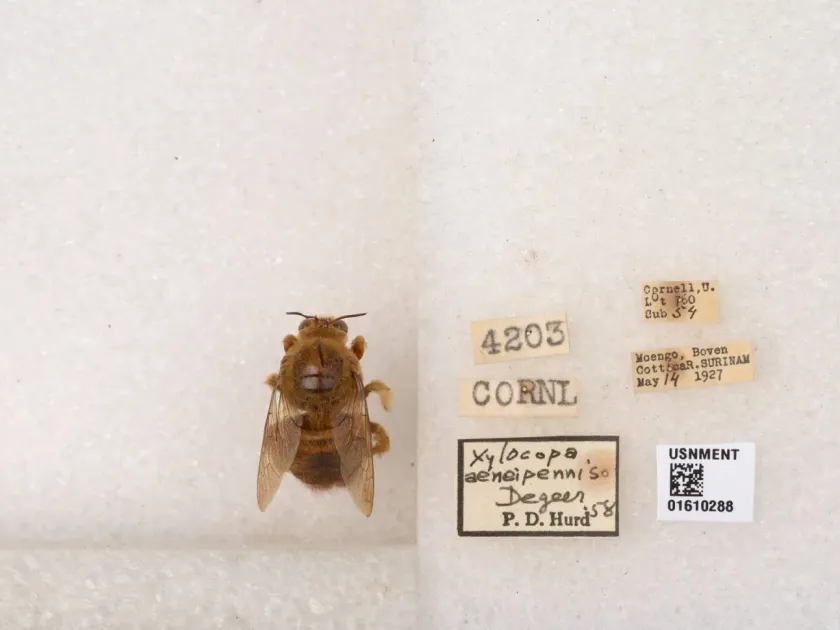
The carpenter bee (Xylocopa aeneipennis) belongs to the Apidae family and is known for its metallic appearance with a distinct copper or bronze sheen. These insects are large, robust, and often mistaken for bumblebees due to their size and hairy bodies.
Adults typically measure between 20–25 mm in length. Their wings often exhibit a deep violet or bluish iridescent glow when exposed to direct sunlight. Females are generally larger and more aggressive in their nesting behavior.
Unlike honeybees, carpenter bees are solitary. Each female is responsible for constructing her own nest, utilizing powerful mandibles to tunnel through dense wood. This behavior is biologically significant for pollination but problematic for infrastructure.
The life cycle involves complete metamorphosis, progressing through egg, larval, pupal, and adult stages. They prefer dry, unpainted, and weathered wood to establish their nesting galleries.
These bees are most prevalent in temperate climates, where they successfully navigate between blossoming fruit orchards and wooden structures, using the latter for their reproductive cycle.
What it damages
The primary damage caused by carpenter bees is structural. They infest wooden garden posts, vineyard stakes, greenhouse frames, eaves, and exterior siding, compromising their integrity.
Females bore perfectly round tunnels, which can extend up to 30 cm into the wood. Over time, multiple generations using the same nesting site can hollow out timber, leading to structural instability or collapse.
Damage is often exacerbated by moisture entering the tunnels, promoting fungal growth and wood rot. This combined effect significantly reduces the lifespan of agricultural infrastructure.
While they are valuable pollinators of various crops, their tendency to select wooden supports in close proximity to orchards classifies them as a notable pest for property management.
If left unmanaged, the cumulative damage from multiple nesting sites can result in costly repairs, especially when load-bearing wooden components are involved.
Signs of infestation
The most visible sign of infestation is the presence of perfectly circular, smooth-edged holes, approximately 10–15 mm in diameter, found on the surface of wooden timbers or beams.
Small piles of sawdust (frass) directly beneath these holes indicate active nesting. This debris is produced as the female bee excavates the interior wood to create individual brood cells.
During the spring and early summer, one may observe large bees hovering near wooden structures or flying in erratic patterns as they search for suitable nesting sites.
Tapping on the wood near the holes often reveals a hollow sound, confirming the existence of deep internal galleries carved out by the developing larvae.
Staining around the entrance holes, often caused by waste or pollen deposits, is another indicator of established and occupied nests that have been in use for some time.
Control measures
Painting, staining, or varnishing wood surfaces is the most effective deterrent. Carpenter bees are rarely attracted to well-sealed or painted wood, as they prefer exposed, natural surfaces.
Existing holes should be promptly sealed with wood putty, caulk, or wooden dowels treated with insecticide. This prevents further tunneling and discourages other bees from utilizing the same galleries.
For new agricultural constructions, substituting wood with metal, concrete, or pressure-treated lumber can significantly reduce the attractiveness of the site to nesting bees.
In cases of severe infestation, residual insecticide dust or sprays can be applied into the entrance holes during the appropriate season to eliminate active populations effectively.
Regular monitoring of wooden structures, especially in early spring, is crucial for early detection, allowing for quick action before the bees can cause extensive internal damage.
Taxonomy
- Latin name
- Xylocopa aeneipennis
- Order
- Hymenoptera
- Family
- Apidae
- EPPO code
- XYOAAE
Discussion
No discussions yet — be the first.