
Common European adder
Vipera berus
Description
How to identify
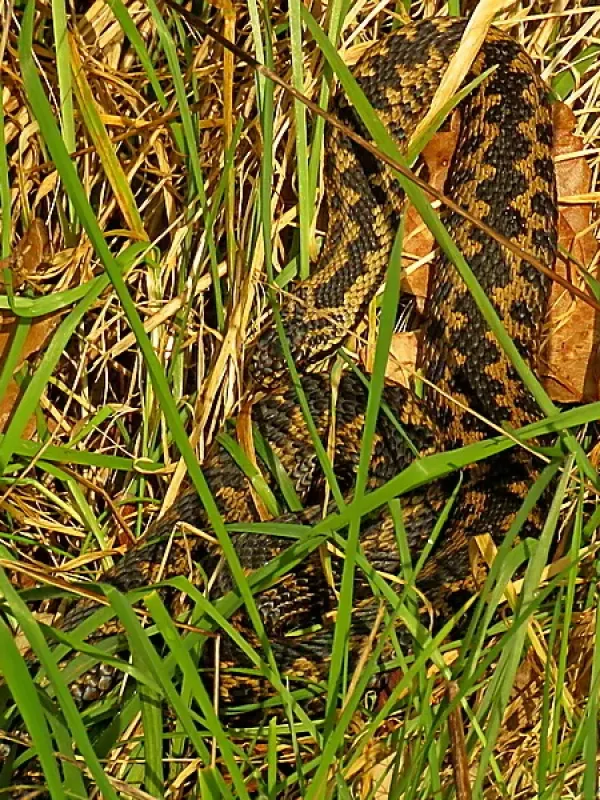
The Common European Adder (Vipera berus) belongs to the Viperidae family. It is a venomous snake generally measuring between 50 and 80 cm in length.
It is easily recognizable by a characteristic dark zigzag pattern running along the dorsal side of its body, which contrasts with the lighter base color.
The head is distinctly triangular and broader than the neck, with a snout that is rounded at the front and features a sharp ridge along the sides.
The eyes are equipped with vertical, slit-like pupils, which is a key diagnostic feature separating them from non-venomous colubrid snakes.
While their color varies from gray and beige to red-brown or solid black, the zigzag pattern typically remains visible in most light-colored specimens.
What it damages
The Common European Adder is not a crop pest in an agronomic sense because it does not feed on vegetation or agricultural produce.
As a carnivorous predator, it plays a role in the ecosystem by controlling populations of small rodents, which are major agricultural pests.
However, its presence in agricultural fields presents a significant occupational hazard for staff involved in planting, harvesting, or maintenance.
Accidental bites pose a severe health risk to workers, which can disrupt field operations and lead to liability issues for agricultural enterprises.
Ultimately, while the adder provides a biological control service, the risks associated with human interaction require careful management.
When it appears
Adders emerge from their winter hibernation sites in early spring, typically around March, when temperatures reach about 10 degrees Celsius.
Peak activity is observed during the mating season in spring, coinciding with the timing of major agricultural field preparation and sowing.
Throughout the summer, these snakes are most active during the cooler hours of the day, preferring to stay in shaded or hidden spots during the heat.
As autumn approaches, activity patterns shift towards preparing for hibernation, leading to increased movement towards shelter areas.
They retreat to underground burrows or voids beneath frost level for winter hibernation, remaining inactive until the following spring.
Signs of infestation
Evidence of adder presence often includes shed skins, which are left behind in protected areas such as rock piles or dense vegetation edges.
The presence of abundant rodent prey in a field is a strong indicator that the area might serve as a hunting ground for adders.
Visual sightings of snakes basking on sunny slopes, field margins, or agricultural roads during morning hours are common signs of their habitat.
Unusual movement in thick vegetation or a defensive hissing sound can alert workers to the proximity of a snake.
Specific burrow openings in the ground that appear larger than mouse holes, combined with snake tracks, can indicate active dens.
Control measures
Management of the Common European Adder focuses on habitat modification to prevent snakes from settling in areas frequented by workers.
- Maintain low vegetation levels by mowing field borders and around agricultural structures.
- Eliminate debris, log piles, and stone heaps that provide shelter and wintering sites.
- Implement effective rodent control programs to reduce the snake's food source near fields.
- Ensure all field workers wear appropriate personal protective equipment, such as heavy-duty leather boots.
- Provide training on safe working practices and snakebite first aid to minimize health risks.
Taxonomy
- Latin name
- Vipera berus
- Family
- Viperidae
- EPPO code
- VIPEBE
Discussion
No discussions yet — be the first.