
Copperhead
Agkistrodon contortrix
Description
How to identify
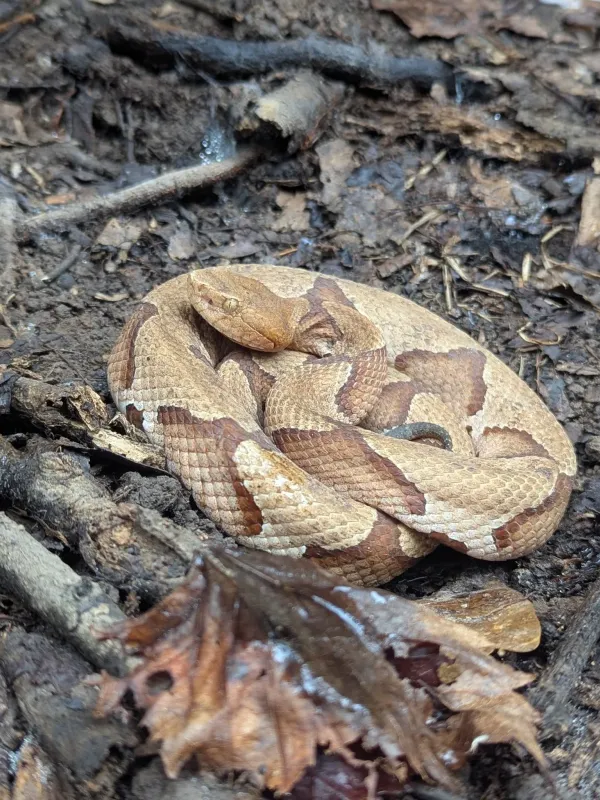
The Copperhead (Agkistrodon contortrix) is a venomous pit viper species native to various habitats. It is easily identified by its copper-colored head and a distinct hourglass pattern on its body.
This species is highly adept at camouflage, blending perfectly into leaf litter and agricultural debris. Adults typically range between 60 to 90 centimeters in length.
Like other pit vipers, it possesses heat-sensing pits located between the eyes and nostrils, allowing it to accurately detect warm-blooded prey in low-light conditions.
Classified under the order Squamata, the Copperhead is not a plant pest but acts as a significant hazard to human activity and livestock management on farms.
Their defensive strategy involves remaining perfectly still, which often leads to accidental encounters when workers are walking through high-grass fields or brush.
What it damages
While the Copperhead does not directly damage crops, its impact on agriculture is felt through the disruption of farming operations and safety risks to personnel.
These snakes are attracted to agricultural fields primarily due to high rodent populations. An increase in mice and voles in crops provides a steady food source for the species.
The presence of venomous snakes causes significant operational delays. Farm workers cannot safely perform manual weeding, irrigation maintenance, or crop harvesting in infested areas.
The snake poses a constant threat to livestock and working farm animals. A single bite can lead to veterinary costs and the loss of valuable farm animals.
By creating unsafe working conditions, the presence of these reptiles reduces overall farm efficiency and increases insurance and labor costs.
When it appears
Copperheads become active in early spring, emerging from hibernation as temperatures rise above the soil threshold for their metabolic activity.
Peak activity is observed during late spring and summer, which corresponds with their breeding season, leading to increased movement across agricultural landscapes.
During the autumn months, these snakes are highly active as they seek out suitable overwintering sites, often migrating toward storage barns or compost piles.
Daily activity cycles shift depending on ambient temperatures; they tend to be diurnal in cooler months and nocturnal or crepuscular during the peak of summer heat.
Farmers should be especially vigilant during the active season, particularly when working near field edges, irrigation ditches, or debris-filled areas.
Signs of infestation
One of the primary indicators of a Copperhead presence is the discovery of shed skins in hidden, warm, and dry places near agricultural storage units.
High rodent density in barns or field perimeters acts as a strong indicator that the area will support a snake population due to available prey.
A faint but distinct musky odor can sometimes be detected in areas where multiple snakes have gathered or established a den, serving as a warning to workers.
Visual sightings on sunny days along field borders or near water sources indicate established hunting territory for the local snake population.
Tracks on soft, damp soil may reveal the movement patterns of snakes migrating from natural habitats into crop rows for foraging.
Control measures
The most effective management strategy is habitat modification. Regularly mowing field edges and clearing tall vegetation significantly reduces the snake's cover.
Remove all debris, such as wood piles, discarded equipment, and overgrown trash, from the farmyard to eliminate potential hiding spots.
Implement a strict rodent control program. By removing the food source (mice and voles), the farm becomes significantly less attractive to Copperheads.
Provide employees with appropriate personal protective equipment (PPE), including heavy-duty boots, when working in areas where snake sightings have been reported.
- Maintain a clean and organized farm layout.
- Prioritize integrated pest management for rodents.
- Install snake-proof fencing around high-risk zones.
Taxonomy
- Latin name
- Agkistrodon contortrix
- Family
- Viperidae
- EPPO code
- AGKICO
Discussion
No discussions yet — be the first.