
Copperheads
Agkistrodon
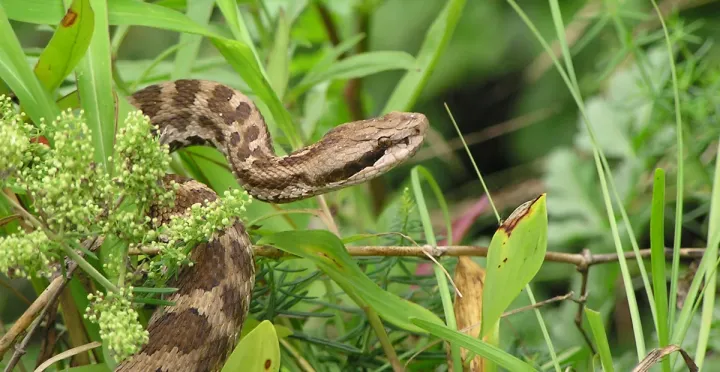
Description
How to identify
Copperheads (genus Agkistrodon) are venomous snakes belonging to the viper family. It is critical to clarify that they are not plant pests; they do not consume crops, damage plant tissues, or transmit diseases to plants.
Physically, these snakes are characterized by heat-sensing pits located between their eyes and nostrils, which they use to hunt small mammals. Their coloration is typically cryptic, blending in with soil, dead leaves, and agricultural debris.
For an agronomist, copperheads are an occupational safety consideration rather than a biological threat to crops. Their presence requires specific management strategies for field workers to prevent accidental bites during harvest or cultivation.
Taxonomically, they are part of the order Squamata. As predators, they perform an ecological service by keeping populations of crop-damaging rodents under control, effectively acting as natural pest suppressors.
Accurate identification is essential for farm safety. Recognizing their habitats helps minimize human-snake encounters and ensures that field operations remain productive without compromising safety protocols.
What it damages
Copperheads cause no mechanical or chemical damage to agricultural crops. They are not herbivores and do not interfere with the growth, development, or yield of plants in any agricultural system.
The economic impact associated with these snakes is strictly logistical. High snake activity in a field can disrupt manual labor, particularly during hand-harvesting of vegetables, berries, or orchard fruits, leading to delayed harvests and potential yield losses.
Management costs may rise due to the implementation of mandatory safety training, provision of protective footwear, and increased insurance or safety oversight for workers operating in infested zones.
The use of pesticides to "control" snake populations is strongly discouraged. Such measures are ineffective, environmentally damaging, and detrimental to the overall health of the soil and beneficial insect populations.
In summary, the "damage" is purely operational, forcing farmers to adapt their working practices rather than fighting a pest that is actually aiding in rodent control.
When it appears
Snake activity is strictly governed by ambient temperatures. They emerge from winter dormancy during the spring as ground temperatures rise, making them more visible during early-season field preparation.
Summer activity peaks during the twilight hours. Because snakes are ectothermic, they often seek cool, damp, and shaded areas provided by dense crop canopies or irrigation equipment during the heat of the day.
Autumn triggers a return to dormancy. Snakes migrate toward hibernacula, which may sometimes be located in field borders, compost heaps, or storage facilities, necessitating caution when cleaning up at the end of the harvest season.
The life cycle is closely tied to local thermal conditions. Understanding these patterns allows management to schedule high-risk manual tasks for times when snake activity is at its lowest.
Temperature fluctuations in the soil dictate their metabolism; hence, agronomists should prioritize mechanized tasks during high-activity periods to keep personnel safe and out of harm's way.
Control measures
Control strategies should focus on environmental modification and personal protective equipment. The goal is to make the field less attractive for snakes to settle in while maintaining a safe environment for workers.
Habitat management is the most effective approach. By keeping field edges clear of debris, tall weeds, and brush piles, farmers can remove the primary refuge spots snakes prefer for concealment and hunting.
Personal safety protocols are non-negotiable. Field staff should be equipped with heavy-duty snake-proof boots and trained in situational awareness to avoid accidental encounters in thick foliage.
- Mowing field perimeters regularly to reduce hiding cover.
- Removing debris, logs, and agricultural waste near work zones.
- Conducting regular safety briefings on snake behavior and first aid.
- Prioritizing mechanized harvest to reduce manual labor in dense vegetation.
Maintaining a balanced ecosystem is vital. Copperheads serve as efficient rodent controllers, and their presence suggests a robust ecosystem that, with proper safety management, requires no lethal control.
Taxonomy
- Latin name
- Agkistrodon
- Family
- Viperidae
- EPPO code
- AGKISP
Discussion
No discussions yet — be the first.