
Vehilius stictomenes
Vehilius stictomenes
Description
How to identify
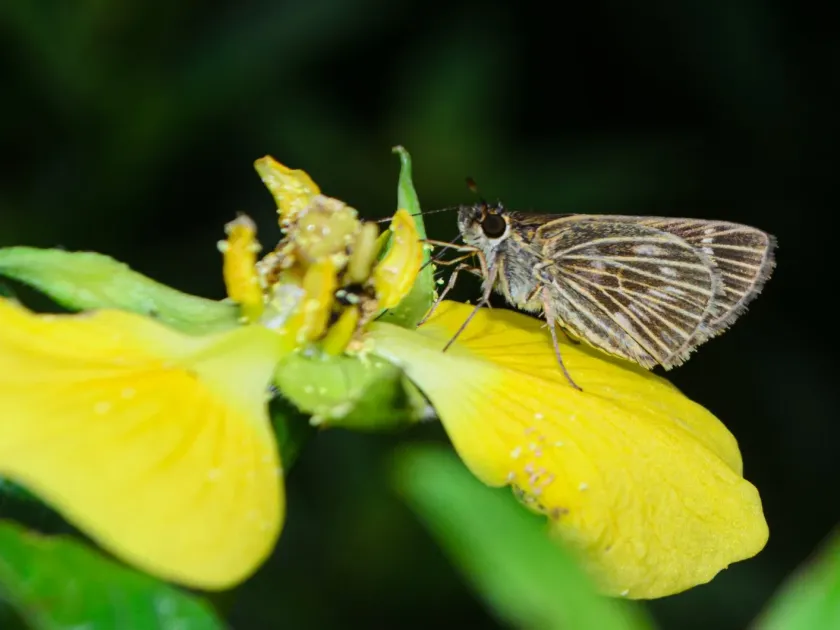
Vehilius stictomenes is a species of butterfly belonging to the family Hesperiidae, commonly known as skippers, within the order Lepidoptera. It is primarily found in tropical environments where it interacts with various grass species.
The adult moth is characterized by its distinct wing patterns with small spots, which is a diagnostic feature of this particular species within the Hesperiinae subfamily.
The larval stage, or caterpillar, possesses a robust body and a hard head capsule, adapted for feeding on tough graminoid foliage. As the caterpillar grows, it undergoes several instars.
The pupa is formed within a protective structure created by folding and stitching together host plant leaves with silk, providing camouflage from predators.
Taxonomically, it represents a group of skippers that are often underestimated as agricultural pests until they reach high population densities in favorable microclimates.
What it damages
The damage caused by Vehilius stictomenes is primarily inflicted by the larvae, which feed on the leaves of diverse Poaceae family members.
This pest affects both wild grasses and commercially cultivated cereals. By consuming the leaf tissue, larvae significantly reduce the plant's capacity for photosynthesis.
Young cereal crops are particularly vulnerable; severe defoliation at the early growth stage can lead to stunted growth and potentially significant yield loss.
The removal of healthy leaf area also makes the plants more susceptible to secondary infections, such as fungal pathogens that enter through feeding lesions.
In high-density scenarios, the accumulation of damage across a field can lead to economic losses, requiring urgent management intervention to protect the crop quality.
When it appears
The seasonal activity of Vehilius stictomenes is closely linked to rainfall patterns and temperatures that support lush growth of grass hosts.
Adults are highly active during warm, sunny days, when they search for suitable host plants to lay eggs, typically placing them on the underside of leaves.
The complete life cycle duration is temperature-dependent. In optimal tropical conditions, multiple generations may occur within a single growing season.
The species survives periods of dormancy (diapause) in cooler or drier months, usually as a pupa sheltered within leaf litter or protected by curled foliage.
Agronomic field scouting is essential during the primary vegetation phases of the host crop to detect early-stage damage and prevent population outbreaks.
Signs of infestation
Initial signs of infestation appear as irregular holes and notched edges on the leaf margins, caused by small, developing larvae.
As the larvae grow, they exhibit the characteristic behavior of rolling or folding leaves to create a shelter, often secured with silk threads.
The presence of frass (larval excrement) on the leaf surface near the shelter sites is a clear indicator of active feeding by the caterpillars.
Plants suffering from infestation often show signs of overall yellowing or wilting, reflecting the loss of leaf area and the metabolic stress caused by the feeding.
Large patches of damaged, skeletonized leaves within a field of healthy crop indicate a localized but expanding infestation that requires immediate attention.
Control measures
Management of Vehilius stictomenes involves a combination of cultural, biological, and chemical methods designed to mitigate crop damage efficiently.
Cultural practices, such as removing alternative host weeds and ensuring clean field borders, are critical for reducing the initial pest pressure.
Biological control agents, including parasitic wasps and predatory flies, play a vital role in maintaining the pest population below economic injury levels.
Chemical control should only be implemented when threshold levels are reached, favoring selective insecticides that preserve beneficial insect populations.
- Regular monitoring and field inspections.
- Promotion of natural enemy habitats.
- Use of Bacillus thuringiensis-based bio-insecticides.
- Strict adherence to IPM (Integrated Pest Management) guidelines.
Taxonomy
- Latin name
- Vehilius stictomenes
- Order
- Lepidoptera (butterflies)
- Family
- Hesperiidae
- EPPO code
- VEHIST
Discussion
No discussions yet — be the first.