
Long-tailed skipper
Urbanus proteus
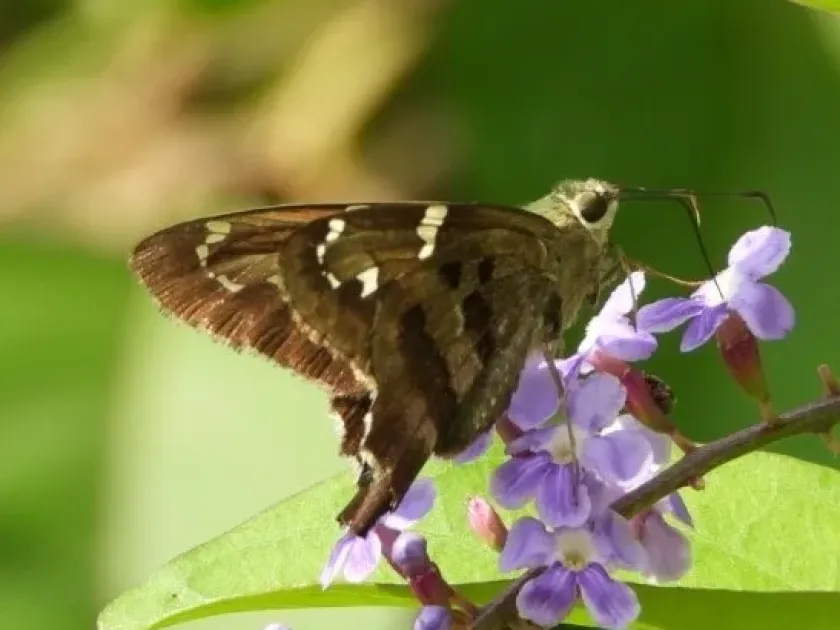
Description
How to identify
The Long-tailed skipper (Urbanus proteus) is a butterfly belonging to the Hesperiidae family (skippers) within the order Lepidoptera.
Adult butterflies are characterized by their dark brown wings with a distinct iridescent blue-green base and transparent light spots on the forewings.
The larvae, or caterpillars, change throughout their growth from a pale yellow to a vibrant green color, marked by a dark dorsal stripe and a brown head.
Pupae are typically hidden within shelters made from folded leaves of the host plant, held together by silk to provide protection from predators.
This species is widely distributed throughout warmer regions, but its range frequently expands northward during exceptionally warm growing seasons.
What it damages
The primary hosts for the larvae are plants within the Fabaceae (legume) family, causing significant economic damage to agricultural production.
Commonly affected crops include beans, soybeans, peas, and cowpeas, where the caterpillars consume large portions of the leaf tissue.
Extensive feeding by the caterpillars can lead to severe defoliation, which limits the plant's ability to photosynthesize and develop properly.
Damage during the early vegetative stage is particularly harmful, often resulting in reduced pod set and lower overall crop yields at harvest time.
Furthermore, the physical damage to stems and leaves can weaken the plant, making it more susceptible to secondary infections or environmental stress.
When it appears
The life cycle of Urbanus proteus is highly dependent on temperature, leading to peak activity during the hottest months of the summer.
Adult butterflies emerge in late spring or early summer, laying eggs in clusters on the undersides of leaves of host plants.
Embryonic development is rapid, with caterpillars hatching within approximately 4 to 6 days under favorable weather conditions.
In tropical and subtropical zones, multiple generations can occur within a single year, necessitating persistent monitoring throughout the season.
As summer progresses, the population size usually increases, creating a compounding threat to late-planted legume crops.
Signs of infestation
The most reliable sign of an infestation is the presence of leaves that have been folded over and stitched together with silk threads.
By inspecting these folded leaf shelters, one can often find the larvae feeding inside, leaving irregular, ragged holes in the foliage.
Accumulations of frass, which appear as dark, small, pellet-like droppings, on the leaves or the ground beneath the plant indicate current activity.
Heavy infestations result in a skeletonized appearance of the foliage, leaving only the primary veins of the leaves intact.
Small, carefully arranged egg clusters found on the underside of young leaves serve as an early warning for potential future damage.
Control measures
Effective management of Urbanus proteus requires an integrated approach combining biological, physical, and chemical strategies.
For home gardens, manual removal and destruction of the folded leaf shelters is often sufficient to keep populations at a manageable level.
- Apply biological insecticides, such as those containing Bacillus thuringiensis, directly to affected foliage.
- Utilize systemic chemical insecticides only if the pest density exceeds the economic threshold for the crop.
- Control weeds from the Fabaceae family around the field perimeter to eliminate alternative breeding sites.
- Encourage natural predators, including predatory wasps and parasitic flies, to thrive in the garden environment.
Routine scouting of legume plantings, at least twice a week during peak flight periods, is essential to detect early egg-laying activity.
Taxonomy
- Latin name
- Urbanus proteus
- Order
- Lepidoptera (butterflies)
- Family
- Hesperiidae
- EPPO code
- GONUPR
Discussion
No discussions yet — be the first.