
Long-tailed skipper
Urbanus
Description
How to identify
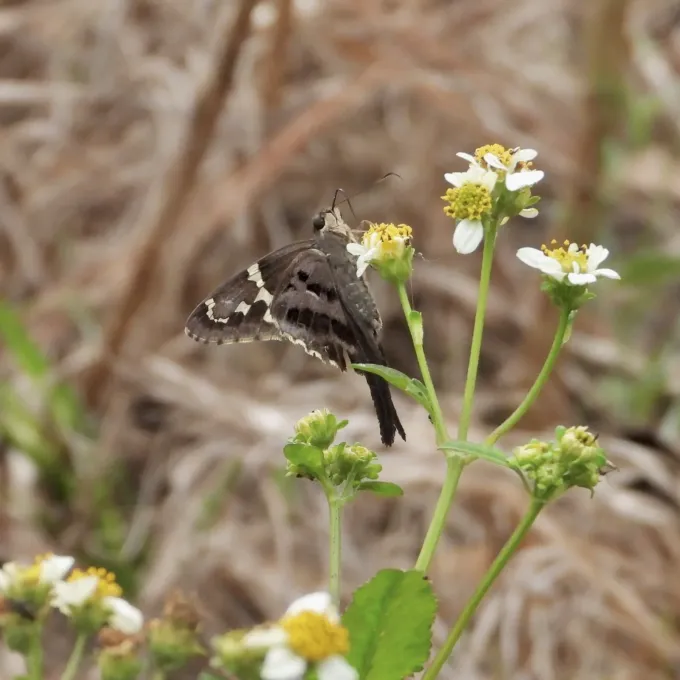
The long-tailed skipper (Latin Urbanus proteus) is a butterfly belonging to the Hesperiidae family. Adult specimens are characterized by a stout body covered in dense hairs and a wingspan typically reaching 4 to 5 centimeters.
The wing coloration is dark brown, featuring prominent translucent, whitish or light-colored spots on the forewings. A distinct diagnostic feature is the long tail-like extension on the hindwings, from which the species derives its common name.
Larvae (caterpillars) are easily identified by their yellow-green body and a large, dark, conspicuous head. They are typical lepidopteran larvae that undergo several developmental stages while feeding on host plant foliage.
Eggs are deposited by females either singly or in small clusters on the undersides of leaves. Upon hatching, the larvae immediately begin feeding, rapidly increasing in size and accumulating nutrients for metamorphosis.
The pupa stage occurs within a leaf shelter created by the caterpillar, which protects it from adverse weather and predators. After the transformation, the adult butterfly emerges to continue the reproductive cycle.
What it damages
The primary damage is caused by the larvae, which are specialized feeders on plants within the Fabaceae family. They pose a significant threat to crops such as beans, soybeans, peas, and various decorative legumes in many agricultural regions.
The larvae feed on vegetative parts, particularly leaves and tender shoots. High population densities can lead to severe defoliation, significantly reducing the plant's photosynthetic capacity and hindering normal growth and pod development.
Early-stage larvae start by feeding on leaf margins, eventually skeletonizing the leaf blades. In cases of severe infestation, plants may be left nearly leafless, which can cause irreparable damage to yield potential.
The larvae roll or fold leaves to create protective shelters, securing them with silk webbing. This behavioral adaptation complicates pest control, as the shelters act as a physical barrier against topical insecticide applications.
The economic threshold for this pest depends on the growth stage of the crop. Seedlings and young plants are particularly vulnerable, as premature loss of foliage can lead to stunted growth or total crop failure.
When it appears
The activity of the long-tailed skipper is highly dependent on regional climatic conditions. In tropical and subtropical regions, the pest may develop through multiple generations throughout the year, posing a continuous threat to production.
Adult emergence typically peaks during warmer months when temperature conditions are optimal for flight and mating. Spring serves as the critical period for the first generation to lay eggs on emerging legume crops.
In temperate climates, the population may decline significantly during winter months; however, in protected environments like greenhouses or coastal areas, the life cycle may persist, requiring year-round vigilance.
Field observations indicate that larval population density peaks mid-summer, coinciding with the active vegetative and flowering stages of the host crops. This window is essential for systematic monitoring and intervention.
As temperatures decrease in the autumn, pupal development may slow down; nevertheless, the species can continue to affect late-season plantings if favorable conditions are maintained, necessitating ongoing field scouting.
Signs of infestation
The most reliable indicator of an infestation is the presence of rolled or folded leaves on legumes. The caterpillar uses silk to pull the edges of the leaf together, creating a tubular shelter.
Inside these shelters, one can usually find granular dark excrement (frass). If the leaf is carefully unrolled, the larva can typically be found within, often attempting to drop or retreat to safety upon detection.
Characteristic damage includes scalloped leaf edges or irregular holes in the center of the leaf. As the caterpillar matures, the area of consumed tissue expands rapidly, signaling a need for immediate action.
Secondary signs include leaf yellowing and the wilting of branches that have sustained heavy feeding. Severe loss of leaf integrity leads to visible plant stress, which can be seen across the field during scouting.
Sighting adult butterflies flying near the crop is a warning that eggs are likely being laid. Timely scouting for adults allows growers to predict when the next generation of larvae will likely emerge.
Control measures
Chemical control involves the use of systemic or contact insecticides effective against lepidopteran pests. Applications are most successful when targeted at newly hatched larvae before they have constructed their protective leaf shelters.
Biological control is highly recommended, utilizing products based on Bacillus thuringiensis. These bacterial agents are specific to caterpillars and do not harm beneficial insects, natural predators, or pollinators.
Cultural practices include rigorous weed management, as many weeds act as alternative hosts for the skipper. Crop rotation and the removal of crop residues post-harvest are vital to reducing overwintering populations.
Pheromone traps are effective for monitoring adult populations. By tracking the number of adults, growers can time their control efforts more precisely, reducing costs and unnecessary pesticide exposure.
On smaller scales, such as home gardens, manual collection of larvae and removal of infested leaves can be highly effective. This labor-intensive method prevents the need for chemicals and helps maintain plant vigor.
Taxonomy
- Latin name
- Urbanus
- Order
- Lepidoptera (butterflies)
- Family
- Hesperiidae
- EPPO code
- URBASP
Discussion
No discussions yet — be the first.