
Udaspes folus
Udaspes
Description
How to identify
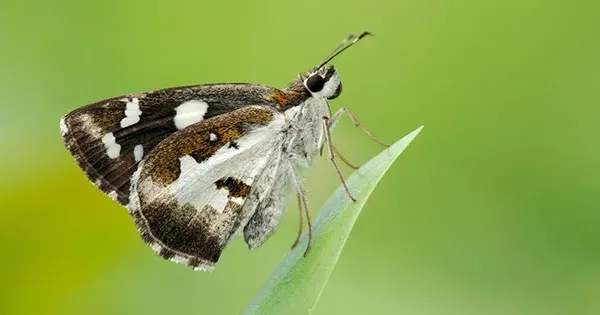
Udaspes folus, commonly known as the grass demon, is a butterfly species belonging to the Hesperiidae family (skippers) within the order Lepidoptera.
Adults have dark brown or blackish wings with distinctive white patches. They are small in size but are easily recognizable by their flight pattern and wing markings.
The body is thick and robust, which is a common characteristic of skippers. In the resting phase, they often maintain their wings in a half-open position.
The larvae are greenish, transitioning to a lighter shade as they mature, with a noticeable dark-colored head capsule which is a key identifying feature.
Pupation occurs within a rolled leaf, protected by a white waxy substance that acts as a shield against environmental humidity and potential predators.
What it damages
The primary host plant for Udaspes folus is ginger (Zingiber officinale), where it causes significant economic losses in tropical agriculture.
In addition to ginger, the pest is known to infest turmeric and other related species in the Zingiberaceae family, posing a threat to spice production.
The larvae feed specifically on the leaf tissues, consuming the foliage and significantly reducing the plant's capacity for photosynthesis.
By rolling the leaves into tubes, the larvae create protected niches, which further hampers the development of the plant and reduces its overall vigor.
Heavy infestations can lead to total defoliation, severely impacting the quality and size of the harvested rhizomes at the end of the growth cycle.
When it appears
Udaspes folus is highly active during the rainy season when ginger plants are in their peak vegetative growth phase, providing an abundant food supply.
In tropical climates, the pest can remain active year-round. Its short life cycle allows for multiple generations to occur within a single cropping season.
New plants are particularly susceptible to early attacks, but the infestation can persist until the harvest, depending on local weather conditions.
Population surges are often observed following high-humidity periods, which are optimal for larval development and survival on the host plant.
Regular field monitoring is essential as the pest can rapidly spread throughout a plantation if left unchecked during the favorable season.
Signs of infestation
The most prominent sign of infestation is the presence of rolled ginger leaves, which serve as shelters for the developing larvae.
Feeding damage is usually characterized by irregular, wavy margins on the leaves, indicating the presence of late-instar larvae.
Accumulation of larval frass (droppings) on the leaves or on the soil surface below the plant is a clear indicator of active feeding in the vicinity.
Yellowing or necrosis of the leaf blades often occurs following sustained larval feeding due to the disruption of the leaf's vascular tissue.
Visual identification of the adult butterflies flying in the field is a warning sign that egg-laying is likely taking place.
Control measures
Manual removal of infested leaves is an effective cultural practice, especially in small-scale gardens or early stages of infestation.
Field sanitation is critical; clearing weeds and removing crop residues prevents the pest from completing its life cycle in the environment.
Biological control, particularly the use of Bacillus thuringiensis sprays, has proven effective in reducing larval populations without harsh chemicals.
Systemic insecticides may be used in commercial plantations, provided they are applied during periods of peak larval activity to ensure efficacy.
- Weekly monitoring of crop health.
- Integration of natural predators such as parasitic wasps.
- Crop rotation to break the life cycle of the pest.
Taxonomy
- Latin name
- Udaspes
- Order
- Lepidoptera (butterflies)
- Family
- Hesperiidae
- EPPO code
- UDASSP
Discussion
No discussions yet — be the first.