
Trypoxylon politum
Trypoxylon politum
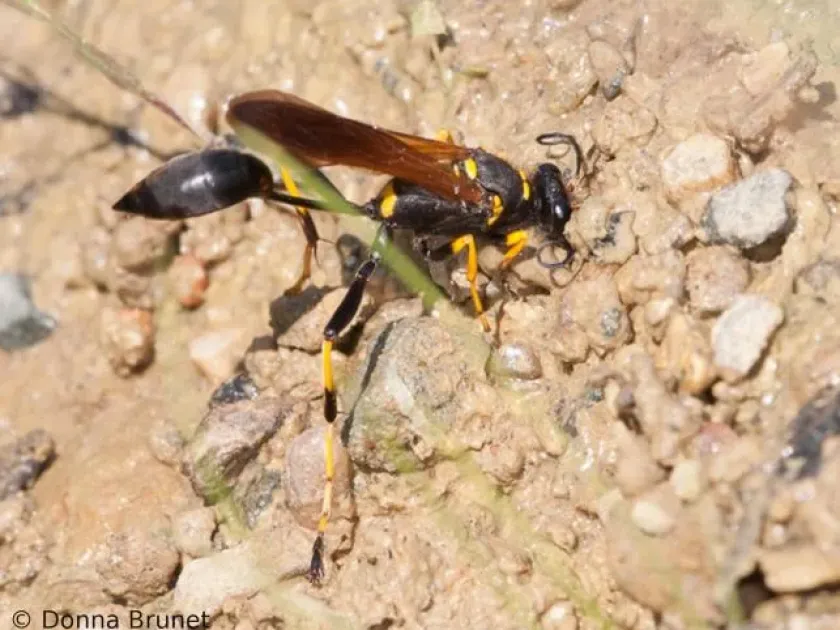
Description
How to identify
Trypoxylon politum, commonly known as the organ pipe mud dauber, is a species of solitary wasp within the Crabronidae family. They are easily recognized by their slender, shiny black body and distinctive white hind tarsi.
These wasps are famous for building elaborate tube-like nests made of mud, which are attached to vertical surfaces like walls, eaves, and beams. Each pipe contains several cells where the larvae develop, fueled by a supply of paralyzed spiders.
Unlike social wasps, these insects operate individually, though they may construct several nests in close proximity, leading to clusters that can look quite significant on the side of a building.
The life cycle features a complete metamorphosis. The mother seals each cell with a mud partition after provisioning it with enough spiders to sustain the developing larva until it pupates.
They are generally non-aggressive towards humans and will typically only sting if handled directly or if the nest is severely threatened during the construction phase.
What it damages
While Trypoxylon politum does not damage agricultural crops, they are considered structural pests due to their mud nest construction. Their nests can accumulate on porches, garages, and sheds, causing significant aesthetic damage to painted surfaces.
The most practical problem occurs when these wasps clog ventilation ducts, drainage pipes, or electrical conduits, which can lead to equipment malfunctions or moisture issues in enclosed structures.
From an agro-ecological perspective, their impact is neutral to mixed. They prey upon spiders, which are predators themselves; therefore, in areas where spider populations are vital for natural pest control, the presence of these wasps may reduce natural biological control services.
Property owners often find the mud architecture unsightly and difficult to clean. If nests are left for years, they can attract other insects and harbor pathogens, accelerating the degradation of wood or masonry underneath.
Despite these issues, they are not structural wood-boring insects, and their damage remains largely superficial, limited to the addition of mud material to surfaces.
Control measures
Management focuses on exclusion. Sealing cracks and crevices in exterior walls and using fine-mesh screens on ventilation openings are the most effective ways to prevent nesting in unwanted areas.
If you prefer to remove active or abandoned nests, wait until late in the season when the wasps have vacated the pipes. Simply scrape off the mud nests using a putty knife and wash the area with water and soap.
Avoid using harsh pesticides unless absolutely necessary, as these wasps are generally harmless and contribute to natural ecosystem balance. Physical deterrents, such as slick surfaces, can make it difficult for the wasp to adhere her mud nest.
Regular maintenance of building exteriors is key. By keeping walls clean and structures in good repair, you minimize the number of favorable sites for these wasps to establish their nests.
- Install screening on all vents.
- Mechanically remove dormant nests.
- Caulk wall crevices.
- Maintain smooth, clean exterior surfaces.
Taxonomy
- Latin name
- Trypoxylon politum
- Order
- Hymenoptera
- Family
- Crabronidae
- EPPO code
- TRYXPO
Discussion
No discussions yet — be the first.