
Ectemnius sexcinctus
Ectemnius sexcinctus
Description
How to identify
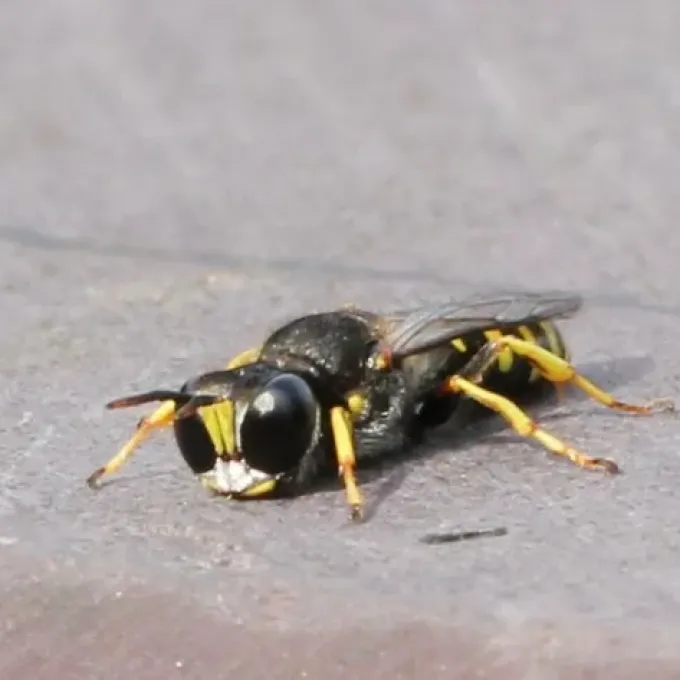
Ectemnius sexcinctus is a species of digger wasp belonging to the Crabronidae family. These insects exhibit a distinct black and yellow pattern, resembling common social wasps.
The adult wasps typically measure between 10 and 15 mm in length. They feature a robust head equipped with strong mandibles, which are essential for their nesting behavior.
Systematically, they are classified under the order Hymenoptera. Unlike social wasps, these are solitary insects that build individual nests for their offspring.
They are frequently found in sunny environments, where they actively seek out pre-existing cavities in dead or decaying wood to construct their larval cells.
Their flight pattern is rapid and erratic, often pausing on wood surfaces to inspect potential nesting sites or to excavate debris from existing channels.
What it damages
The primary damage caused by these wasps is mechanical, resulting from the excavation of tunnels within tree stems, branches, or stumps.
While the wasps themselves do not consume plant tissues, their nesting activities compromise the structural integrity of the wood, creating channels for moisture ingress.
These entry points often become pathways for secondary infections, including fungal spores and bacteria, which can cause significant heartwood rot.
In weakened trees or shrubs, extensive nesting can cause premature dieback of branches, particularly if the vascular tissue is repeatedly severed.
Although they rarely harm healthy, vigorous trees, their presence indicates an environment suitable for wood-decay organisms and other xylophagous pests.
When it appears
The active life cycle of Ectemnius sexcinctus occurs during the summer months, typically spanning from mid-June through late August.
Adults are most visible during warm, sunny weather when they are engaged in nesting, foraging, and mating activities.
The larval stage resides within the constructed nests, protected by wooden partitions, where they remain through the winter until the following season.
Environmental factors like temperature play a crucial role in their development, with peak activity coinciding with the warmest weeks of the year.
By late summer, adult populations decline as their life cycle concludes, leaving the next generation safely sequestered in the wood.
Signs of infestation
The most reliable indicator of their presence is the appearance of small, perfectly round holes on the surface of branches or woody stems.
Small piles of sawdust or wood shavings near the base of a tree or below an entry hole are characteristic signs of active tunneling and excavation.
Hollowed-out branches that show signs of brittleness or fungal discoloration often indicate long-term nesting activity within the structure.
Visual observation during summer can reveal adult wasps hovering around or landing on tree bark, as they inspect potential nesting sites.
The presence of mud or wood-pulp plugs at the end of tunnels confirms that a nest has been successfully provisioned and sealed.
Control measures
Effective management begins with proper garden hygiene, focusing on the removal and disposal of dead or damaged wood where wasps tend to nest.
Ensuring that tree wounds, pruning cuts, and cracks in the bark are promptly sealed with protective paints or waxes significantly reduces nesting opportunities.
In cases of high infestation, the application of systemic or contact insecticides during the early stages of the nesting season can help limit wasp populations.
- Regular pruning of dead or decaying branches.
- Prompt treatment of all bark injuries and branch cuts.
- Removing piles of cut wood from the vicinity of healthy trees.
Maintaining overall tree health through adequate fertilization and irrigation helps prevent the environmental conditions that attract these wood-nesting insects.
Taxonomy
- Latin name
- Ectemnius sexcinctus
- Order
- Hymenoptera
- Family
- Crabronidae
- EPPO code
- ECTESE
Discussion
No discussions yet — be the first.