
Bembix
Bembix
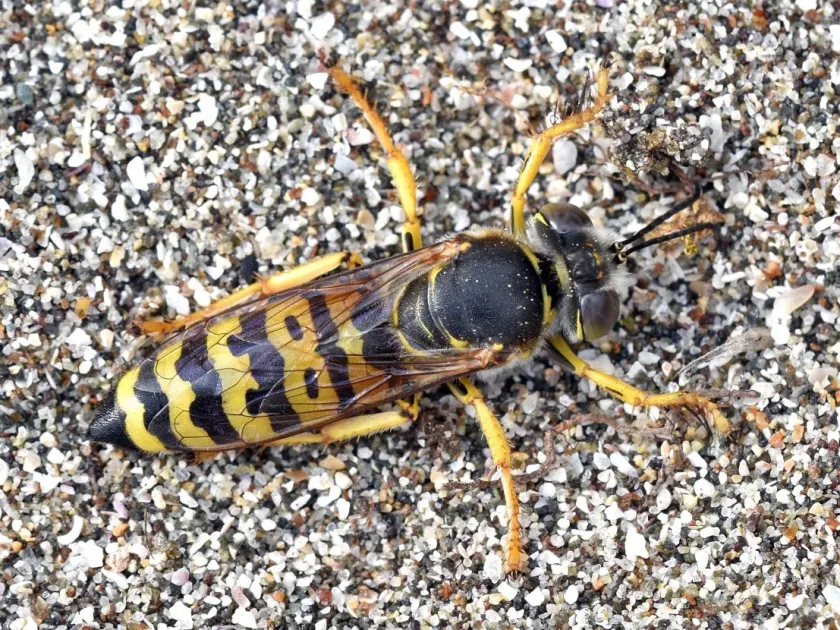
Description
How to identify
Bembix is a genus of solitary wasps belonging to the family Crabronidae (order Hymenoptera). These insects are known for their distinct appearance, featuring robust bodies and yellow-black markings, often seen hovering over sandy habitats.
A defining trait of these wasps is their unique nesting behavior. Females dig burrows in loose, sandy soil, where they create individual cells for their future offspring.
Adults are highly agile flyers, capable of rapid movement. They are often larger and more robust than typical social wasps, with a specialized mouth structure adapted for their unique lifestyle.
They prefer sunny, open areas with minimal vegetation, which explains why they are often found in sandy soil, garden paths, or disturbed soil patches near agricultural fields.
Identifying Bembix correctly is important because, despite their intimidating digging behavior, they are not pests and represent a natural component of a healthy environment.
What it damages
From an agronomic perspective, Bembix is not a plant pest. They do not consume plant tissues, roots, stems, or fruits, and therefore pose no mechanical threat to agricultural crops.
Adult wasps feed primarily on nectar from a variety of flowering plants. By visiting numerous flowers, they contribute to cross-pollination, acting as beneficial insect pollinators in the garden.
The larvae of Bembix are carnivorous. Mothers provision their nests with various insects, most commonly flies, which helps naturally regulate the population of potential agricultural or household pests.
Because they actively hunt dipterans that may be nuisance or harmful, their presence is considered beneficial for the broader ecosystem of the farm or garden.
The absence of bite marks, wilting, or tissue destruction on nearby plants serves as clear evidence that Bembix wasps are harmless to the crop itself.
When it appears
Bembix activity is highly correlated with warm summer temperatures. Peak adult emergence and activity typically occur during the months of June and July.
This is the period when females are most industrious, spending their days excavating burrows and foraging for prey to supply their nest chambers with food.
As nocturnal temperatures drop or weather becomes cooler, their activity levels decrease significantly. They remain inactive within their burrows during these periods.
By late August, the reproductive cycle is generally completed, and the colony becomes dormant until the following season, leaving the surface soil undisturbed.
Unlike true pests, their cycle is not linked to specific plant phenology but is governed strictly by soil temperatures and the availability of their insect prey.
Signs of infestation
The most common sign of a Bembix colony is the presence of small, circular holes in the ground, usually surrounded by a small mound of excavated sandy soil.
Gardeners may observe the wasps hovering above these holes, often emitting a distinct buzzing sound. This behavior is usually territorial or related to the return of females with prey.
The appearance of these ground holes often leads to misidentification. Many gardeners assume they are dealing with root-damaging pests, but this is a common misunderstanding of their biology.
A key indicator of their benign status is the health of the surrounding flora. If plants near the colony remain vigorous and show no signs of distress, the wasps are not the cause of any issues.
In areas where they nest in high concentrations, such as sandy paths or bare garden beds, the ground may show a pattern of multiple, well-spaced openings.
Control measures
No chemical control measures are recommended for Bembix. They are beneficial insects that play a role in pollination and natural pest regulation.
If their presence is unwanted in specific areas, the best approach is to modify the habitat. Adding mulch, planting ground cover, or grassing over sandy areas makes the soil unsuitable for burrowing.
Avoid the use of insecticides, as these chemicals will indiscriminately kill beneficial pollinators and predators, potentially leading to an increase in actual harmful pests.
Maintain a respectful distance. Bembix wasps are generally non-aggressive toward humans and will usually ignore people unless they feel their nesting site is being directly threatened.
Focus on long-term management through agronomic practices like improving soil cover and maintaining plant health, which naturally encourages these wasps to relocate to less managed areas.
Taxonomy
- Latin name
- Bembix
- Order
- Hymenoptera
- Family
- Crabronidae
- EPPO code
- BEMXSP
Discussion
No discussions yet — be the first.