
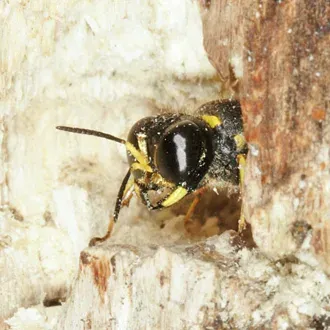
Ectemnius cavifrons
Ectemnius cavifrons
Description
How to identify
Ectemnius cavifrons is a species of solitary wasp belonging to the Crabronidae family within the Hymenoptera order. They are often characterized by their slender bodies and distinctive black and yellow markings that make them look like typical wasps.
Adults possess specialized mandibles adapted for wood excavation, which is their primary method of creating nesting chambers for their offspring. They are active fliers and are commonly found in gardens and forest edges.
Unlike social wasps that build paper nests, these solitary wasps utilize existing hollows or bore into soft, decayed wood to lay their eggs and provide food for the larvae.
Identification often requires careful observation of their nesting behavior and anatomical features, as they can sometimes be confused with other species of solitary wasps.
The morphology of the head and the color patterns on the abdomen are key diagnostic features used by entomologists to distinguish this species from its relatives.
What it damages
The damage caused by Ectemnius cavifrons is primarily related to the structural integrity of wood. They prefer to nest in weak, damaged, or decaying hardwood branches and trunks.
By boring into the wood, these wasps create internal tunnels that can weaken the affected branches, making them susceptible to snapping during high winds or heavy weather conditions.
The nesting tunnels also act as entry points for various wood-decaying fungi and pathogens, which can exacerbate the decline of an already stressed or damaged tree.
While the wasps do not consume the wood as a food source, their construction activities interrupt the vascular pathways and weaken the tree's overall stability.
In cases of high infestation density, the cumulative impact of these tunnels can lead to the premature death of significant portions of the tree's canopy.
When it appears
The adult activity period for Ectemnius cavifrons typically ranges from June through August, when temperatures are most suitable for reproduction and nesting.
During these summer months, the wasps are intensely focused on selecting suitable nesting sites and provisioning them with prey for their developing larvae.
As autumn approaches, adult activity declines, and the species enters its over-wintering phase inside the protected wooden galleries where the larvae develop.
The life cycle is closely synchronized with the seasonal availability of nesting substrates, with the emergence of the next generation occurring in the following spring.
Environmental factors, such as unusually warm springs or extended periods of precipitation, can influence the precise timing of emergence and the intensity of their activity.
Signs of infestation
The most visible sign of an infestation is the appearance of small, neat entry holes on the bark of trunks, stumps, or dead branches, often accompanied by piles of fine wood dust.
Gardeners may observe the wasps flying in and out of these openings during the peak of summer, which confirms active nesting behavior in the tree.
The presence of unexplained wilting or dieback in specific branches can be a strong indicator that internal structural damage from boring insects is occurring.
Accumulated sawdust beneath branch intersections or near the base of the tree is a classic symptom of internal excavation efforts by the nesting wasps.
In some cases, the sound of rhythmic vibration or buzzing coming from within the wood on hot days can alert observant owners to the presence of an active nest.
Control measures
Effective management begins with proper cultural practices, specifically the removal of dead, diseased, or decaying wood that serves as a nesting habitat.
Applying tree wound dressings or grafting waxes to exposed wood and pruning cuts prevents the wasps from accessing the internal wood tissue of otherwise healthy trees.
If nests are detected in valuable specimen trees, targeted insecticide application into the entry tunnels, followed by sealing the opening, can be an effective control method.
Promoting overall tree health through adequate irrigation and nutrient management makes trees less attractive to wood-boring insects by increasing their natural resistance.
- Sanitary pruning of dead branches.
- Sealing exposed wood wounds.
- Monitoring for entry holes in bark.
- Targeted insecticide injection for active nests.
Taxonomy
- Latin name
- Ectemnius cavifrons
- Order
- Hymenoptera
- Family
- Crabronidae
- EPPO code
- ECTECA
Discussion
No discussions yet — be the first.