
Powderpost beetle
Trogoxylon parallelipipedum
Description
How to identify
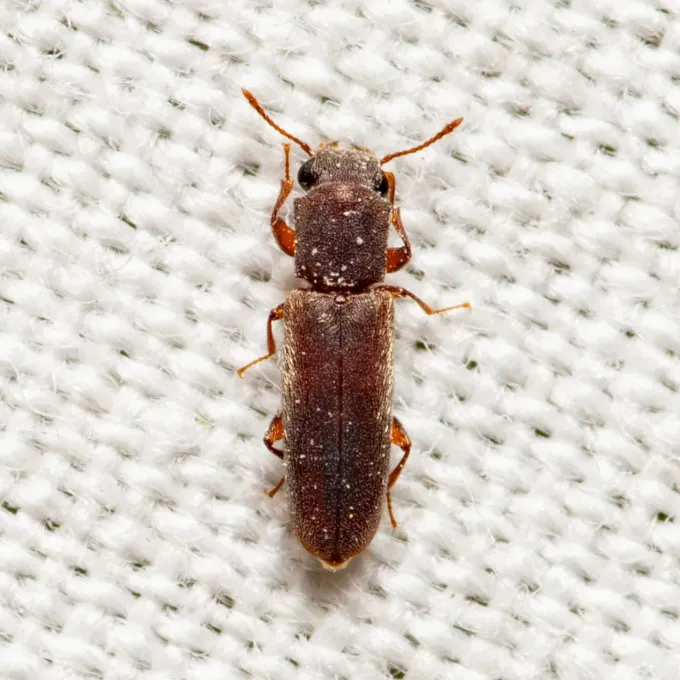
The powderpost beetle (Trogoxylon parallelipipedum) is a wood-boring insect belonging to the family Bostrichidae. Adults are small, cylindrical beetles, typically measuring between 2.5 and 4 mm in length.
They possess a dark brown to black coloration and a robust pronotum that partially shields the head. Their morphology is highly adapted for navigating within the tunnels they excavate in wood.
The species undergoes a complete metamorphosis, including egg, larva, pupa, and adult stages. The adult stage is the only one commonly visible on the surface, usually emerging during the mating season.
Larvae are legless, white, and possess strong mandibles capable of digesting starch-rich wood fibers. They remain hidden inside the timber for their entire developmental period.
Pupation occurs within small chambers near the wood surface, where the final transformation into an adult takes place before the beetle exits the substrate.
What it damages
This beetle is a serious technical pest that primarily attacks dried hardwoods. It infests timber, finished wood products, furniture, parquet flooring, and structural beams.
It shows a strong preference for hardwoods containing high levels of starch, such as oak, elm, ash, and walnut. Softwoods are generally less attractive to this specific species.
The damage is caused by larvae that feed on the wood, creating extensive internal galleries. Over time, these galleries weaken the structural integrity of the wood, often turning it into a powder.
In commercial settings, such as warehouses or museums, these beetles can destroy valuable assets and historical items if infestations are left unchecked for long periods.
Although they play a natural role in decomposing dead wood in forests, their presence in residential or commercial buildings is considered a major nuisance and an economic threat.
Signs of infestation
The most distinctive sign of an infestation is the presence of small, circular exit holes, approximately 1–1.5 mm in diameter, on the wood's surface.
Beneath these holes, one often finds fine, flour-like dust known as frass, which is pushed out by the larvae as they consume the wood from within.
In quiet environments, a faint ticking or rasping sound might be heard, which is caused by the larvae feeding inside the wooden structure.
Wood that appears sound from the outside may actually be completely hollowed out, making the affected areas feel soft or fragile to the touch.
Finding adult beetles near wooden furniture or structural supports during the spring or summer months is a definitive indicator of an active infestation site.
Control measures
Prevention involves applying wood preservatives and insecticidal treatments to raw lumber before it is utilized in construction or furniture manufacturing.
Controlling moisture levels is a critical factor, as keeping wood dry and sealed with varnishes or paints can discourage the beetles from laying eggs on the surface.
For active infestations, professional fumigation is often the most effective method, as the gas can reach deep into the wood to kill larvae, pupae, and adults.
Localized treatments involve using pressurized insecticide injections directly into the flight holes to target specific areas of infestation within a larger structure.
Regular inspections of stored wood and historical artifacts are essential for early detection, allowing for quick intervention before the infestation causes irreparable damage.
Taxonomy
- Latin name
- Trogoxylon parallelipipedum
- Order
- Coleoptera (beetles)
- Family
- Lyctidae
- EPPO code
- TROXPA
Discussion
No discussions yet — be the first.