
Lyctus linearis
Lyctus linearis
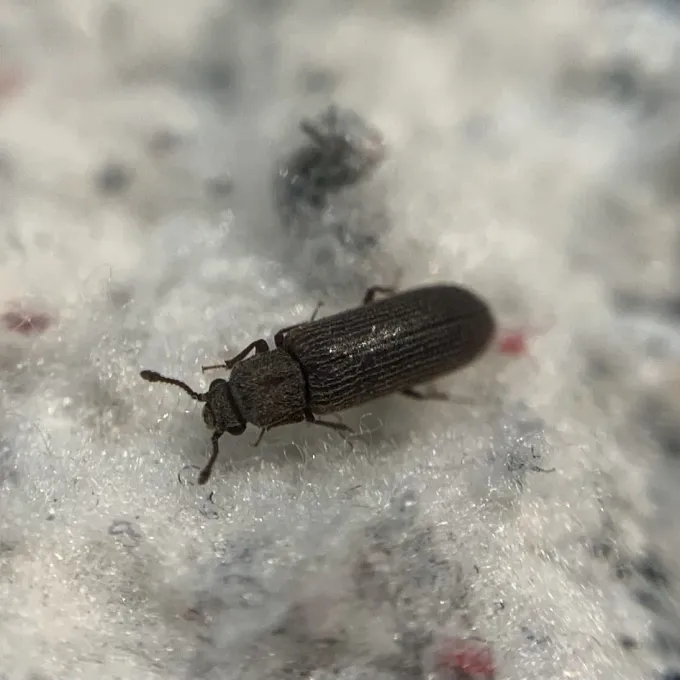
Description
How to identify
Lyctus linearis, commonly known as the powderpost beetle, belongs to the family Bostrichidae, noted for its wood-destroying capabilities.
The adult beetle is slender, ranging from 2.5 to 5 mm in length, with a coloration that typically spans from reddish-brown to dark brown or black.
Its distinctive feature is the pronotum, which is broader at the front and overlaps the head, providing an appearance similar to a hood.
Larvae are white, C-shaped, and equipped with strong mandibles capable of breaking down cellulose and starch found within the wood fibers.
The beetles are proficient fliers, allowing them to infest new timber stocks in lumber yards, construction sites, and residential buildings.
What it damages
This pest exclusively targets seasoned, dry hardwood timber that contains a sufficient level of starch, which is vital for larval growth.
Preferred wood species include oak, ash, walnut, and elm, particularly those with wide pores that allow the beetle to deposit eggs easily.
Softwood species like pine or spruce are generally avoided because they lack the specific starch reserves required by the developing larvae.
The damage is severe in furniture, parquet flooring, tool handles, and structural components of historical buildings made from vulnerable timber.
Over time, infested wood can be reduced to a fine powder, leaving the structure hollowed out and lacking any mechanical strength.
When it appears
Under natural conditions, the life cycle of the powderpost beetle typically spans one year, but indoor conditions can lead to continuous breeding.
Adult emergence occurs primarily during the warmer months, typically from late spring through summer, as they emerge to mate.
Females insert eggs deep into the wood pores using their ovipositor, ensuring the larvae are shielded from external predators and environmental changes.
The larval stage is the most destructive phase, as they bore long, winding galleries throughout the wood, feeding on the interior tissues.
Pupation takes place within a specialized chamber close to the surface, and shortly after metamorphosis, the adult beetle chews its way to freedom.
Signs of infestation
The most telltale sign of an infestation is the presence of small, perfectly round exit holes, about 1-2 mm in diameter, on the surface of the timber.
A fine, powdery dust, often referred to as frass, accumulates around these exit holes, indicating that the larvae are active inside the material.
Severe infestations often result in the wood surface crumbling under pressure, as the interior galleries become interconnected and weaken the structure.
Finding piles of fine wood flour on floors or shelves underneath wooden items is a clear indicator that immediate control measures are required.
Tapping the wood might produce a hollow sound, indicating that the internal structure has been compromised by the extensive network of larval tunnels.
Control measures
Effective management begins with the immediate removal and destruction of heavily infested wood to prevent the spread to healthy materials.
Applying borate-based wood preservatives provides excellent long-term protection, as these compounds are toxic to larvae and prevent egg-laying.
Heat treatment is highly effective; exposing the timber to temperatures of 60°C or higher for a sufficient period kills all life stages of the beetle.
Professional fumigation may be necessary for large quantities of infested materials, antique furniture, or structures where surface treatment is insufficient.
- Apply deep-penetrating insecticidal wood treatments.
- Maintain low humidity levels in storage areas to discourage infestation.
- Conduct routine visual inspections of wood products for exit holes.
Taxonomy
- Latin name
- Lyctus linearis
- Order
- Coleoptera (beetles)
- Family
- Lyctidae
- EPPO code
- LYCTLI
Discussion
No discussions yet — be the first.