
Southern lyctus beetle
Lyctus planicollis
Description
How to identify
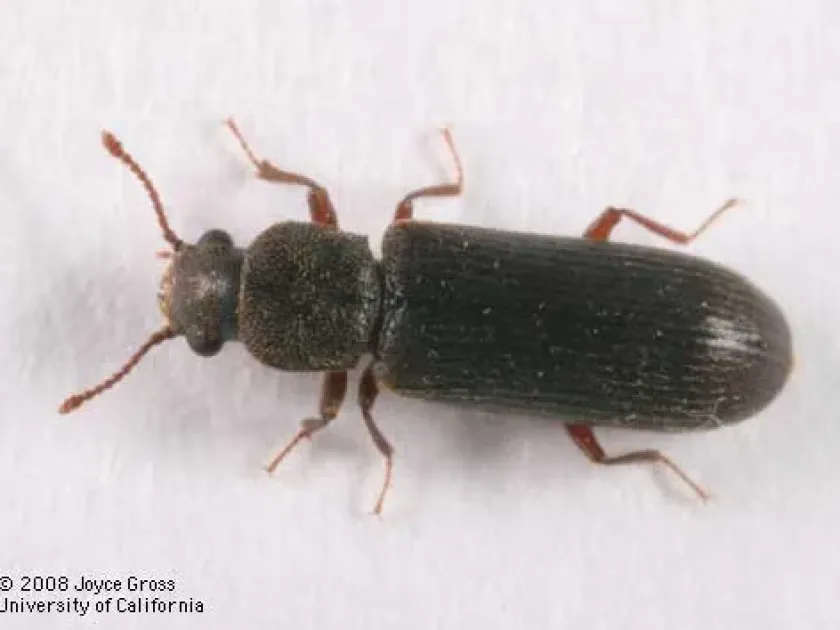
The southern lyctus beetle (Lyctus planicollis) is a wood-boring insect belonging to the Bostrichidae family. Adult beetles are small, typically ranging from 4 to 6 mm in length, with an elongated and slightly flattened body, often dark brown or black.
Their heads are partially concealed by the pronotum, which features a fine, granular texture. A key identifying feature is the two-segmented club at the end of their antennae, distinguishing them from other similar wood-boring species.
The larvae, which are the main destructive stage, appear as creamy-white, C-shaped grubs. They possess powerful mandibles designed for excavating and consuming the nutrient-rich starch within the wood fiber.
The lifecycle duration is highly dependent on environmental conditions, particularly humidity and temperature. In climate-controlled warehouses or homes, these beetles can complete their development and produce offspring year-round.
Females deposit their eggs directly into the pores of hardwood using a specialized ovipositor. This clever strategy ensures that the larvae have immediate access to food upon hatching, minimizing their exposure to external threats.
What it damages
This beetle primarily attacks hardwoods, favoring species such as oak, ash, walnut, and various tropical timbers. They focus their feeding activity on the sapwood, which is where the highest concentrations of starch are stored.
The damage caused by the southern lyctus beetle is insidious because it occurs deep inside the timber. Furniture, parquet flooring, and structural wooden elements can become hollowed out from the inside while appearing perfectly sound on the surface.
In the timber and furniture industry, this insect is considered a significant economic pest. Infested wood can quickly spread the infestation to other stored materials, causing widespread financial losses for manufacturers and retailers.
As the larvae feed, they convert the interior wood structure into a fine, flour-like powder. Over time, the structural integrity of the wood is completely compromised, leading to a total loss of load-bearing capacity.
Because the damage is internal, it is often discovered only when the piece is nearing total collapse. This necessitates rigorous inspection protocols for all raw timber products entering a facility to prevent contamination.
Signs of infestation
The most visible sign of an infestation is the presence of small, round exit holes, about 1–2 mm in diameter. These holes are created by emerging adult beetles once they have completed their metamorphosis.
Beneath or near these exit holes, one can often find small piles of fine, powdery dust, commonly known as frass. The presence of this powder is a definitive indicator of active larval feeding and development inside the material.
In quiet environments, it is sometimes possible to hear a faint scratching or ticking sound produced by the larvae as they tunnel through the wood. This acoustic sign confirms that the infestation is currently active.
If you press on the surface of an infested item and it feels soft or appears to bow, it indicates that the internal structure has been destroyed. Such signs warrant immediate isolation of the object to prevent spread.
Consistent monitoring of storage areas is vital. Any fresh piles of dust on shelving or floorboards should be treated as an immediate red flag, requiring a professional pest assessment and prompt intervention.
Control measures
Kiln-drying of timber is the most effective preventative measure. High temperatures maintained for the correct duration effectively kill all life stages of the beetle, including eggs hidden deep within the grain.
Applying deep-penetrating insecticides or wood preservatives can provide a protective barrier against infestation. This is especially recommended for valuable hardwood components intended for long-term use in furniture making.
If an infestation is detected in finished goods, localized injection of insecticides into the exit holes can help eradicate the colony. This process must be carefully performed to reach the larvae living inside the galleries.
For large-scale infestations in warehouses, professional fumigation is the required solution. This process uses specialized gases that penetrate the wood to eliminate all pests while adhering to strict safety protocols.
Maintaining a clean, dry, and well-organized storage environment reduces the risk of infestation. Regularly checking incoming batches of wood and keeping them separate from older stock is critical to preventing cross-contamination.
Taxonomy
- Latin name
- Lyctus planicollis
- Order
- Coleoptera (beetles)
- Family
- Lyctidae
- EPPO code
- LYCTPL
Discussion
No discussions yet — be the first.