
Lyctus cavicollis
Lyctus cavicollis
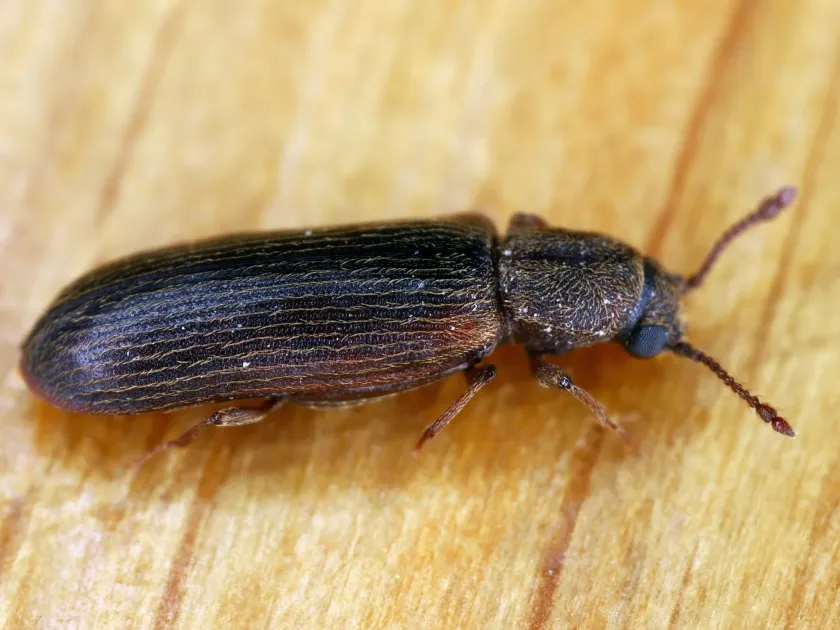
Description
How to identify
Lyctus cavicollis is a small wood-boring beetle belonging to the Lyctidae family, often referred to as a type of powderpost beetle. Adults are reddish-brown to dark brown and typically measure 3 to 5 mm in length.
The species is distinguished by a specific indentation on its pronotum. Its body is elongated, with the head being partially hidden when viewed from above, which is typical for this family.
The larvae are cream-colored, curved in shape, and possess strong mandibles adapted for boring into hardwood. They remain hidden deep within the wood throughout their entire developmental stage.
Adult beetles are capable of flight, allowing them to disperse effectively within warehouses, wood processing plants, and residential areas to locate suitable egg-laying sites.
The biological success of this species relies on its ability to utilize starch-rich vessels in hardwoods, which provides the necessary nutrients for larval growth.
What it damages
This pest exclusively targets seasoned hardwoods, specifically those with large vessels such as oak, ash, walnut, and eucalyptus. Softwoods are rarely attacked by this specific beetle.
It causes significant economic damage to furniture, parquet floors, flooring, interior trim, and antique wooden artifacts that contain a high level of starch.
The larvae create extensive tunnels along the grain, filling them with fine, flour-like frass. Over time, the internal wood structure is completely pulverized.
In severe infestations, the timber loses all structural integrity, appearing intact on the outside while being completely hollowed out on the inside.
The risk is highest in storage facilities where dried lumber is kept, as the beetle can rapidly spread between stacks of susceptible hardwood species.
When it appears
Adult activity typically peaks during the warm months, from late spring through autumn. However, in climate-controlled buildings, the life cycle can continue year-round.
Females lay their eggs into the open vessels of the wood surface. Once hatched, the larvae immediately begin boring into the timber to feed.
The life cycle length is highly dependent on environmental factors, typically ranging from 9 to 12 months under optimal conditions.
As the larvae reach maturity, they construct a small pupal chamber near the surface of the wood. The emerging adults then chew their way out.
This emergence leaves characteristic exit holes, which are often the first visible evidence of an active infestation within the wood structure.
Signs of infestation
The presence of fine, powder-like dust known as "frass" is the primary indicator of an infestation. This dust often accumulates under or around affected wooden items.
Small, circular emergence holes, approximately 1 to 1.5 mm in diameter, are visible on the surface of infested timber, indicating that adult beetles have recently emerged.
If the infested wood is probed or struck, it may sound hollow or crumble, reflecting the extensive tunneling performed by the larval population.
Visual inspection of the wood surface for these specific exit holes and the associated fine powder is the most common diagnostic method.
Structural weakening of wooden joints or surface depressions can indicate that the infestation has reached a critical stage of internal destruction.
Control measures
The most effective long-term solution is kiln-drying timber at temperatures exceeding 60°C, which ensures the total eradication of all life stages of the beetle.
Applying borate-based wood preservatives or insecticidal coatings can create a protective barrier that prevents female beetles from laying eggs on the wood surface.
For large-scale infestations in stored goods, professional fumigation using authorized chemicals is necessary to reach larvae deep within the wood.
Regular monitoring of hardwood stocks and the immediate removal of infested material are essential to break the cycle of re-infestation within facilities.
Sealing the surface of wooden furniture with high-quality varnishes or polyurethanes blocks the pores and limits the accessibility for egg-laying females.
Taxonomy
- Latin name
- Lyctus cavicollis
- Order
- Coleoptera (beetles)
- Family
- Lyctidae
- EPPO code
- LYCTCA
Discussion
No discussions yet — be the first.