
Chilean powderpost beetle
Lyctus chilensis
Description
How to identify
The Chilean powderpost beetle (Lyctus chilensis) is a member of the family Bostrichidae, subfamily Lyctinae. These small beetles are typically 3 to 5 mm long, with an elongated, flattened body that ranges in color from reddish-brown to almost black.
The head of the adult beetle is partially hidden by the prothorax, a characteristic feature of this family. They are equipped with strong mandibles adapted for boring into seasoned or dried wood.
Larvae are C-shaped, creamy-white in color, and possess well-developed head capsules. They are the primary agents of destruction, as they spend their entire life cycle tunneling within the wood.
These insects are highly specialized, targeting the starch-rich sapwood of hardwood trees. Their small size and cryptic habits make them difficult to detect until significant damage has already occurred.
The species has successfully adapted to human environments, where it often thrives in warehouses, furniture, and structural timber, posing a persistent threat to wooden goods.
What it damages
Lyctus chilensis primarily attacks hardwoods, such as oak, ash, walnut, and eucalyptus. They require a starch content sufficient to support larval development, which is typically found in the sapwood.
The larvae feed by creating intricate tunnels throughout the wood, breaking down the cellulose and lignin structure. This extensive tunneling turns the interior of the wood into a fine, flour-like powder.
In forest ecosystems, they play a role in the decomposition of deadwood. However, in agriculture and forestry, they can damage young trees in nurseries if conditions for bark protection are compromised.
Trade in infested timber is the main pathway for the spread of this pest. Once established in a storage area, they can spread rapidly to all susceptible wood products present in the vicinity.
Structural damage can lead to the collapse of wooden items, furniture, and structural beams, necessitating costly repairs or complete replacement of the infested material.
When it appears
Adult emergence typically occurs during the warmer months, starting in late spring and continuing through the summer. During this time, adults are active and seeking mates.
Females lay eggs in the pores and vessels of the wood, using specialized ovipositors. The suitability of the wood, based on pore size and nutrient content, dictates the success of egg deposition.
The larval stage is the longest part of the life cycle and can last several months to over a year, depending on the wood's moisture content, temperature, and nutritional quality.
In climate-controlled environments, such as heated warehouses or homes, the beetle can complete its life cycle year-round, leading to overlapping generations and a constant risk of infestation.
Pupation takes place inside the wood, near the surface. Once metamorphosis is complete, the adult chews its way to the surface, emerging through the characteristic circular exit holes.
Signs of infestation
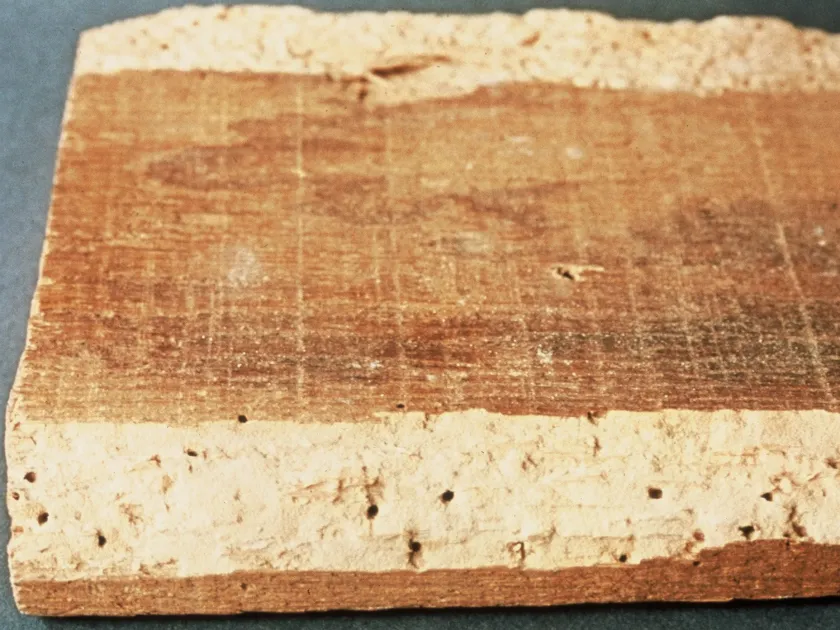
The most prominent sign of an active infestation is the presence of numerous small, circular exit holes, typically 1 to 2 mm in diameter, on the wood surface.
Below the exit holes, one can often find piles of fine, powdery dust, known as frass. This material is expelled by the larvae as they tunnel and is a reliable indicator of recent or ongoing feeding.
A loss of structural integrity is often noticed when wood begins to sound hollow or becomes noticeably brittle. Surfaces may even collapse under slight pressure due to the internal voids created by larvae.
Adult beetles may occasionally be found wandering near infested wood during their emergence period, which serves as a visible warning sign of an active infestation.
Using a probing tool or a borescope to inspect hidden areas of furniture or structural components can reveal the extent of the damage before it becomes visible on the surface.
Control measures
Preventive measures are the most effective way to manage Lyctus chilensis. Treating lumber with borate-based wood preservatives provides a long-lasting barrier against larval entry.
- Kiln drying lumber at temperatures above 60°C to kill all life stages.
- Fumigation of infested structures and stored products using gas treatments.
- Sealing wood surfaces with high-quality paint, varnish, or lacquer.
- Removing and destroying heavily infested items to prevent further spread.
Maintaining lower moisture levels in stored wood products discourages female beetles from selecting the material for egg-laying, as they prefer wood with a certain moisture content.
For localized infestations in valuable furniture, insecticidal injection into the exit holes can be performed to eliminate larvae within the wood matrix.
Integrated pest management involves regular monitoring and strict quarantine protocols for incoming wood shipments to ensure that no new pest populations are introduced into the facility.
Taxonomy
- Latin name
- Lyctus chilensis
- Order
- Coleoptera (beetles)
- Family
- Lyctidae
- EPPO code
- LYCTCH
Discussion
No discussions yet — be the first.