
African powderpost beetle
Lyctus africanus
Description
How to identify
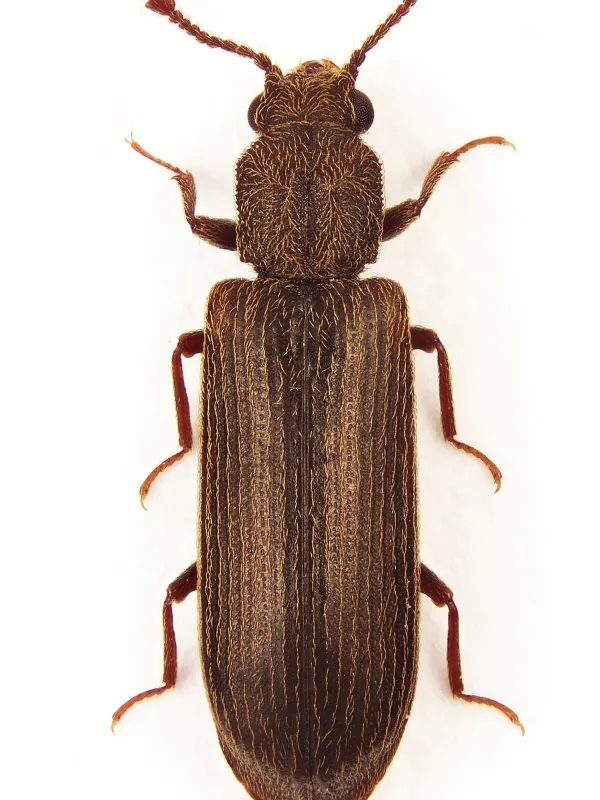
The African powderpost beetle (Lyctus africanus) is a small wood-boring insect belonging to the Bostrichidae family. Adults typically measure between 2.5 and 5 mm in length.
The insect has a slender, elongated body, usually dark brown in color, with a surface marked by tiny pits and fine, short hairs.
Larvae are white, C-shaped, and equipped with strong mandibles designed for excavating and consuming the dense cellulose of seasoned wood.
Adult beetles are capable of flight, allowing them to disperse quickly within lumber yards, warehouses, and storage facilities to find suitable egg-laying sites.
These pests are nocturnal and tend to remain hidden within the wood grain during daylight hours, making early detection quite challenging.
What it damages
The primary hosts for Lyctus africanus are dried hardwoods with high starch content, which serves as the essential nutrient source for developing larvae.
They commonly infest furniture, plywood, flooring, and decorative wood items, often entering these materials during the manufacturing or storage process.
Larvae create extensive tunnels inside the wood, reducing the internal structure to a fine, powdery debris known as frass.
Significant structural damage can occur if infestations remain untreated, leading to the collapse or total disintegration of wooden components.
The pest is a major threat to the timber industry, particularly concerning stocks of untreated or improperly seasoned wood products.
When it appears
The life cycle of the African powderpost beetle is highly dependent on environmental temperature and humidity levels within storage areas.
In heated buildings or tropical climates, breeding can occur year-round, as the developmental stages are not limited by seasonal cooling.
Females deposit their eggs directly into the open pores of the wood surface, selecting spots that offer the best conditions for larval survival.
The emergence of adult beetles is most frequent during warmer periods, when they bore out of the wood to find mates and expand their infestation.
Effective management requires continuous monitoring, as generational overlap can keep an infestation active for an extended period.
Signs of infestation
The most visible indicator of a powderpost beetle infestation is the appearance of fine, talcum-like dust piling up near the affected timber.
- Small, perfectly round exit holes, usually 1–2 mm in diameter, on the wood surface.
- Soft or hollow areas in the wood that indicate deep tunneling by larvae.
- Audible crunching or scratching sounds heard near the wood during quiet periods.
- Accumulation of wood flour in corners or on shelves beneath stored wooden furniture.
- Presence of dead beetles on windowsills or floor surfaces near the infested material.
Control measures
Kiln-drying of wood at high temperatures is the most reliable method for eradicating larvae and eggs within the timber before it is used for production.
Applying borate-based wood preservatives or insecticidal sprays creates a chemical barrier that deters females from laying eggs on the treated surface.
Sanitation practices, such as the rapid removal of scrap wood and regular cleaning of storage areas, are vital to preventing the establishment of the pest.
For severe infestations, professional fumigation using specialized gases is necessary to reach larvae deep within the wood structure.
Routine inspections and the use of sticky pheromone traps help detect the presence of adults early, allowing for timely intervention before structural damage occurs.
Taxonomy
- Latin name
- Lyctus africanus
- Order
- Coleoptera (beetles)
- Family
- Lyctidae
- EPPO code
- LYCTAF
Discussion
No discussions yet — be the first.