
Lyctus beetles
Lyctus
Description
How to identify
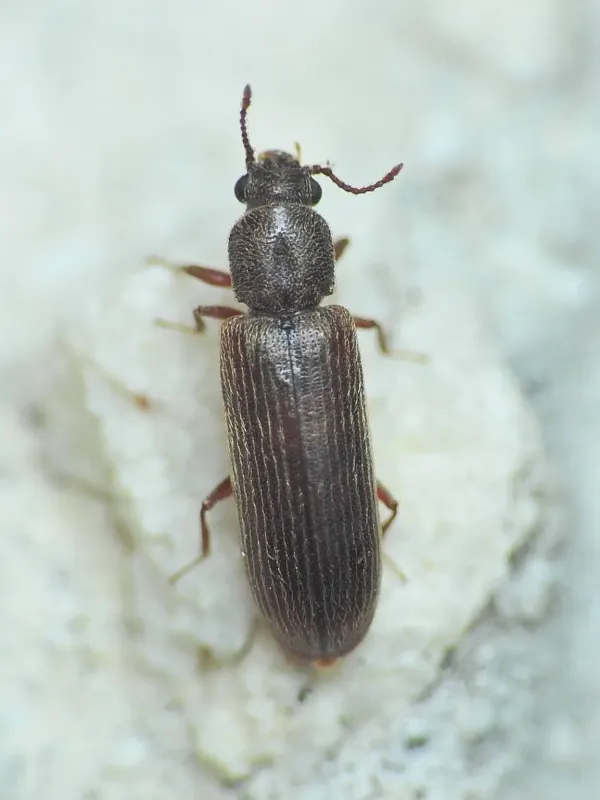
Lyctus beetles, commonly known as powderpost beetles, belong to the family Bostrichidae. Adult beetles are small, typically ranging from 2 to 7 mm in length, with an elongated body.
They possess a distinctive reddish-brown to black coloration and a head that is partially hidden by the prothorax, resembling a hood or cap.
The larvae are cream-colored, C-shaped, and legless, equipped with strong mandibles designed for boring through the tough starch-rich fibers of hardwoods.
The life cycle typically takes about one year to complete, although it can be shorter or longer depending on the environmental conditions and wood quality.
Due to their nocturnal nature and small size, these beetles are rarely seen, with evidence of their presence usually being the only way to detect them.
What it damages
These pests specialize in attacking the sapwood of hardwoods such as oak, ash, hickory, and walnut, specifically wood that contains high levels of starch.
They are frequently found in furniture, flooring, cabinetry, decorative woodwork, and stored lumber that has a moisture content between 8 and 20 percent.
Larvae consume the interior of the wood, creating narrow, circular tunnels and leaving behind fine, powdery debris known as frass.
Over time, infested wood loses its structural integrity, eventually crumbling into dust if the infestation is left unchecked for a prolonged period.
Because the beetles do not emerge until they are adults, significant interior destruction can occur while the exterior remains relatively pristine.
Signs of infestation
The most telltale sign of a Lyctus beetle infestation is the appearance of small, circular exit holes on the surface of the wood, measuring 1 to 2 mm across.
A pile of fine, flour-like wood dust often accumulates beneath these holes, which is pushed out by the adult beetles as they emerge.
If you tap on an infested piece of wood, it may feel hollow or brittle, as the internal structure has been compromised by the larval tunneling.
In very quiet environments, a faint, rhythmic clicking or crunching sound may sometimes be heard as the larvae feed on the wood fibers.
The presence of fresh piles of light-colored powder is a strong indicator that the infestation is currently active and requires treatment.
Control measures
Heat treatment is the most effective way to eliminate Lyctus beetles, as wood kiln-dried to internal temperatures of 60 degrees Celsius will kill all stages of the insect.
For valuable antiques or large structural elements, professional fumigation services are often required to ensure that the chemical reaches deep into the wood tunnels.
Surface treatments with professional-grade borate solutions or residual insecticides can help protect wood and prevent future attacks by egg-laying females.
Regular inspections of hardwood items, particularly during late spring and summer, are crucial for early detection and prevention of widespread damage.
- Ensure all incoming timber is inspected for exit holes or dust.
- Apply sealants or paints to wood surfaces to deter beetle entry.
- Maintain low humidity levels in storage areas to make the environment less hospitable.
Taxonomy
- Latin name
- Lyctus
- Order
- Coleoptera (beetles)
- Family
- Lyctidae
- EPPO code
- LYCTSP
Discussion
No discussions yet — be the first.