
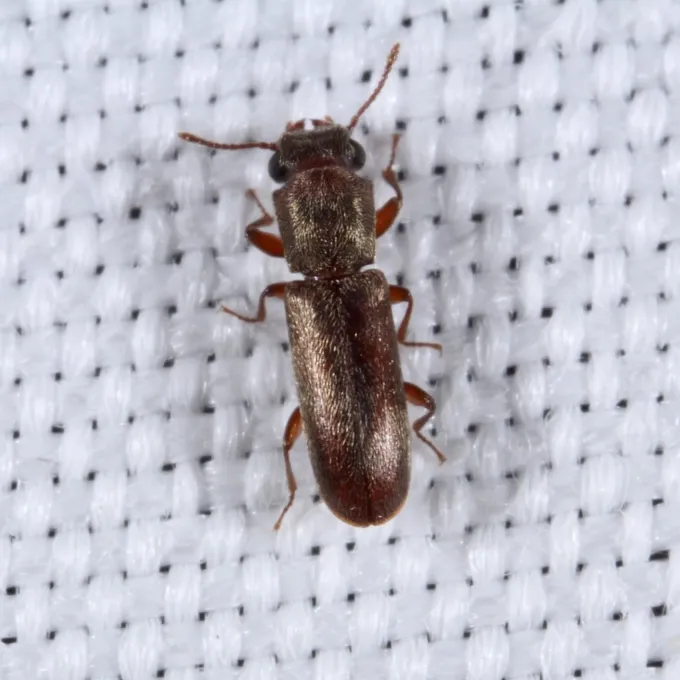
Powderpost beetle of the genus Trogoxylon
Trogoxylon
Description
How to identify
Beetles of the genus Trogoxylon belong to the family Bostrichidae. These are small insects, typically measuring between 2.5 and 4 millimeters in length.
Adult beetles have a cylindrical body shape and are usually dark brown or black, allowing them to blend into the texture of the wood they infest.
The larvae are white, C-shaped, and legless, equipped with strong mandibles specifically designed for breaking down and digesting hard wood fibers.
Diagnosis is often based on the observation of small, circular exit holes, which are characteristic of the adults emerging from the wood after mating.
A distinctive morphological feature is the presence of small tubercles or projections on the pronotum, which are typical for members of this beetle family.
What it damages
This pest primarily attacks dry, seasoned hardwood rich in starch, specifically targeting species such as oak, ash, walnut, and beech.
Common targets include wooden furniture, parquet flooring, antique artifacts, musical instruments, and various structural wooden components in homes.
In warehouse environments, Trogoxylon can cause significant financial losses by infesting large batches of timber and making them unfit for sale.
Larvae bore complex networks of tunnels throughout the inner part of the wood, gradually transforming the structural material into fine, dust-like powder.
The resulting damage reduces the mechanical strength of the wood, eventually leading to the complete failure of the structural or aesthetic integrity of the object.
When it appears
The flight period for adult beetles generally occurs during warmer months, typically between late spring and early autumn, depending on climate conditions.
In temperature-controlled indoor environments, such as houses or heated workshops, the development cycle can continue year-round without a clear dormant period.
Females lay eggs within the pores or crevices of the wood, selecting locations that provide larvae with immediate access to nutrition and protection.
The speed of the life cycle is highly dependent on humidity levels and ambient temperatures, with optimal conditions significantly accelerating development.
Overwintering usually takes place in the larval stage deep within the wood, which provides effective protection against extreme external temperatures.
Signs of infestation
The most reliable sign of a Trogoxylon infestation is the presence of fine, wood-colored powder or frass beneath or on the surface of wooden items.
Close inspection reveals numerous tiny, round exit holes, typically 0.5 to 1.5 mm in diameter, indicating where mature beetles have bored their way out.
Tapping damaged wooden elements often produces a hollow or dull sound, which confirms that the interior structure has been significantly compromised.
In quiet environments, a faint crunching or ticking sound can sometimes be heard, which is generated by the larvae actively feeding inside the wood.
In cases of severe infestation, the surface of the wood may appear distorted and can easily crumble or collapse when light pressure is applied.
Control measures
Effective control involves applying deep-penetrating insecticidal wood preservatives, such as permethrin-based treatments, to protect surfaces from infestation.
Fumigation using specialized gases is the most reliable method for eradicating existing infestations in commercial warehouses or large quantities of timber.
Heat treatment in industrial drying kilns, keeping wood at temperatures above 60 degrees Celsius for several hours, effectively kills all stages of the insect.
For localized damage in valuable furniture, manual injection of insecticides directly into the larval tunnels followed by sealing holes is a standard approach.
Preventive maintenance, including the application of varnish, paint, or sealants, significantly reduces the accessibility of the wood to foraging beetles.
Taxonomy
- Latin name
- Trogoxylon
- Order
- Coleoptera (beetles)
- Family
- Lyctidae
- EPPO code
- TROXSP
Discussion
No discussions yet — be the first.