
Trypoxylon figulus
Tripoxylon figulus
Description
How to identify
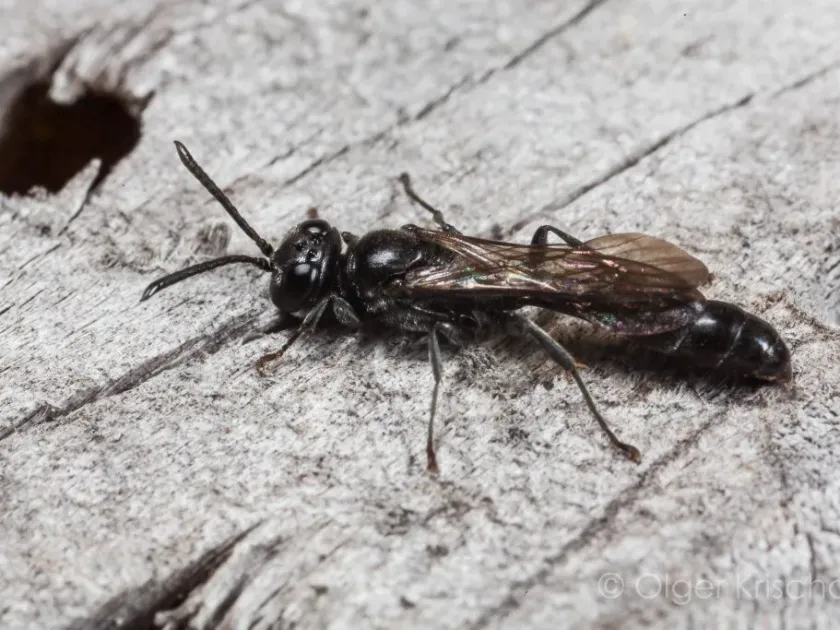
Trypoxylon figulus is a species of solitary wasp belonging to the Crabronidae family. These insects are easily recognized by their slender, elongated black bodies, typically measuring between 8 and 15 mm in length.
A distinctive feature of the species is the extremely narrow first segment of the abdomen, which gives the body a petiolated (stalk-like) appearance. The overall coloration is black, with some individuals showing pale markings on their legs.
Adults lead a solitary life, with females exhibiting strong maternal instincts. They construct individual nests for their offspring, carefully sealing them with clay and sand.
The larvae develop within tube-like structures, and the female provides each cell with paralyzed spiders to serve as food for the growing larvae.
This wasp is not aggressive toward humans and will rarely sting unless directly handled, as its stinger is used primarily for hunting prey.
What it damages
It is crucial to note that Trypoxylon figulus is not a plant pest in the traditional sense, as it does not consume leaves, fruits, or roots. Instead, it acts as a natural predator of spiders.
The primary concern is the physical damage to wood and plant stems. Females often occupy existing holes made by wood-boring insects or hollow plant stalks to establish their nests.
In commercial orchards or wooden structures, frequent nest building can lead to the deterioration of dry branches or wooden supports over several seasons.
Secondary damage occurs through the contamination of materials with clay particles and larval waste, which can degrade the aesthetic quality of ornamental plants or wood products.
In rare instances, their nest-building activity can interfere with the structural integrity of thin-walled agricultural or decorative structures.
When it appears
The activity period for adult wasps begins in late spring, around May, and persists through the end of the summer and into early autumn.
The species typically undergoes one or two generations per year, depending on the local climate and the availability of their spider prey.
The peak activity for nesting occurs during the warm months of June and July, when conditions are optimal for rapid larval development.
Overwintering takes place in the prepupal stage, protected within the hermetically sealed clay cells constructed inside their chosen nesting sites.
The emergence of the new generation in spring is synchronized with the breeding cycle of the spiders upon which they rely for larval food.
Signs of infestation
The most common indicator of their presence is the appearance of small holes in wood or hollow stalks, which are plugged with a mixture of clay and sand.
Rows of these clay "plugs" or seals on wooden surfaces, fences, or in the cavities of garden tools are clear signs of nest establishment.
Near the nesting sites, one might find discarded spider body parts or silk, which are left over after the larvae have finished their feeding cycle.
Visual observation of solitary wasps flying back and forth carrying paralyzed spiders in their mandibles confirms their presence in the area.
- Entrance holes approximately 3-5 mm in diameter.
- Clay partitions visible within tubular cavities.
- Presence of spider debris near nesting entrances.
Control measures
Generally, intensive control measures are unnecessary because Trypoxylon figulus acts as a beneficial regulator of spider populations in the garden ecosystem.
If their presence in specific structures is undesirable, you can seal existing holes with putty, wax, or exterior paint to discourage future nesting.
Installing fine mesh screens or end-caps on hollow tubes and structural pipes is an effective way to prevent wasps from using them for nesting.
In ornamental gardens, providing dedicated "insect hotels" can serve as an alternative nesting habitat, drawing the wasps away from structural wood.
Chemical control is not recommended, as the wasp is not a significant agricultural pest and is highly susceptible to general-purpose insecticides, which would harm other beneficial pollinators.
Taxonomy
- Latin name
- Tripoxylon figulus
- Order
- Hymenoptera
- Family
- Crabronidae
- EPPO code
- TRYXFI
Discussion
No discussions yet — be the first.