
Trigona testaceicornis
Trigona testaceicornis
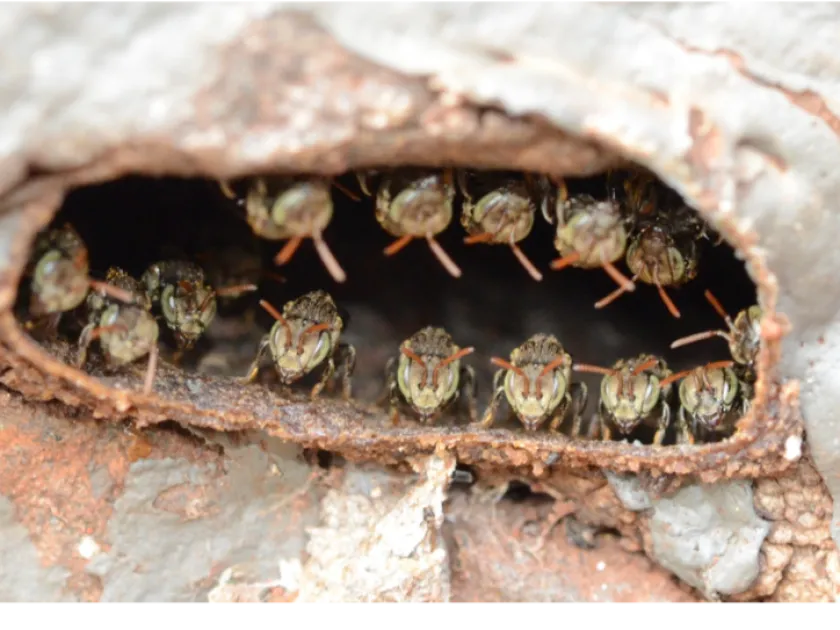
Description
How to identify
Trigona testaceicornis is a species of stingless bee within the Apidae family and the Meliponinae subfamily, known for its unique colonial structure.
These bees are relatively small, characterized by dark bodies with distinct reddish-orange tints on their legs and antennae, which is a key diagnostic feature.
The colonies build complex nests using a mixture of resin and wax, typically located in tree cavities or natural crevices, providing them with effective protection.
As social insects, they maintain a clear division of labor, with worker bees foraging extensively during daylight hours to sustain the hive's brood development.
Distinguishing this species requires careful observation, as they share morphological similarities with other stingless bee species inhabiting tropical regions.
What it damages
While often beneficial as pollinators, Trigona testaceicornis can become a pest when they damage agricultural crops during their foraging for building materials.
They frequently attack the skin of young fruits and tender shoots, using their mandibles to harvest plant resins, which results in mechanical injuries to the plant.
These wounds create entry points for secondary infections, such as bacteria and pathogenic fungi, often leading to fruit rot and significant yield loss.
Citrus, mango, and various berry crops are particularly susceptible to their activity, which can lead to scarred, deformed, or unmarketable produce.
In addition to direct damage, their presence on flowers can interfere with other beneficial pollinators, indirectly impacting the overall fertilization rate of the orchard.
When it appears
The activity patterns of Trigona testaceicornis are heavily dependent on tropical climate conditions, specifically temperature and humidity levels.
Activity remains high throughout the year, with peak foraging periods coinciding with the major flowering cycles of local vegetation.
Daily activity is most intense during warmer hours, as ambient heat promotes higher flight efficiency and constant resin collection.
During the dry season, the bees may become more persistent in foraging for moisture or resinous substances, potentially increasing their negative impact on crops.
Continuous brood production within the hive dictates a constant demand for resources, ensuring the colony remains active in the field whenever conditions permit.
Signs of infestation
Clear signs of infestation include small, irregular, or etched marks on the surface of young fruits where the bees have been scraping the epidermis.
Evidence of resin collection, such as sticky residues or small wax-like deposits on branches and fruit stalks, often indicates the presence of a nearby colony.
Persistent buzzing sounds around specific trees and observable flight paths suggest that the bees are utilizing the area for both nesting and resource gathering.
Premature abscission (dropping) of flowers and fruits is a common symptom following severe damage to the peduncle caused by the bees' aggressive foraging.
Farmers can identify the pest by spotting the bees themselves on the plant surface or by finding their characteristic nest structures in nearby hollow trees.
Control measures
Management of Trigona testaceicornis is delicate, as they are naturally valuable pollinators, necessitating the use of non-lethal control methods where possible.
Installing physical barriers, such as protective mesh netting, is the most effective way to prevent bees from contacting vulnerable fruit and flower tissues.
Sanitation practices, including the removal of old, hollow trees near agricultural fields, can help reduce the number of potential nesting sites for the bees.
Applying natural, plant-based repellents can successfully discourage bees from foraging on specific crops without causing direct harm to the colony.
- Installation of protective netting.
- Sanitary pruning and tree management.
- Monitoring of hive proximity.
- Application of organic repellents.
Taxonomy
- Latin name
- Trigona testaceicornis
- Order
- Hymenoptera
- Family
- Apidae
- EPPO code
- TRGOTE
Discussion
No discussions yet — be the first.