
Kissing bug
Triatoma infestans
Description
How to identify
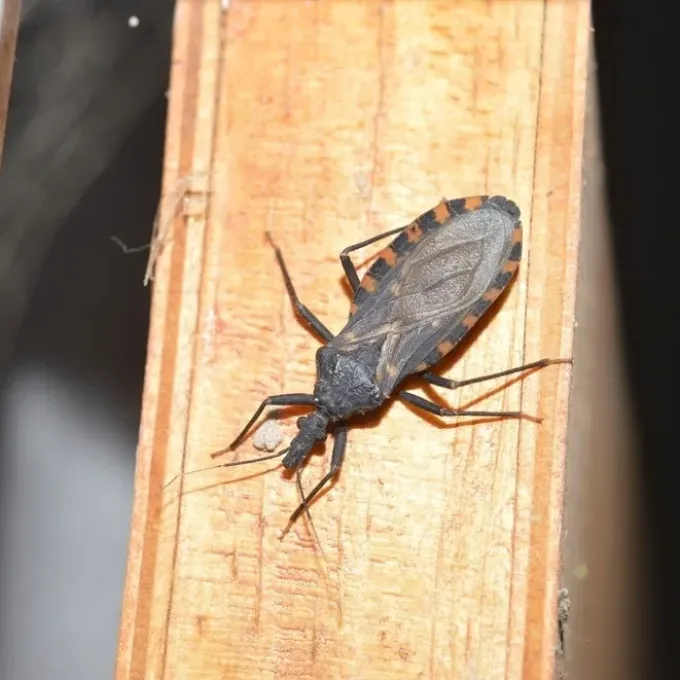
The Kissing bug (Triatoma infestans) belongs to the Reduviidae family, order Hemiptera. It is a blood-feeding insect, typically 20–25 mm in length.
The adult body is elongated, dark brown or black in color, featuring distinctive red or orange markings along the edges of the abdomen.
While adults possess developed wings, they predominantly move by crawling, seeking out dark, sheltered areas during the daylight hours.
The lifecycle consists of an egg stage, five nymphal stages, and an adult stage. Each life stage requires a blood meal to progress through development.
They are commonly found in cracks in walls, thatched roofs, or cluttered storage areas where they can easily access hosts while remaining hidden.
What it damages
It is important to note that Triatoma infestans is not a crop pest; it does not consume or damage plants, agricultural produce, or vegetation of any kind.
Its primary harm is as a vector for the parasite Trypanosoma cruzi, which causes Chagas disease in humans and several domestic animal species.
Their presence in agricultural buildings creates a severe sanitary hazard, as their bites can cause allergic reactions and prolonged irritation for workers.
Livestock may experience stress and decreased productivity due to frequent bites from these insects, especially when populations are high in animal shelters.
Controlling this insect is primarily a matter of veterinary and public health safety rather than traditional crop protection or integrated pest management.
When it appears
These insects are highly active during warm periods when temperatures facilitate rapid development and increased foraging behavior for blood meals.
In regions with fluctuating seasonal temperatures, activity peaks during the summer months, while cold weather often induces a period of dormancy.
Within climate-controlled or insulated farm buildings, these bugs can maintain activity and reproduce consistently throughout the entire year.
Nocturnal activity is standard, with peak movement and feeding occurring in the middle of the night when hosts are asleep and stationary.
Nymphs are active during the warmer season, as they must feed frequently to grow and reach the adult stage, thereby increasing the total colony size.
Signs of infestation
The presence of dark, droplet-like fecal spots on walls, furniture, or wooden structures is a key indicator of a Kissing bug infestation.
Finding shed exoskeletons (exuviae) in cracks, crevices, or dark corners provides physical proof that the population is actively breeding in the area.
Unexplained bite marks on exposed skin, occurring primarily at night, often serve as the first sign of an infestation in human or animal living quarters.
A distinct, somewhat unpleasant odor can sometimes be detected in areas with high densities of bugs, caused by secretions from their specialized glands.
Directly sighting the insects during a nighttime inspection using a flashlight is the most accurate way to locate specific hiding spots and nests.
Control measures
The most effective strategy involves home and farm maintenance: sealing wall cracks, replacing thatched roofs, and eliminating clutter that provides shelter.
Application of residual insecticides, particularly pyrethroids, on infested surfaces is highly effective at reducing bug populations in agricultural buildings.
Installing fine-mesh screens on windows and doors helps prevent the ingress of insects from nearby natural habitats or neighboring infested structures.
Maintaining strict hygiene and regular cleaning schedules in livestock enclosures helps to minimize potential hiding spots for these persistent parasites.
- Use of professional pest control services for heavy infestations.
- Monitoring animal health for signs of parasitic distress.
- Frequent white-washing of wall surfaces to close small crevices.
Taxonomy
- Latin name
- Triatoma infestans
- Order
- Hemiptera (bugs, aphids, leafhoppers)
- Family
- Reduviidae
- EPPO code
- TRMAIN
Discussion
No discussions yet — be the first.