
Cypress buprestid
Trachykele opulenta
Description
How to identify
The cypress buprestid (Trachykele opulenta) is a wood-boring beetle belonging to the Buprestidae family, known for its metallic appearance and significant impact on conifers.
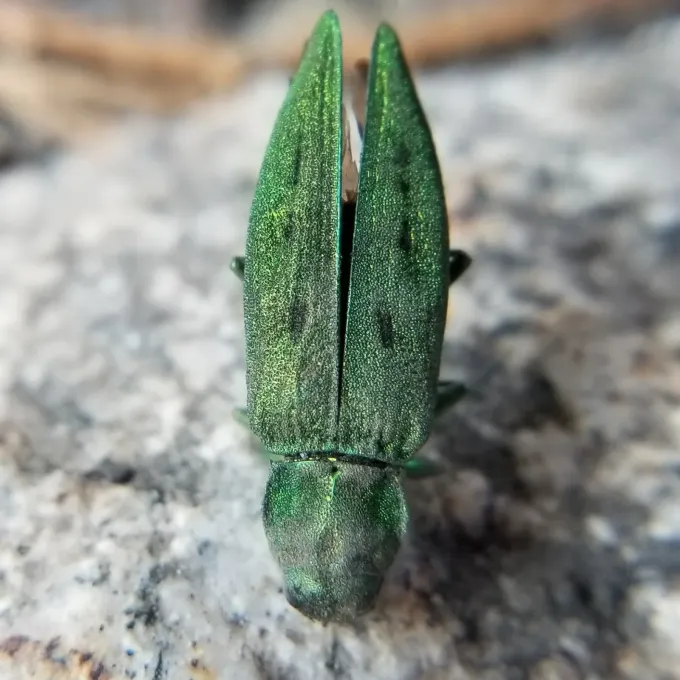
Adult beetles are typically medium-sized, ranging from 10 to 15 mm, with a brilliant metallic green or golden-green iridescent coloration.
Their bodies are elongated and somewhat flattened, an adaptation that allows them to navigate narrow spaces and crevices within the bark.
Larvae are legless, white, and possess a flattened, enlarged thoracic segment, which distinguishes them from other wood-boring larvae found in coniferous trees.
These insects are primarily sun-loving, frequently observed on the exposed sides of trees during the warmest hours of the day.
What it damages
This pest mainly targets species within the Cupressaceae family, including true cypresses, junipers, and western red cedars.
Damage is caused by the larvae, which bore through the inner bark and the sapwood, creating extensive galleries that disrupt the transport of nutrients and water.
Small trees in nurseries are particularly vulnerable; a single infestation can compromise the structural integrity of the main trunk, leading to tree death.
Older, mature trees may survive longer, but chronic infestation leads to canopy thinning, branch dieback, and increased susceptibility to drought and pathogens.
In ornamental settings, the presence of this pest ruins the aesthetic value of the trees by causing uneven growth and permanent branch loss.
When it appears
Adult beetles typically emerge in late spring or early summer, synchronized with the onset of consistent warm weather conditions.
The life cycle of the cypress buprestid is complex and often spans one to two years, depending on the climatic conditions of the host environment.
Females lay eggs in bark fissures or crevices, and once hatched, the larvae immediately begin boring into the protective layers of the wood.
The feeding activity of the larvae continues throughout the active growing season, with development slowing significantly during the winter months.
Pupation occurs in specialized chambers created within the sapwood, where the insects wait for optimal conditions to emerge as adults.
Signs of infestation
The most reliable sign of an infestation is the presence of small, oval-shaped exit holes on the bark of the trunk and major branches.
Visual symptoms include the yellowing, browning, and premature dropping of foliage as the tree's vascular system becomes impaired.
- Accumulation of fine frass (wood dust) at the base of the tree or in bark crevices.
- Isolated branch dieback, often leading to the death of the entire tree over several seasons.
- Patches of loose or dead bark that can be easily pulled away to reveal galleries.
Trees under stress, such as those suffering from insufficient water or nutrient deficiencies, show signs of infestation much earlier than healthy specimens.
In advanced cases, the tree may exhibit a general decline in vigor, with sparse needles and limited new terminal growth.
Control measures
Prevention is the most effective management strategy; this includes maintaining tree health through regular irrigation, proper fertilization, and reducing mechanical trauma.
Infested trees or severely damaged branches should be removed and destroyed (chipped or burned) before the emergence of adult beetles to break the life cycle.
Systemic insecticides applied as trunk injections or soil drenches can provide protection, particularly for high-value ornamental trees in infested areas.
Monitoring the population using pheromone-based lures during the emergence period helps in determining the precise timing for chemical interventions.
Biological control efforts often focus on encouraging the presence of parasitic wasps, which can naturally reduce larval populations within the wood galleries.
Taxonomy
- Latin name
- Trachykele opulenta
- Order
- Coleoptera (beetles)
- Family
- Buprestidae
- EPPO code
- TRAHOP
Discussion
No discussions yet — be the first.