
California oak borer
Agrilus angelicus
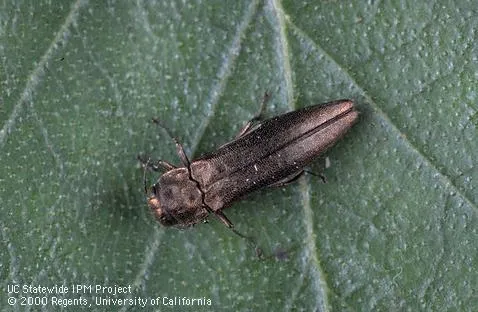
Description
How to identify
The California oak borer (Agrilus angelicus) is a species of metallic wood-boring beetle belonging to the Buprestidae family. Adult beetles are small, slender, and possess an iridescent metallic sheen, which is a signature characteristic of the Agrilus genus.
This species is native to California and has co-evolved with local oak species. Adult beetles are primarily active during the warmer months, focusing on finding mates and suitable hosts for egg-laying on the bark of healthy or stressed oak trees.
The life cycle involves a larval stage that bores through the bark into the cambium layer. The larvae are creamy-white, flat-bodied, and specialized for survival within the woody tissues of their host tree, making them difficult to detect from the outside.
The development cycle can be extended depending on the environmental conditions and the health status of the host tree. During the larval stage, the insect grows and creates extensive galleries that serve as both a food source and protection.
Field identification is often based on the adult emergence holes which are distinctly D-shaped. Entomologists use these marks, alongside the tree's overall condition and specific host preference, to distinguish A. angelicus from other wood-boring beetles.
What it damages
The primary hosts for the California oak borer are various species of oak (Quercus). The beetle is highly host-specific, causing localized damage that disrupts the tree's vital transport systems by feeding on the cambium and phloem.
Infestation by these beetles weakens the tree significantly, leading to canopy dieback. As the vascular tissue is compromised, water and nutrients can no longer reach the extremities of the branches, resulting in rapid drying and branch mortality.
The damage often acts as a precursor to secondary infestations. Once the tree is stressed by the borer, it becomes highly susceptible to opportunistic fungi and other wood-boring insects, which further accelerates the tree's decline.
In regions where the borer is prevalent, sustained drought conditions can trigger large-scale infestations. Trees that lack the physiological energy to defend themselves become vulnerable, potentially leading to the death of entire stands of oak.
Landscape trees and forest ecosystems suffer significant economic and ecological losses due to this pest. The management of the California oak borer is essential for preserving the integrity of local oak-dominated habitats.
Signs of infestation
The most noticeable symptom of a California oak borer infestation is the flagging of individual branches, where the foliage suddenly withers. This is a clear indicator that the flow of nutrients to that branch has been severed by larval galleries.
Examination of the bark may reveal small, D-shaped exit holes where adult beetles have emerged. These holes are usually found in clusters on the branches or the main trunk, indicating the level of infestation intensity.
Dead wood in the upper canopy is a common sign of an established population. If one observes multiple branches dying back simultaneously, it suggests that the borer has been present in the tree for several seasons.
Upon removing the bark of a symptomatic branch, one can observe the characteristic winding larval tunnels filled with frass. These tunnels essentially girdle the branch, preventing it from sustaining the leaves above the affected zone.
Sparse foliage and premature leaf drop are also common signs. When a tree fails to exhibit its normal seasonal growth, it is often a sign of underlying damage caused by the accumulation of internal pest activity over many months.
Control measures
Sanitation is the most effective cultural control method. By promptly pruning and destroying infested branches, landowners can significantly reduce the beetle population before the next generation of adults emerges.
Improving tree vigor is a critical preventative measure. Providing adequate irrigation, especially during drought years, and avoiding mechanical damage to the tree helps the oak maintain the defensive resin and callus production required to repel borers.
Chemical control involving systemic insecticides may be necessary for high-value ornamental trees. Applications are timed to coincide with the flight period of the adult beetles, aiming to prevent them from successfully laying eggs on the bark.
Biological control, focusing on the preservation of natural predators and parasitoids, plays a role in managing beetle numbers. Integrated pest management (IPM) strategies emphasize the importance of these natural enemies in keeping borer populations in check.
Ongoing monitoring using pheromone-based traps is highly recommended to detect the presence of the pest early. Early detection allows for more precise management, reducing the reliance on broad-spectrum pesticides and minimizing environmental impact.
Taxonomy
- Latin name
- Agrilus angelicus
- Order
- Coleoptera (beetles)
- Family
- Buprestidae
- EPPO code
- AGRLAG
Discussion
No discussions yet — be the first.