
Golden-necked buprestid
Agrilus auricollis
Description
How to identify
The Golden-necked buprestid (Agrilus auricollis) is a wood-boring beetle belonging to the Buprestidae family. These insects are significant pests of various deciduous trees.
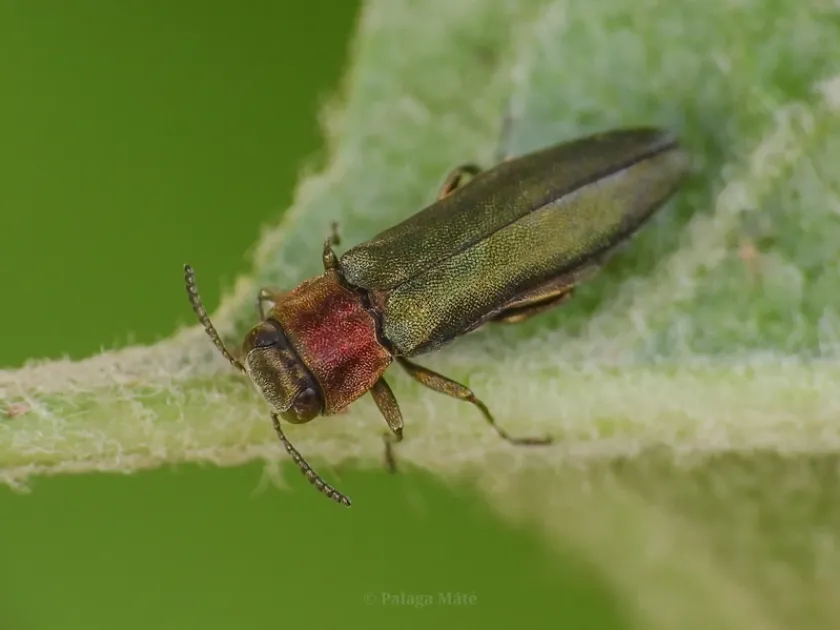
Adult beetles are relatively small, typically reaching 5-8 mm in length. They are characterized by a metallic sheen and a distinct golden-copper color on the pronotum.
The larvae are legless, flattened, and elongated, specifically adapted to survive beneath the bark of host trees. Their powerful mandibles allow them to chew through hardwood.
The life cycle involves complete metamorphosis, including egg, larva, pupa, and adult stages. The adult stage is primarily focused on reproduction and dispersal.
These insects are highly agile, capable of flight on sunny days, which facilitates the spread of the population across an orchard during the active season.
What it damages
The primary hosts of this pest include stone fruit trees such as cherries, plums, and peaches. It can also infest apple and pear trees under certain conditions.
Larvae cause the most severe damage by constructing galleries under the bark, which disrupt the vascular system of the tree, specifically the phloem and cambium layers.
Infested branches eventually lose vigor, exhibit leaf yellowing, and may die off completely. Extensive tunneling can lead to the death of the entire tree.
Beyond physical damage, the galleries created by the larvae serve as entry points for pathogens, fungi, and bacteria, further compromising the tree's immunity.
Young trees are particularly susceptible to severe damage, as their limited vascular supply is easily disrupted by larval feeding activity.
When it appears
Adult beetles emerge in late spring, typically in May. This emergence period is synchronized with rising temperatures and the budding of host trees.
The peak activity for mating and egg-laying occurs during the early summer months, primarily June and July, when temperatures are most favorable.
After hatching, the larvae immediately begin burrowing into the bark to start their development, which continues throughout the summer and autumn.
The insect typically overwinters in the larval stage, residing inside the galleries they have created. This allows them to survive cold winter temperatures.
Pupation takes place in the spring of the following year. Once the metamorphosis is complete, the new generation of adults emerges to restart the cycle.
Signs of infestation
Visual identification of an infestation includes the presence of D-shaped exit holes on the surface of the bark, which are created by emerging adults.
Dieback of branches is a common symptom. Upon inspection, these branches will show clear signs of restricted sap flow and structural damage.
If the bark is carefully removed, characteristic zigzag galleries packed with frass (insect excrement) become visible, confirming the presence of larvae.
Gumosis (oozing of sap) is a frequent defensive response, particularly in stone fruit trees, indicating that the tree is being attacked.
In cases of severe infestation, the bark over the larval galleries may appear depressed, discolored, or detached from the underlying wood.
Control measures
Management strategies focus on a combination of cultural practices, mechanical removal, and targeted chemical applications to minimize damage.
Sanitation is critical. All dead, infested, or weakened branches must be pruned and burned immediately to destroy the larvae before they emerge.
Insecticides can be effective when applied during the peak flight period of adult beetles, aiming to prevent egg-laying on the bark surfaces.
Maintaining high orchard vigor through proper fertilization and irrigation helps trees resist minor infestations and recover from stress.
- Pruning and destroying infested wood throughout the season.
- Application of systemic insecticides prior to peak adult emergence.
- Monitoring populations using specialized pheromone traps.
- Whitewashing tree trunks to deter females from laying eggs.
- Promoting biodiversity to encourage natural predators of buprestid beetles.
Taxonomy
- Latin name
- Agrilus auricollis
- Order
- Coleoptera (beetles)
- Family
- Buprestidae
- EPPO code
- AGRLAU
Discussion
No discussions yet — be the first.