
Bronze birch borer
Agrilus anxius
Description
How to identify
The bronze birch borer, Agrilus anxius, is a wood-boring beetle belonging to the Buprestidae family. Adult beetles are small, measuring about 7 to 13 mm in length, and typically exhibit a metallic bronze or olive-green shimmer.
The insect possesses an elongated, slender body shape, which enables it to navigate easily within the narrow spaces beneath the tree bark. The head is small and retracted into the prothorax, while the antennae are serrated, a common feature among metallic wood-boring beetles.
The larvae are legless and creamy-white, with a distinctly flattened body and an expanded thoracic region. They feature two chitinous, pincer-like appendages at the posterior end, known as urogomphi, which help them stabilize themselves within their tunnels.
Eggs are oval and microscopic. Females deposit them individually or in small clusters within bark crevices, covering them with a secretion that quickly hardens into a protective layer or shield.
Pupae develop within specialized chambers carved into the wood. During this transformation, their color transitions from white to dark brown, signaling that the adult beetle is preparing to emerge.
What it damages
The bronze birch borer primarily infests various birch species, including paper birch, gray birch, and white birch. The pest can attack both stressed and apparently healthy mature trees depending on the local population density.
The insect prefers trees growing in suboptimal conditions, such as those suffering from drought, soil compaction, or overcrowding in forest stands. Healthy trees may be attacked during periods of major pest outbreaks.
Larvae feed by creating winding, serpentine tunnels directly beneath the bark within the cambium layer. This feeding activity disrupts the flow of water and nutrients, eventually causing dieback and tree death.
Severe infestations can kill a tree in as little as two to four years. The pest spreads aggressively, creating hotspots of infection that can rapidly encompass entire groves or urban landscapes.
The economic impact is significant, as the loss of birch trees necessitates expensive removal and disposal operations, especially in residential or municipal areas.
When it appears
The life cycle of Agrilus anxius typically lasts one to two years, depending on regional climatic conditions and the overall health of the host tree.
Adult emergence begins in late spring or early summer, coinciding with warmer temperatures. During this time, adults feed on foliage to gain energy for mating and reproduction.
The egg-laying period occurs during the first half of the summer. Upon hatching, the larvae immediately bore into the bark, initiating the construction of their tunnels, where they will spend the winter months.
Larvae overwinter at various stages of development within their tunnels or inside the wood. Feeding resumes in the spring, culminating in pupation before the emergence cycle repeats.
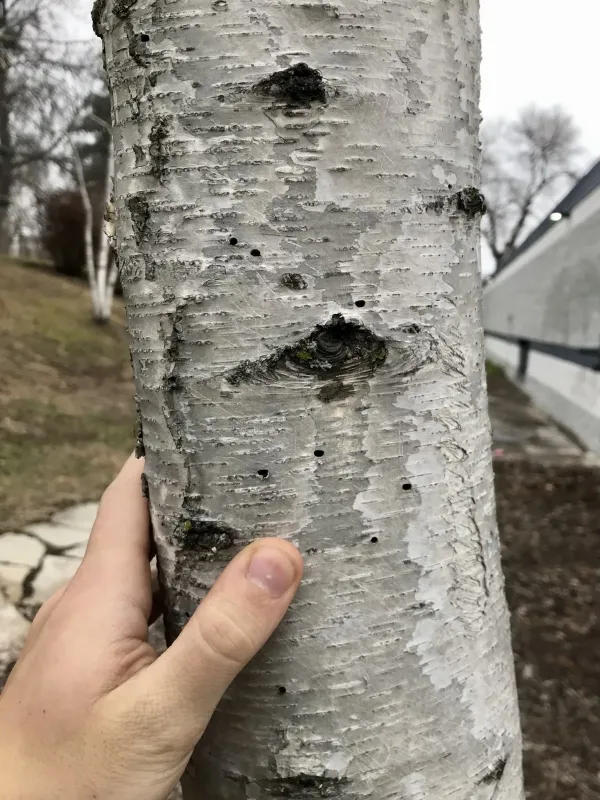
Adults emerge by chewing through the bark, leaving behind characteristic D-shaped exit holes. These holes are the most reliable indicator of a borer presence in an area.
Signs of infestation
The first noticeable symptom of infestation is the dieback of the tree crown. Foliage on the uppermost branches begins to turn yellow, thin out, and eventually drop, giving the tree a sparse appearance.
Characteristic D-shaped exit holes, roughly 3–4 mm in diameter, can be found on the trunk and larger branches. These holes are definitive evidence of beetle emergence.
Peeling back the bark reveals winding larval galleries packed tightly with frass. These galleries intersect and create complex patterns that essentially girdle the tree's vascular system.
Vertical bark cracks and raised ridges often appear as the tree attempts to compartmentalize the damage and heal itself, leading to abnormal growths or callus tissue around the tunnels.
In advanced stages, sap flow may occur, and secondary infestations by other bark beetles or borers often accelerate the decline and death of the host tree.
Control measures
Effective management begins with maintaining high standards of tree care. Providing sufficient irrigation and protecting trees from mechanical stress helps improve their natural resistance.
Sanitary removal is the most critical control strategy. Infested trees should be pruned or removed entirely and properly disposed of before the next generation of adults emerges.
Systemic insecticides, particularly when applied via trunk injections, are highly effective in protecting high-value individual trees in urban or landscape settings.
Ongoing monitoring using pheromone traps is essential for detecting the pest's presence early and implementing timely interventions to prevent major outbreaks.
- Removal and destruction of infested wood.
- Systemic trunk injections of authorized insecticides.
- Regular crown monitoring for signs of dieback.
- Strategic irrigation during dry periods.
- Using pheromone traps for population density tracking.
Taxonomy
- Latin name
- Agrilus anxius
- Order
- Coleoptera (beetles)
- Family
- Buprestidae
- EPPO code
- AGRLAX
Discussion
No discussions yet — be the first.