
Rose stem girdler
Agrilus aurichalceus
Description
How to identify
The rose stem girdler (Agrilus aurichalceus) is a member of the Buprestidae family, known commonly as metallic wood-boring beetles. The adult beetle is small, typically measuring between 6 to 9 mm in length, and possesses a striking bronze or emerald metallic sheen.
The larvae are white, legless, and flattened, specifically adapted for boring within woody stems. Their head is retracted into the thorax, and they possess two distinct dark, curved, pincer-like projections on the end of the abdomen, which are key for identification.
Adult beetles are typically active during warm, sunny spring and summer days. They are agile fliers and often feed on the foliage of host plants, although this damage is generally cosmetic compared to larval activity.
The beetle follows a one-year life cycle. They overwinter as larvae within the stems of host plants, pupate in the early spring, and emerge as adults just as the roses begin to bloom.
This species is highly host-specific, primarily targeting members of the Rosaceae family, which includes wild and cultivated roses, as well as raspberries and blackberries.
What it damages
Larval activity is the primary cause of damage. As the larvae tunnel beneath the bark, they create spiral galleries that interrupt the flow of water and nutrients, effectively girdling the stem.
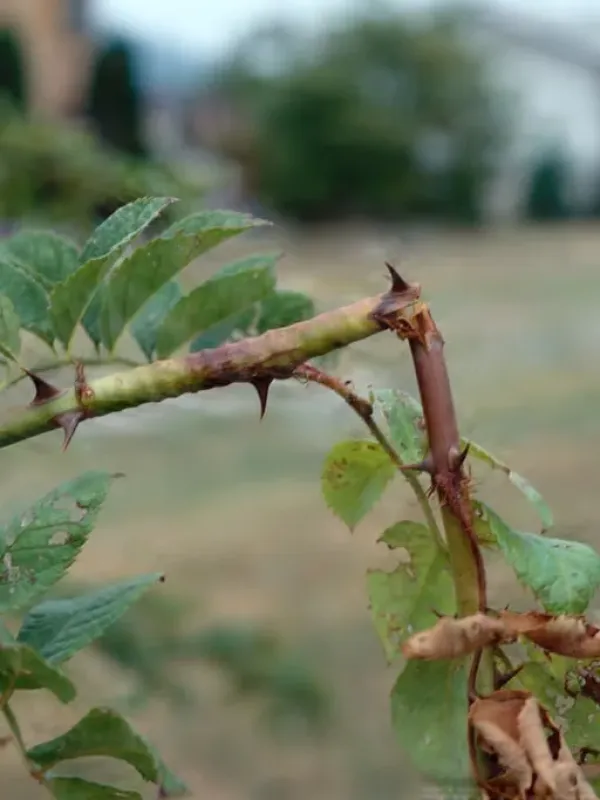
The immediate physical consequence is the formation of characteristic swellings or galls on the stems. These areas become weak points, leading to stunted growth and the gradual decline of the entire shoot.
In raspberries, the girdling effect often results in the canes breaking off during windy weather. This can lead to significant yield losses as the fruit-bearing canes are destroyed before harvest.
In roses, infested stems often dry out and wither. The plant may attempt to produce new growth, but the underlying structural damage significantly compromises the health of the entire shrub.
Severe infestations can lead to the death of entire branches or canes. Without intervention, a healthy patch of roses or raspberries can become a reservoir for the pest, spreading to neighboring plants.
Signs of infestation
The most prominent sign is the presence of abnormal, spiral-shaped swellings or galls on the canes or stems. These swellings are often accompanied by longitudinal cracking of the bark.
Small, irregular, oval-shaped feeding holes on the leaves, observed during late spring, indicate the presence of adult beetles, though these are often overlooked compared to the stem damage.
Wilting of the tips of the shoots or branches during the summer is a classic indicator. When checked, these tips often break easily, revealing a tunnel filled with frass, which is the waste product of the larva.
In the winter or during early spring maintenance, examining cut ends of canes can reveal the larvae or the empty tunnels they have created throughout the previous season.
Early leaf drop and premature autumn coloration on individual canes compared to the rest of the plant are also clear indicators that the stem has been compromised by the borer.
Control measures
Sanitation is the most critical control measure. All stems showing signs of swelling, cracking, or damage must be pruned well below the site of infestation to remove the larvae.
Pruned material should be immediately disposed of by burning or burying deep in the ground to ensure that any larvae contained within do not complete their development.
Chemical control using systemic insecticides applied during the peak adult emergence period (late spring) can be effective. This targets the adults before they can deposit eggs on the healthy stems.
Maintaining vigorous plant health through adequate irrigation, fertilization, and spacing makes plants less attractive and more capable of recovering from minimal pest pressure.
In larger production fields, monitoring for adult beetles using visual cues or traps can help in timing management strategies more precisely, reducing the overall reliance on broad-spectrum pesticides.
Taxonomy
- Latin name
- Agrilus aurichalceus
- Order
- Coleoptera (beetles)
- Family
- Buprestidae
- EPPO code
- AGRLRC
Discussion
No discussions yet — be the first.