
Oak splendour beetle
Agrilus angustulus
Description
How to identify
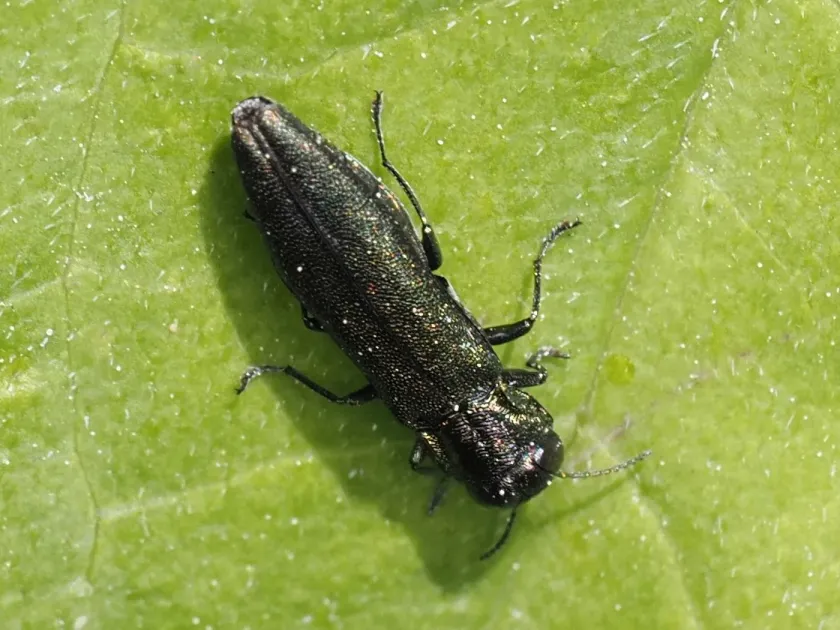
The Oak splendour beetle (Agrilus angustulus) is a member of the jewel beetle family (Buprestidae), known for its slender, metallic body and destructive larval stage.
Adult beetles measure approximately 4 to 6 millimeters in length, possessing a distinctive bronze-green or metallic brown coloration that helps them camouflage against the bark.
The larvae are typically legless, flat, and creamy white, featuring an enlarged thoracic segment that allows them to move efficiently through the vascular cambium of the tree.
The beetle typically follows a one-year life cycle, although in colder northern climates, the larval development can sometimes extend over two seasons.
These insects are highly active during warm summer days, often congregating on the sunlit sides of the canopy where they feed and find mates.
What it damages
The primary host for this pest is the oak tree (Quercus species), although it has been documented to attack hazel and hornbeam in certain environments.
Damage is primarily caused by the larvae, which bore winding galleries under the bark, disrupting the flow of water and nutrients within the tree's conductive tissue.
Adult beetles feed on the margins of leaves, creating small, jagged notches; however, this foliage damage is generally superficial and does not threaten the tree's life.
Severe infestations lead to the gradual decline of the tree, starting with branch dieback and eventually causing total tree mortality in the absence of treatment.
Trees suffering from drought, soil compaction, or poor site conditions are significantly more susceptible to successful colonization by this wood-borer.
When it appears
Adult beetles emerge in late spring and early summer, typically between May and July, corresponding with the peak growth phase of the host oak trees.
Following mating, the females deposit their eggs in bark crevices, targeting young trees or the smaller, thinner-barked branches of mature oaks.
Upon hatching, the larvae bore directly into the cambium layer, where they spend the summer feeding and expanding their intricate gallery systems.
As winter approaches, the larvae retreat deeper into the wood or remain under the bark to survive the colder temperatures in a semi-dormant state.
Transformation into the pupal stage occurs in early spring within the larval gallery, eventually leading to the emergence of the next generation of adults.
Signs of infestation
One of the earliest symptoms of an infestation is the premature yellowing and thinning of leaves in specific parts of the tree canopy.
Upon close inspection, D-shaped exit holes (approximately 2–3 mm wide) can be found on the surface of the bark, indicating successful adult emergence.
Necrotic patches and sunken areas on the bark are often visible where the larvae have extensively damaged the cambium and phloem underneath.
Peeling back the bark in affected areas reveals distinctive, zig-zagging larval tunnels packed tightly with frass and wood dust.
Crown dieback is a sign of advanced infestation, where the tree loses the ability to transport nutrients to its uppermost branches, causing them to wither.
Control measures
Proactive forest management, including the timely removal and destruction of infested branches or trees, is the most effective way to limit population growth.
Promoting tree vigor through adequate irrigation and balanced fertilization can significantly improve a tree's natural defenses against boring insects.
In ornamental settings, systemic insecticides applied during the adult flight period may offer protection, though coverage remains a challenge on large oaks.
Biological control, particularly the protection and encouragement of woodpecker populations, provides natural and sustainable regulation of larval numbers.
Monitoring for signs of infestation in high-value oak stands during the spring is crucial to intervene before the pest population becomes unmanageable.
Taxonomy
- Latin name
- Agrilus angustulus
- Order
- Coleoptera (beetles)
- Family
- Buprestidae
- EPPO code
- AGRLAN
Discussion
No discussions yet — be the first.