
Black poplar buprestid
Agrilus ater
Description
How to identify
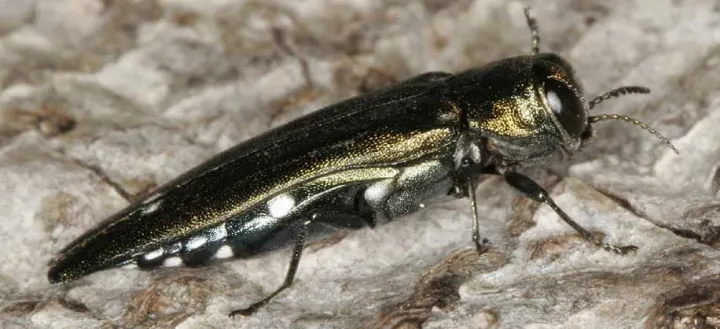
The Black poplar buprestid (Agrilus ater) is a wood-boring beetle belonging to the Buprestidae family. Adult beetles are small, typically ranging from 8 to 10 mm in length, with a distinct, elongated, black metallic body.
The larvae are flat, white, and legless, which is characteristic of the genus Agrilus. They possess a broad thoracic segment and a pair of small, heavily sclerotized appendages at the end of their abdomen.
These insects primarily inhabit weakened or stressed poplar trees. Their biological adaptation allows them to thrive in the nutrient-rich cambium layer between the bark and the wood.
Populations are often distributed in areas where poplar stands are subjected to drought, competition, or environmental stress, making them susceptible to colonization.
The adults are sun-loving insects often found on leaves and branches, while the larvae spend their entire developmental period hidden beneath the tree bark.
What it damages
This pest targets various poplar species, including Populus nigra and Populus alba. In some cases, it may also attack willow trees if preferred hosts are unavailable.
Larval feeding causes significant structural damage by excavating serpentine galleries through the cambium, which effectively severs the tree’s water and nutrient pathways.
Adults consume poplar leaves during their maturation feeding phase, creating irregular notches along the leaf margins, though this damage is generally secondary in severity.
The cumulative effect of larval activity leads to crown dieback, thinning foliage, and the eventual death of branches or the entire tree if the infestation is severe.
Trees affected by Agrilus ater often show reduced vigor, making them more vulnerable to secondary invasions by fungi and other wood-decay organisms.
When it appears
Adult beetles emerge in late spring, typically between May and July. They remain active in the tree canopy for several weeks to feed and reproduce.
Eggs are laid in the bark crevices of the host tree. Once hatched, the larvae bore directly into the phloem and cambium layers to begin their development.
Larvae overwinter inside the tree within prepared chambers in the wood or the inner bark, waiting for the warmer spring temperatures to pupate.
The life cycle is usually completed in one year, but environmental factors, such as temperature and tree moisture content, can influence the development rate, occasionally extending it.
The emergence of the new generation is marked by the appearance of exit holes, signaling the beginning of the next cycle of the population growth.
Signs of infestation
The most reliable sign of an infestation is the presence of D-shaped exit holes on the bark of the trunk and branches, created by emerging adults.
Peeling bark or vertical cracks often reveal the intricate galleries made by the larvae. These galleries are typically filled with dense, sawdust-like frass.
Visible decline in the canopy, including yellowing leaves, premature shedding, and dead branches, indicates that the tree's vascular system has been compromised.
In advanced stages, the tree may exhibit sunken areas of bark or necrotic patches caused by the interrupted flow of nutrients around the larval galleries.
Checking for the presence of the beetle can be done by carefully inspecting the bark for entrance/exit points or by detecting the subtle structural weaknesses in the branches.
Control measures
Sanitation is the primary management strategy: prompt removal and disposal of infested trees or branches prevent the emergence of the next generation of beetles.
Maintaining high tree health standards is critical. Proper irrigation and fertilization during dry periods help trees resist colonization by these wood-boring pests.
Systemic insecticides may be applied to the canopy during the peak adult activity period to reduce the population before egg-laying begins.
Biological control methods involve promoting natural enemies, such as parasitic wasps and predatory birds, which play a significant role in limiting population outbreaks.
Careful site planning and the use of site-appropriate poplar varieties help decrease the probability of infestations and maintain the long-term health of forest stands.
Taxonomy
- Latin name
- Agrilus ater
- Order
- Coleoptera (beetles)
- Family
- Buprestidae
- EPPO code
- AGRLAT
Discussion
No discussions yet — be the first.