
Cypress buprestid
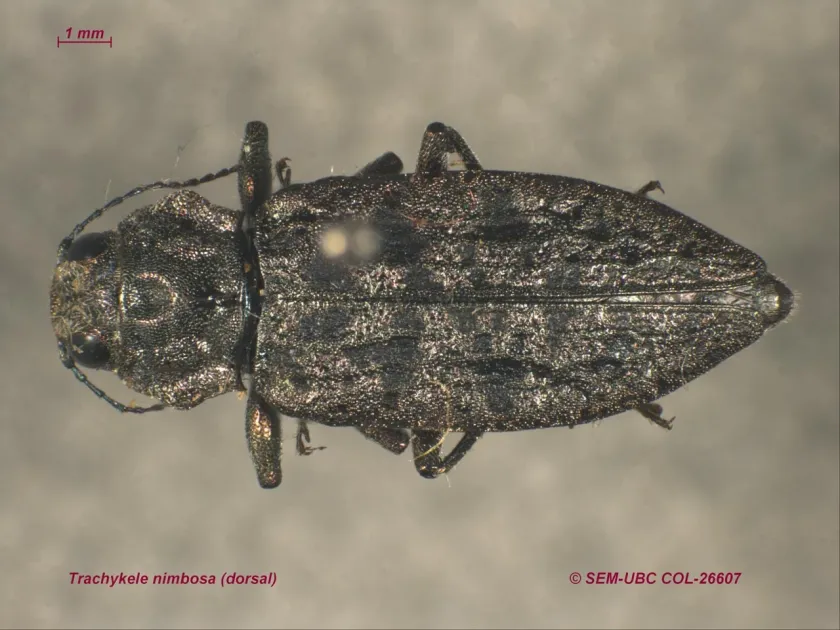
Trachykele nimbosa
Description
How to identify
The cypress buprestid (Trachykele nimbosa) is a wood-boring beetle belonging to the Buprestidae family, known for causing significant damage to various coniferous tree species.
Adult beetles are typically metallic green or golden-green in color, with an elongated, flattened body measuring approximately 10–15 mm in length.
The larvae are legless, flattened, and creamy white, specifically adapted to survive within the inner bark and sapwood of host trees.
As a member of the Buprestinae subfamily, this insect is characterized by its hidden development cycle, making early detection a primary challenge for arborists.
These beetles are most easily identified during their flight period, usually observed basking on the sun-exposed sides of trunks and large branches.
What it damages
The primary hosts of the cypress buprestid include members of the Cupressaceae family, particularly cypress (Cupressus), juniper (Juniperus), and arborvitae (Thuja).
Larvae feed by excavating winding galleries in the sapwood and cambium layer, which effectively girdles the tree and disrupts the transport of water and nutrients.
Initial signs of damage often include a gradual thinning of the foliage, followed by the browning and dieback of individual branches or entire sections of the canopy.
When infestation levels are high, the structural integrity of the tree is severely compromised, often resulting in complete mortality over several growing seasons.
Economic damage is most pronounced in ornamental nursery production and landscape forestry, where the loss of mature specimens represents a significant aesthetic and financial loss.
When it appears
Adult emergence and activity typically occur during the warmer months, generally from late spring to mid-summer, depending on regional temperature variations.
During this flight window, mating occurs, and females seek suitable sites on the bark of susceptible hosts to lay their eggs individually or in small clusters.
The larval stage is the most destructive and can persist for several years, as the larvae slowly mature while consuming the tree's vascular tissues.
Pupation takes place within the tree, where the larvae construct specialized chambers before transforming into adults and cutting their way through the bark.
Monitoring for adults during the peak flight period is essential for planning targeted pest management applications and reducing the potential for future generations.
Signs of infestation
The most diagnostic sign of an active infestation is the presence of small, oval-shaped exit holes located on the bark of the trunk or larger branches.
Frass, or fine wood shavings mixed with excrement, can often be found near these holes or at the base of the tree where the beetle has been active.
- Gradual yellowing or flagging of branches throughout the canopy.
- Noticeable dieback of tree tops or distinct structural segments.
- Resin flow or bleeding at the point of larval entry or larval gallery activity.
- Visible cracks or structural fissures on the trunk surface due to internal boring.
Peeling away small sections of the bark will reveal the characteristic larval galleries, which are tightly packed with fibrous wood particles and frass.
Control measures
Proactive tree care is the first line of defense, emphasizing proper irrigation and soil management to maintain tree vigor and resistance against stressors.
Sanitation practices, such as the prompt removal and destruction of infested trees or heavily damaged branches, are critical to limiting population outbreaks.
Systemic insecticides, applied as soil drenches or trunk injections, may provide effective control by reaching the larvae feeding within the vascular tissues.
Integrated Pest Management (IPM) strategies, including the use of pheromone-based monitoring, can assist in determining the exact timing for preventative sprays.
Regular inspections, especially during the spring, allow for early intervention before the borer population reaches levels that threaten the entire tree's health.
Taxonomy
- Latin name
- Trachykele nimbosa
- Order
- Coleoptera (beetles)
- Family
- Buprestidae
- EPPO code
- TRAHNI
Discussion
No discussions yet — be the first.