
Cypress buprestid
Trachykele blondeli
Description
How to identify
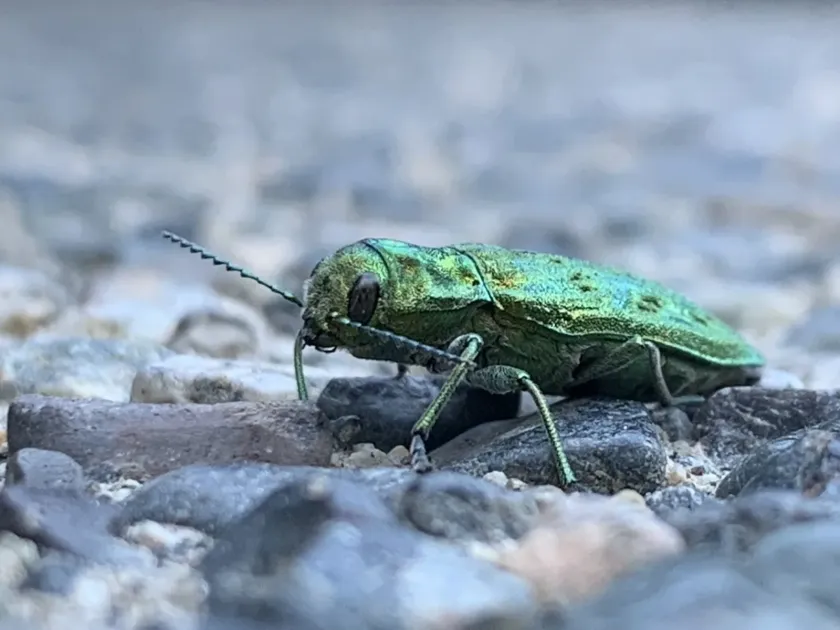
The cypress buprestid (Trachykele blondeli) is a beetle belonging to the Buprestidae family, known as metallic wood-boring beetles. The adults are typically 10–15 mm long with a shimmering, iridescent green or copper-gold color.
These beetles are hard to spot because their coloration allows them to blend perfectly with the needles and bark of host trees. They are most active during warm, sunny days in the late spring and summer.
The larvae are creamy white, legless, and have a flattened head region, which is a characteristic feature of this species. They live exclusively under the bark and within the wood of their host.
The life cycle of Trachykele blondeli can be quite long, often spanning several years, as the larvae develop slowly within the dense wood of the conifer trees.
The adult stage is relatively short-lived compared to the larval stage, focusing primarily on reproduction and dispersal to new host trees within the vicinity.
What it damages
This pest specifically targets members of the Cupressaceae family, including cypresses, junipers, arborvitae (Thuja), and other related conifer species often used in landscaping.
Damage is caused by the larvae, which bore through the phloem and cambium layers of the tree. This activity disrupts the tree's vascular system, preventing the transport of water and nutrients.
As the larvae grow and penetrate deeper into the sapwood and heartwood, the structural integrity of the tree's branches and trunk is compromised, leading to limb failure or overall tree death.
Stressed or recently transplanted trees are more susceptible to attack, though healthy mature trees can also be heavily infested if the pest population density is high.
Severe infestations often result in branch dieback, thinning canopies, and eventually the death of the entire tree if the infestation is not addressed promptly.
Signs of infestation
One of the primary indicators of a cypress buprestid infestation is the presence of small, oval-shaped exit holes on the bark where the adults have emerged.
Visible yellowing or browning of specific branches, often appearing randomly in the canopy, suggests that the vascular pathways have been severed by larval tunneling.
Fine, powdery frass (boring dust) found around the base of the tree or tucked into bark crevices is a clear sign that larvae are actively feeding inside the wood.
Excessive resin flow on the trunk or branches can be a defensive reaction of the tree trying to pitch out the invading larvae, though this is often insufficient.
The foliage may lose its healthy, vibrant sheen and become dull, eventually dropping off as the branch segments die due to the lack of water and nutrient circulation.
Control measures
Cultural management is the first line of defense. Keep trees well-watered, mulched, and pruned to promote overall health, as stressed trees are primary targets for the buprestid.
Systemic insecticides are the most effective chemical approach, as they can be absorbed by the tree and provide internal protection against boring larvae.
- Regular inspection of the trunk and main branches for exit holes.
- Immediate removal and destruction (burning or chipping) of infested branches.
- Applying residual sprays to the bark during the adult flight period (late spring).
- Monitoring for adult beetle activity using sticky traps.
If an infestation is severe and the tree's health is significantly compromised, removal of the entire tree is often necessary to prevent the pest from spreading to neighboring plants.
Consult with a local certified arborist to develop a site-specific management plan, especially if you have a collection of high-value ornamental conifers in your landscape.
Taxonomy
- Latin name
- Trachykele blondeli
- Order
- Coleoptera (beetles)
- Family
- Buprestidae
- EPPO code
- TRAHBJ
Discussion
No discussions yet — be the first.