
Spittlebug
Tomaspis pictipennis
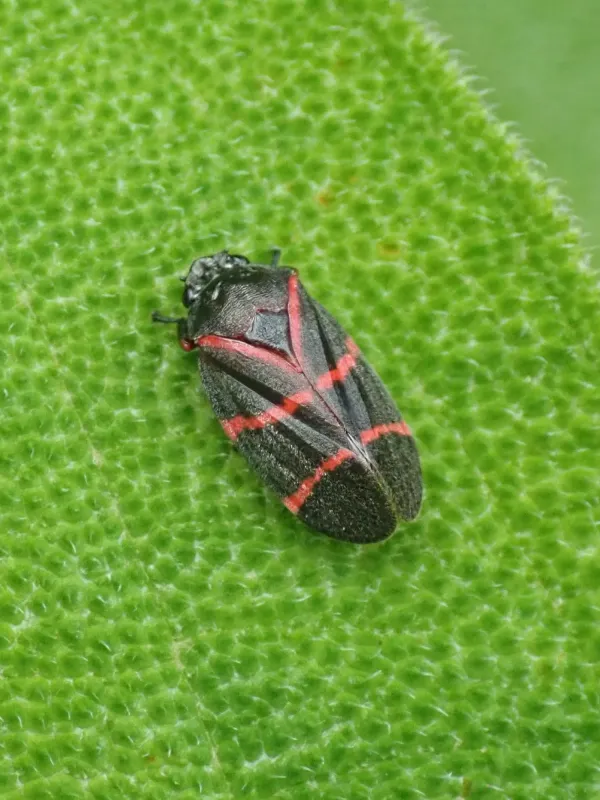
Description
How to identify
The spittlebug Tomaspis pictipennis belongs to the order Hemiptera and the family Cercopidae. These insects are well-known for their unique life cycle, specifically the nymph stage.
Adult insects are characterized by their strong hind legs, which enable them to jump significant distances, and their distinctive mottled wing pattern.
Nymphs are easily identified by the white, bubbly foam they produce; this substance acts as a protective barrier against predators and extreme weather conditions.
The body structure is compact, with a broad head and compound eyes that provide a wide field of vision for detecting threats in their environment.
As tropical insects, they thrive in humid conditions, which are critical for the formation of their protective foam and overall developmental success.
What it damages
This pest primarily targets cereal crops, such as sugarcane, maize, and various pasture grasses, causing substantial physiological stress to the plants.
Both nymphs and adults feed on xylem sap by inserting their piercing-sucking mouthparts deep into the plant vascular system to extract vital fluids.
Feeding disrupts the normal transport of water and nutrients throughout the plant, leading to stunted growth and reduced metabolic efficiency.
The introduction of specific salivary enzymes during feeding triggers a localized toxic reaction, leading to chlorosis, tissue necrosis, and eventual plant death.
High infestation rates can devastate crop yields, especially in young plantations where the plants are most vulnerable to nutritional depletion and secondary infections.
When it appears
The life cycle of Tomaspis pictipennis is heavily dependent on moisture levels, with activity levels rising significantly during the rainy season.
Multiple generations can occur within a single year, provided that the climate remains warm and food resources are consistently available.
The overwintering phase typically occurs in the egg stage, with eggs deposited in the soil or protected plant debris until favorable conditions return.
As the weather warms, eggs hatch into nymphs, which immediately begin searching for succulent plant parts to initiate their feeding and foam production.
Adult population peaks correlate with favorable humidity and temperature ranges, allowing for rapid colonization of new fields and surrounding vegetation.
Signs of infestation
The most reliable indicator of an infestation is the presence of white, frothy foam at the base of stalks, leaf axils, or within dense foliage.
Plants affected by these pests exhibit signs of dehydration, including yellowing leaves, curling blades, and a general lack of vitality in the canopy.
Necrotic spots appear at feeding sites on the stalks, which may eventually lead to the stem drying out and breaking under wind pressure or heavy weight.
Visible reduction in plant height and uniform growth compared to unaffected areas of the field is a sign of high population pressure.
In cases of severe infestation, the foliage may take on a burned or scorched appearance due to the extensive damage to the vascular tissue.
Control measures
Cultural control practices, such as deep plowing after harvest, are essential to destroy the eggs and prevent the emergence of subsequent generations.
Effective weed management is crucial, as wild grasses often serve as alternative hosts for the pest before it migrates to primary crops.
Biological control, utilizing fungal pathogens like Metarhizium anisopliae, has shown great success in reducing spittlebug populations naturally.
Chemical intervention should rely on selective systemic insecticides that are applied when monitoring indicates that population density exceeds economic thresholds.
- Use of sticky yellow traps for population monitoring
- Implementation of crop rotation to break the life cycle
- Biological suppression using natural predators
- Applying systemic insecticides during early nymph stages
Taxonomy
- Latin name
- Tomaspis pictipennis
- Order
- Hemiptera (bugs, aphids, leafhoppers)
- Family
- Cercopidae
- EPPO code
- TOMAPI
Discussion
No discussions yet — be the first.