
Aeneolamia albofasciata
Aeneolamia albofasciata
Description
How to identify
Aeneolamia albofasciata is a species of spittlebug belonging to the family Cercopidae. These insects are characterized by their dark bodies with distinct, pale transverse bands across their wings, which makes them relatively identifiable in the field.
The immature stages, known as nymphs, are well-known for their unique behavior of producing a protective foam or "spittle" mass. This foam shields the nymphs from predators, heat, and desiccation throughout their development.
Adults are highly mobile and possess strong hind legs adapted for jumping, which they use to quickly escape threats. They are generally found near the base of stems or in protected areas of the plant canopy.
The life cycle of this species is highly dependent on environmental humidity and temperature. Tropical and subtropical climates provide the ideal conditions for the rapid completion of their developmental stages.
The mouthparts of both nymphs and adults are specialized for piercing and sucking, allowing them to extract essential nutrients from the phloem of host plants, causing physiological stress to the vegetation.
What it damages
Aeneolamia albofasciata primarily targets graminaceous forage crops and pasture grasses. Heavy infestations can lead to significant biomass loss, reducing the overall nutritional quality of the forage for livestock.
Beyond main crops, these pests can inhabit alternative weed hosts, allowing the population to persist even when the primary food source is seasonally reduced or managed.
Economic losses are particularly high in regions relying on intensive grazing. The direct feeding damage reduces the vigor of the grasses, making them slower to recover after grazing or cutting.
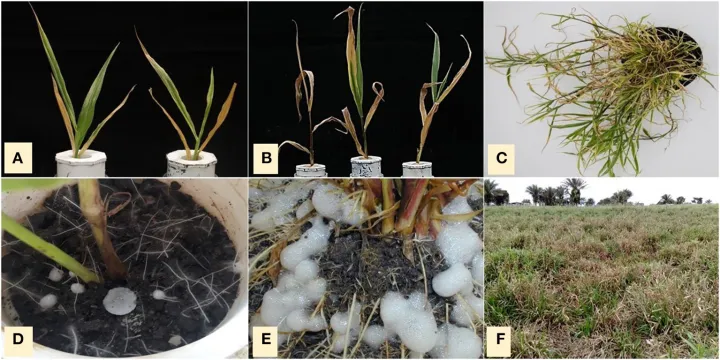
By disrupting the flow of water and nutrients within the plant tissues, the feeding activity of these insects stunts growth and leads to the chlorosis of leaves, significantly lowering total yield.
In cases of severe outbreaks, pasture areas may exhibit large patches of withered or dying grass, which disrupts the rotation cycle and forces farmers to rely on expensive supplemental feed.
When it appears
The seasonal activity of the pest is closely synchronized with the onset of the rainy season. Moisture is critical for the survival of eggs and the early development of nymphs emerging from the soil.
Populations tend to reach their peak density during the mid-season when favorable climatic conditions allow for multiple successive generations to develop within a single growing cycle.
Adults remain active throughout the wet season, exhibiting migratory behavior to exploit new, succulent growth areas within and around pasture fields.
The timing of population surges is often predictable if rainfall patterns are monitored, allowing agricultural producers to prepare protection strategies in advance.
Conversely, the start of the dry season usually triggers a decline in population numbers, as the environmental conditions become increasingly hostile for the survival of the nymphs and their foam-building process.
Signs of infestation
The most reliable sign of an infestation is the presence of the characteristic white foam masses found at the base of the grass stems or near the leaf axils.
Infested plants typically show visible signs of distress, starting with leaf yellowing and progressing to browning of the tips, which can be mistaken for drought stress or nutrient deficiencies.
Observing a sudden increase in the number of adult spittlebugs, which jump or fly when the grass is disturbed, is a strong indicator of a high population level.
The formation of yellowing or scorched-looking patches in the pasture is a sign that the infestation is well-established and causing cumulative damage to the root and stem systems.
Careful inspection of the plant canopy and the thatch layer will reveal the presence of the nymphs, confirming that the infestation is actively progressing.
Control measures
Effective management begins with cultural practices, such as appropriate stocking rates for livestock and strategic grazing rotations, which help to expose nymphs to adverse environmental conditions.
Biological control methods, particularly the use of entomopathogenic fungi like Metarhizium anisopliae, have proven highly effective in suppressing spittlebug populations without the use of broad-spectrum chemicals.
Chemical control should be applied as a last resort, ensuring the products used are safe for livestock and compliant with post-application grazing intervals.
- Systemic insecticide application during peak activity
- Mowing or burning of heavily infested residue
- Improved pasture drainage to modify the microclimate
- Use of yellow sticky traps for monitoring purposes
Integrated Pest Management (IPM) programs emphasize early detection through regular field scouting, ensuring that interventions are targeted only when necessary.
Combining biological agents with resistant forage varieties remains the most sustainable approach to long-term control of this pest in agricultural landscapes.
Taxonomy
- Latin name
- Aeneolamia albofasciata
- Order
- Hemiptera (bugs, aphids, leafhoppers)
- Family
- Cercopidae
- EPPO code
- TOMAOC
Discussion
No discussions yet — be the first.