
Spittlebug
Aeneolamia
Description
How to identify
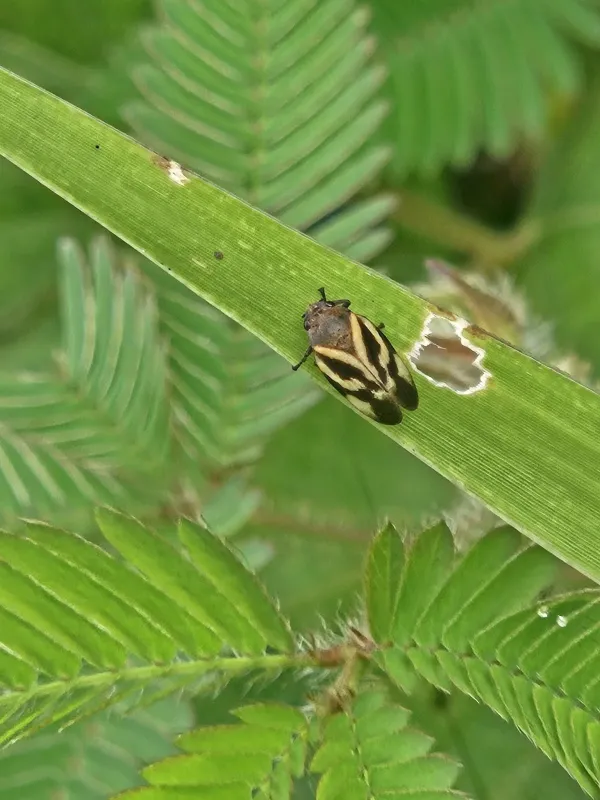
Aeneolamia belongs to the Cercopidae family, within the order Hemiptera. This insect is of medium size, often featuring dark-colored wings with distinctive stripes, which makes it easily recognizable among other froghoppers.
Adult individuals possess strong hind legs adapted for jumping, allowing them to move rapidly between plants when threatened. The body shape resembles an elongated triangle when viewed from above.
The larvae of this pest live within characteristic foamy masses, which they produce from their excrement and gland secretions. This foam protects them from desiccation and predator attacks.
The insect's life cycle is strongly dependent on climatic conditions, especially soil moisture, which is necessary for larval survival within their protective foam structures.
Development involves several molting stages, after which the adult insect emerges from the foam to feed on plant sap, causing the primary economic damage.
What it damages
The primary crops vulnerable to Aeneolamia attacks include sugarcane and various species of forage grasses used in pastures.
The pest targets both the root system and the aerial parts of the plants, sucking sap from tissues, which leads to critical depletion of the crop.
Young shoots are most sensitive to damage, losing turgor and slowing their growth rate during periods of intense feeding by the insects.
Beyond direct mechanical injury, Aeneolamia often promotes the development of secondary fungal and bacterial infections through open wounds in the plant tissues.
Mass infestations on sugarcane plantations can lead to yield losses of up to 30-50% per season due to reduced sugar accumulation.
When it appears
The activity of Aeneolamia is directly linked to the onset of the rainy season, when high humidity provides optimal conditions for larval emergence.
In tropical climates, the pest can undergo several generations if weather conditions remain favorable for many months.
Dry periods act as a limiting factor, during which the insects enter diapause or their populations decrease sharply.
The population peak of adults usually occurs in the second half of the rainy season, when the highest number of mature individuals ready for mating is observed.
Monitoring the appearance of initial foam formations at the base of plants allows agronomists to detect the onset of an infestation in time.
Signs of infestation
The first and most obvious sign of the pest's presence is the appearance of thick white foam at the base of stems or in the leaf axils of forage grasses.
Leaves of affected plants begin to yellow, curl, and wither prematurely, starting from the tips or the edges of the leaf blades.
Plants appear stunted, their development halts, and the root system becomes weak, which is particularly evident by the ease with which turf can be pulled from the soil.
The presence of large numbers of adults on sugarcane stalks is accompanied by characteristic damage, appearing as light spots or necrotic zones.
- Yellowing of leaf blades
- Presence of foam clumps on stems
- Stunted internode growth
- Reduction in forage grass biomass
- Fungal growth in bite marks
Control measures
Biological control methods for Aeneolamia include the use of entomopathogenic fungi, such as Metarhizium anisopliae, which effectively targets larvae in the soil.
The application of insecticides is justified during the peak flight of adults, although it is essential to observe pre-harvest intervals to minimize negative impacts on beneficial fauna.
Cultural practices include regular mowing of pastures, which destroys the foam nests and reduces the survival rate of the pest's young generation.
Implementing resistant sugarcane varieties is a long-term strategy that reduces reliance on aggressive chemical treatments.
Balanced fertilizer application boosts plant immunity, allowing them to recover more quickly after damage caused by the insects.
Taxonomy
- Latin name
- Aeneolamia
- Order
- Hemiptera (bugs, aphids, leafhoppers)
- Family
- Cercopidae
- EPPO code
- AENESP
Discussion
No discussions yet — be the first.