
Cercopis arcuata
Cercopis arcuata
Description
How to identify
Cercopis arcuata is a notable member of the family Cercopidae, commonly known as spittlebugs or froghoppers. These insects belong to the order Hemiptera and are recognized by their distinct appearance.
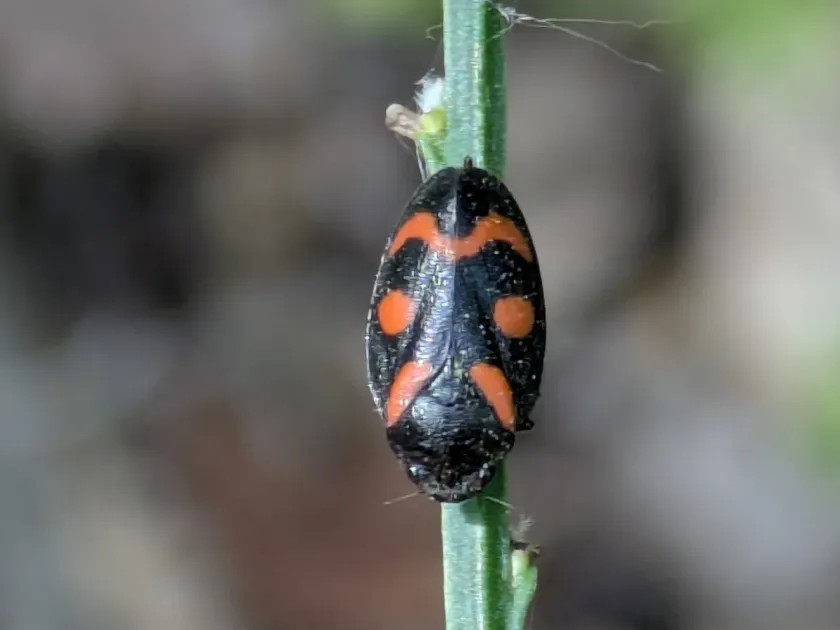
Adult insects are about 10 mm long, featuring a black body with striking red or orange arched bands on their forewings. This color pattern makes them easily identifiable in the field.
The immature stage, or nymph, is famously known for creating a protective mass of froth. This substance, often referred to as cuckoo spit, is secreted by the nymphs to stay moist and hide from predators.
The morphology of the nymph is adapted for life within this foam, allowing it to feed on plant sap while remaining sheltered from environmental stressors and physical threats.
As a member of the Cercopidae family, Cercopis arcuata occupies a specific niche in agroecosystems, often appearing in areas with high vegetation density during spring months.
What it damages
Cercopis arcuata acts as a polyphagous pest, meaning it feeds on a wide variety of plants, including legumes, ornamental shrubs, and diverse herbaceous crops.
The primary damage is inflicted by nymphs. By piercing plant tissues with their sucking mouthparts, they drain essential sap, which deprives the plant of necessary nutrients and energy.
As a result, plants exhibit symptoms such as leaf curling, stunted development of terminal shoots, and in severe cases, the deformation of the entire growing point.
The feeding process often introduces toxins into the plant vascular system, leading to local chlorosis, yellowing, or the appearance of necrotic lesions on leaves and stems.
While adults also feed on sap, their impact is generally considered secondary to the significant stress caused by the nymphal stage, which can substantially reduce overall crop yields.
When it appears
The lifecycle of Cercopis arcuata is strictly seasonal. The species overwinters as eggs deposited in plant debris, soil, or the base of perennial plants.
With the arrival of spring, usually in May, the eggs hatch. Nymphs begin their development by seeking out succulent stems to feed upon and produce their characteristic protective foam.
As temperatures rise into early summer, the nymphs undergo several molts before reaching their adult stage. The adult population becomes most visible during June and July.
During the peak of the summer, adult insects actively reproduce. This is the period when farmers might notice increased activity as the population moves between host plants.
As autumn approaches and temperatures decrease, adult activity declines significantly. The females lay eggs, which enter a diapause state to survive the winter and restart the cycle next year.
Signs of infestation
The most reliable sign of a Cercopis arcuata infestation is the presence of white, bubbly foam covering the stems or leaf axils of susceptible plants.
Observers should look for twisted, curled, or distorted leaves on the upper parts of the plants, which indicate that nymphs have been feeding on the sap in those areas.
Plant growth inhibition is another common sign. If a group of plants appears significantly shorter or less vigorous than surrounding ones, it may indicate a dense infestation of spittlebug nymphs.
Adult insects can be spotted by shaking plants gently. Their jumping behavior is a defensive mechanism, and they will leap away quickly when disturbed during sunny parts of the day.
Close inspection of the lower canopy is recommended if the aforementioned symptoms (stunted growth, froth) are present, as the nymphs are typically clustered near the base or on the underside of leaves.
Control measures
Cultural management is the first line of defense. Keeping fields free of weeds, which serve as alternative hosts, significantly reduces the survival rate of early-stage nymphs.
Deep autumn cultivation or plowing is an effective mechanical method to bury or destroy overwintering eggs, thereby lowering the starting population for the next growing season.
In cases of economic threshold exceedance, systemic insecticides can be applied. It is crucial to time these applications with the period of peak nymphal hatching for maximum efficiency.
Biological control methods involve encouraging natural predators or using microbial-based insecticides that target the insect without disrupting beneficial pollinators in the field.
Monitoring using yellow sticky traps is a recommended practice. This helps track the population dynamics of adults and allows for precision timing in applying necessary protective measures.
Taxonomy
- Latin name
- Cercopis arcuata
- Order
- Hemiptera (bugs, aphids, leafhoppers)
- Family
- Cercopidae
- EPPO code
- CRCOAR
Discussion
No discussions yet — be the first.