
Thymelicus lineola
Thymelicus lineola
Description
How to identify
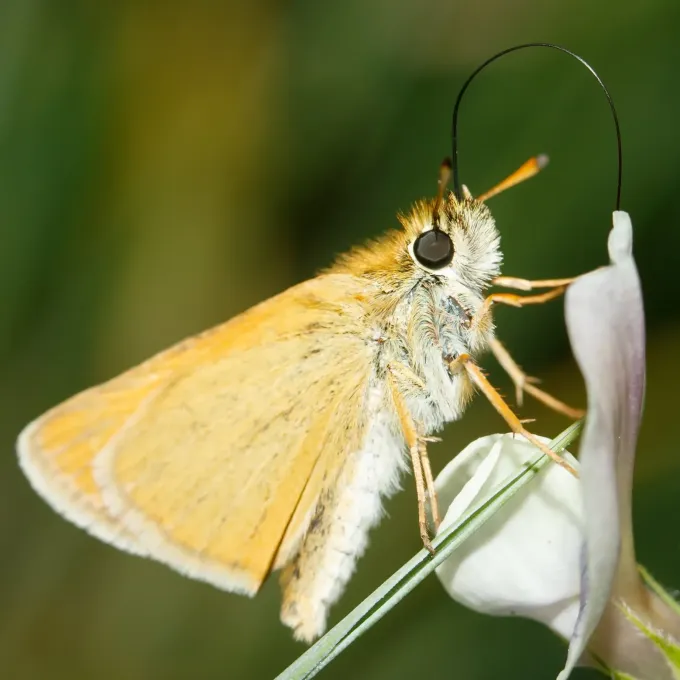
Thymelicus lineola, commonly known as the European skipper, belongs to the family Hesperiidae of the order Lepidoptera. It is a small butterfly with a wingspan of approximately 25–30 mm.
The upper side of the wings is ochre-yellow or tawny-brown with a narrow dark border. Males are distinguished by a prominent, oblique black scent scale (androconial) line on the forewings.
The larvae are bright green with thin, pale longitudinal stripes. A distinct feature of the caterpillar is its relatively large, light brown head.
The pupa is elongated, greenish in color, and is typically found hidden within rolled leaves of the host plant, secured with fine silk threads.
Adult butterflies are day-active, showing a preference for sunny weather and frequently visiting flowering plants near meadows and cultivated fields.
What it damages
The primary food sources for the larvae are wild and cultivated grasses. In agriculture, this pest poses a threat to wheat, rye, barley, and oat crops.
Beyond main cereal crops, the caterpillars feed on various meadow grasses such as timothy, couch grass, and orchard grass, which serve as reservoirs before crop emergence.
The damage is caused by the caterpillars, which consume leaf blades, often starting from the margins or creating irregular holes within the leaves.
High population densities can lead to significant reduction in the total leaf surface area, directly impacting the photosynthetic capacity and final crop yield.
Damage to the flag leaf during the stem elongation stage is particularly critical, as it often leads to lower grain filling and reduced crop quality.
When it appears
Thymelicus lineola completes one generation per year. The insect overwinters in the egg stage, deposited by the female near the base of host grass leaves.
Larvae hatch in the spring, typically between April and May, coinciding with the active vegetative growth phase of cereal crops.
The larval feeding period lasts approximately 1.5 to 2 months, after which pupation occurs directly on the host plant within rolled leaves.
Adult emergence occurs during the summer months, specifically June and July, when mating and egg-laying for the next cycle take place.
In hot and arid climatic conditions, the developmental cycle may accelerate, necessitating increased monitoring of crop health during mid-summer.
Signs of infestation
The first visual indication of an infestation is the presence of characteristic feeding patterns, appearing as longitudinal notches or missing leaf segments.
Caterpillars often create shelter by rolling leaf edges and securing them with silk. Finding these silk-bound leaf tubes on cereal plants is a reliable diagnostic sign.
Close inspection of plants often reveals larval excrement in the form of small, dark granular pellets found on the lower leaves or near the base of the stems.
Wilted or yellowing tips of leaves, combined with reduced plant turgor, signal active feeding sites within the field.
A notable increase in adult activity on flowering weeds surrounding the fields in late June often serves as a precursor to larval outbreaks in subsequent seasons.
Control measures
Agrotechnical control measures include deep autumn plowing (tillage), which helps destroy overwintering egg sites located in plant residues.
Effective weed management, particularly the removal of couch grass and other wild grasses, is essential to minimize pest reservoirs.
Adherence to proper crop rotation schedules prevents the long-term buildup of pest populations within specific agricultural plots.
When the economic threshold of damage is reached, the application of registered contact-stomach insecticides is recommended to suppress outbreaks.
Biological control efforts focus on maintaining habitats for natural parasitoids and entomophagous insects, which effectively suppress caterpillar populations under natural conditions.
Taxonomy
- Latin name
- Thymelicus lineola
- Order
- Lepidoptera (butterflies)
- Family
- Hesperiidae
- EPPO code
- THYMLI
Discussion
No discussions yet — be the first.