
Thymelicus skipper
Thymelicus
Description
How to identify
The genus Thymelicus belongs to the order Lepidoptera and the Hesperiidae family. Adult butterflies are small, typically having a wingspan ranging from 25 to 30 millimeters.
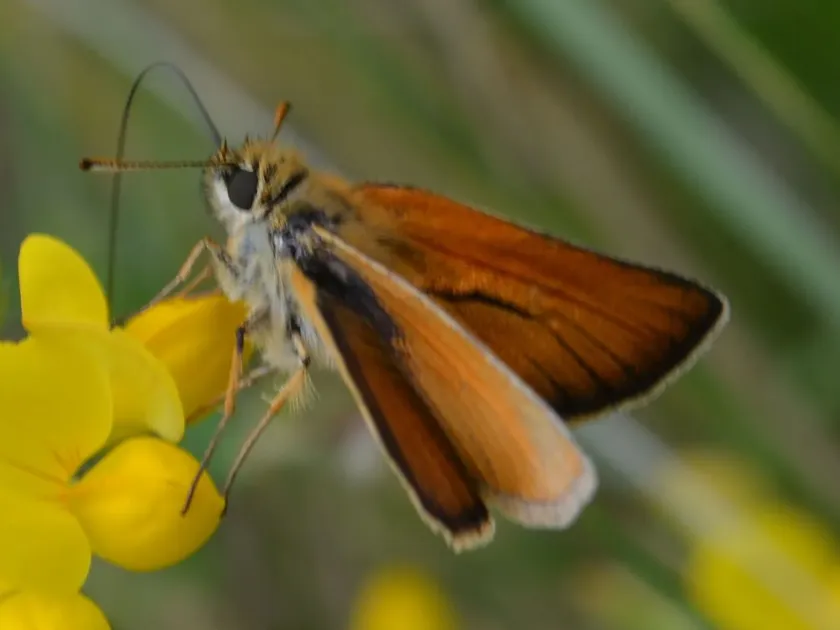
The wing coloration in this genus ranges from ochre-yellow to reddish-brown, with a distinct dark border along the outer edge. A key morphological feature is the absence of a hook on the antennal club.
The larvae, or caterpillars, are spindle-shaped and colored bright green with distinct longitudinal light stripes along the back and sides. The head is large, well-developed, and usually dark brown.
Pupae exhibit a greenish hue and develop within rolled leaves of host plants, providing them with excellent camouflage against natural predators.
The overwintering stage typically occurs as a first-instar larva, which remains protected in a silk cocoon at the base of grass stems or under leaves.
What it damages
The primary food sources for these caterpillars are wild grasses, but during periods of high population density, they can transition to cereal crops such as wheat, barley, and oats.
Larvae primarily feed on young, tender leaves, creating irregular holes or consuming the leaf margins entirely. The damage is most pronounced during the active spring and summer growth phases.
When infestation levels are high, the insects can significantly reduce the photosynthetic leaf surface, leading to a measurable decline in cereal crop yields.
Larvae are particularly destructive during the tillering stage of cereals, where damage to the central leaf can cause wilting and stunt overall plant development.
The economic impact of Thymelicus skippers is generally considered moderate, as massive outbreaks are often localized and regulated by natural entomophages.
When it appears
Adult butterflies are most active in mid-summer, with the flight period generally occurring from June through July, depending on local climatic conditions.
After mating, females lay eggs on the leaves of host plants. Embryonic development is relatively fast, followed by the emergence of the larvae.
The life cycle is typically univoltine, meaning that only one generation is produced annually in temperate climate zones.
Larvae awaken in the spring when average daily air temperatures exceed 10–12 degrees Celsius, coinciding with the active regrowth of grasses.
Larval feeding intensity peaks during the latter half of spring and early summer, immediately preceding the pupation stage.
Signs of infestation
The primary sign of infestation is leaves rolled into tubes, inside which caterpillars construct protective shelters using silk webbing.
Jagged leaf edges are another characteristic sign, often appearing as irregular or shredded margins. Heavy infestations result in widespread yellowing of grass tips.
Inspecting the lower parts of the stems often reveals leaf-made "nests" where older larvae reside during the day.
The presence of adult butterflies fluttering between flowers on sunny days serves as a reliable indicator of a population present in the vicinity.
Damage is frequently observed in patches, as egg batches are laid in groups, leading to localized clusters of defoliated vegetation.
Control measures
The primary agricultural strategy is the timely removal of wild grasses and weeds, which act as a reservoir for the pest between growing seasons.
Deep autumn plowing after harvest helps destroy overwintering larvae by burying them deep in the soil, effectively disrupting their life cycle.
Implementing a proper crop rotation cycle helps reduce the probability of population accumulation in specific fields over consecutive years.
When the economic injury level is reached, the application of broad-spectrum insecticides, such as pyrethroids or organophosphates, may be required.
Biological control methods involve promoting natural predators and parasitoids, such as egg parasitoids and ichneumon wasps, which significantly help suppress population spikes.
Taxonomy
- Latin name
- Thymelicus
- Order
- Lepidoptera (butterflies)
- Family
- Hesperiidae
- EPPO code
- THYMSP
Discussion
No discussions yet — be the first.