
Pistachio processionary
Thaumetopoea solitaria
Description
How to identify
The pistachio processionary moth Thaumetopoea solitaria is a member of the Notodontidae family. It is a specific pest that primarily affects pistachio trees, with the adults appearing as nocturnal, dull-colored moths.
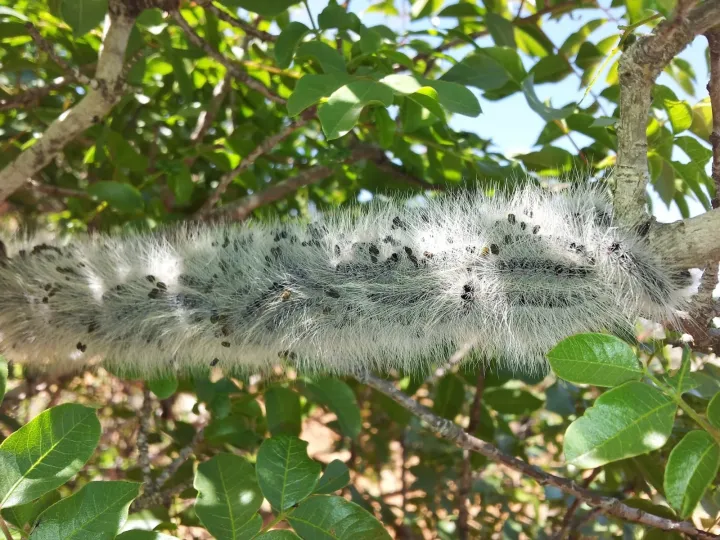
The larvae, or caterpillars, are the most recognizable stage. They are gregarious and covered in urticating hairs, which serve as a defense mechanism and can cause severe skin irritation and allergic reactions in humans and mammals.
These caterpillars typically exhibit a dark, striped body pattern. During the day, they remain in silken nests on the branches to protect themselves from predators and harsh sunlight.
The life cycle involves complete metamorphosis. Overwintering occurs in the egg stage, which is laid in clusters on the twigs of the host tree, often camouflaged with secretions from the female moth.
Due to their specific host preference, they are found primarily in areas where wild or cultivated pistachio trees grow, making them a significant concern for orchardists in these regions.
What it damages
The primary host for Thaumetopoea solitaria is the true pistachio tree (Pistacia vera). The caterpillars are extremely voracious and can cause severe defoliation of the trees.
By consuming the leaf tissue, the larvae disrupt the tree's photosynthesis. This reduction in energy production severely impacts the tree's health, growth rate, and the development of nut-bearing buds for subsequent seasons.
Heavy infestations result in branches being stripped entirely of leaves, leaving only veins or bare wood. This weakened state makes trees highly susceptible to drought, secondary pests, and wood-boring insects.
If the infestation is not managed, it can lead to stunted tree development and, in the case of younger trees, may even cause tree death due to prolonged stress and lack of nutrient reserves.
Economic losses are cumulative, arising from the immediate reduction in yield, the long-term impact on tree vitality, and the costs associated with repeated insecticide applications.
When it appears
Larval emergence coincides with the beginning of the pistachio tree's growing season, typically in early spring. This is when the leaves are most succulent and nutritious for the developing caterpillars.
The feeding period lasts several weeks. As the caterpillars grow, they consume increasing amounts of foliage, causing the most visible damage as they approach their final larval instars.
Pupation occurs in late spring or early summer. The caterpillars descend or find protected areas, such as bark crevices, to spin their sturdy, silk cocoons where they transform into the pupal stage.
Adult moths emerge during the summer months. After mating, the females deposit their eggs on the twigs, which will remain dormant until the following spring, ensuring the survival of the species.
Environmental conditions, particularly temperature and humidity during the spring, significantly influence population dynamics. Warmer springs tend to accelerate the life cycle and increase the severity of outbreaks.
Signs of infestation
The most prominent sign of infestation is the presence of silk-webbed nests on the branches. These nests house colonies of caterpillars and are easily visible once they grow to a significant size.
Extensive leaf consumption, where leaves appear ragged or completely destroyed, is a key indicator of larval activity within the canopy.
The accumulation of caterpillar droppings (frass) under the tree or on the lower leaves serves as a clear indicator of a high population density feeding in the upper foliage.
Old, empty cocoons found in the bark or crotches of branches are evidence of a previous season's infestation, suggesting the need for proactive monitoring of that specific tree.
Premature leaf drop and visibly stressed, thinned-out branches are classic symptoms of an unchecked processionary moth problem, distinguishing the affected trees from healthy ones.
Control measures
Mechanical control is effective in small orchards; it involves pruning and burning the branches containing nests while the larvae are still contained within them.
Biological control using Bacillus thuringiensis (Bt) is highly recommended. This naturally occurring bacterium is specific to caterpillars and poses little risk to beneficial insects or the surrounding environment.
Chemical intervention should be reserved for severe outbreaks where there is an immediate threat to the crop. Only approved systemic or contact insecticides should be used, with careful adherence to pre-harvest intervals.
Maintaining tree vigor through proper irrigation and fertilization helps the trees recover more effectively from defoliation events, building resistance against future attacks.
- Regular inspection of orchard trees for early signs of nests.
- Manual removal and destruction of nests in the early stages.
- Application of Bt-based bio-insecticides.
- Installation of pheromone traps to monitor adult moth flight patterns.
Taxonomy
- Latin name
- Thaumetopoea solitaria
- Order
- Lepidoptera (butterflies)
- Family
- Notodontidae
- EPPO code
- THAUSO
Discussion
No discussions yet — be the first.