
Poplar kitten
Cerura erminea
Description
How to identify
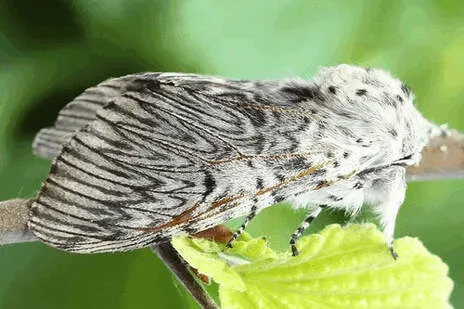
The poplar kitten (Cerura erminea) belongs to the Notodontidae family. It is a large moth with a wingspan of up to 80 mm, featuring white wings with distinct dark patterns and spots that act as camouflage.
The larvae are highly distinct, known for their bright green coloration with a saddle-like diamond patch and two long, whip-like tails that they raise when threatened to deter predators.
Development involves complete metamorphosis. Pupation occurs inside extremely tough, wood-reinforced cocoons attached to tree bark, making them blend perfectly into the tree’s surface.
Adult moths are nocturnal and do not feed; their lifespan is dedicated entirely to reproduction, with females laying eggs on the leaves of host trees.
This species is widely distributed in forest belts and orchards where poplar and willow species are abundant, reflecting their primary ecological niche.
What it damages
The larvae of the poplar kitten feed on the foliage of various species of willow (Salix) and poplar (Populus). Both wild trees and decorative varieties in urban landscaping are susceptible.
Caterpillars consume large amounts of leaf tissue, often leaving only the main veins. This damage reduces the tree’s photosynthetic capacity and weakens its overall physiological state.
In nursery settings, high caterpillar density can lead to severe defoliation of young saplings, significantly stunting their growth and reducing their commercial or aesthetic value.
Repeated infestations over multiple seasons can lead to branch dieback and leave trees vulnerable to secondary infections, such as fungal pathogens or bark-boring insects.
Economic damage is most pronounced in commercial poplar plantations where growth rate and timber quality are directly impacted by the loss of foliage.
Signs of infestation
Evidence of infestation includes ragged, skeletonized leaves, particularly in the upper parts of the canopy. Caterpillars often hide along the midrib of leaves during the day.
Bark inspection may reveal the presence of tough, bark-covered cocoons. These are often mistaken for natural tree knots or bumps, requiring a keen eye to detect.
Frass (caterpillar excrement) accumulating under the canopy is a clear indicator of feeding activity. High concentrations of frass usually suggest a heavy infestation.
If handled or disturbed, the caterpillar performs a defensive display by arching its body and lashing its rear filaments, which is a definitive sign of Cerura erminea.
Seasonal visual inspection of the leaves from late spring through summer is the best way to detect early stages of the population buildup.
Control measures
Integrated pest management is recommended for controlling the poplar kitten. In residential gardens, mechanical removal of caterpillars and cocoons is the safest and most effective strategy.
If population levels are high, targeted applications of insecticides are warranted. These should be applied while larvae are in their early instars to ensure the best results.
Biological control using Bacillus thuringiensis sprays is highly effective, as it specifically targets caterpillars while preserving local populations of beneficial insects and birds.
Maintaining tree vigor through proper pruning and regular monitoring is essential. Removing branches with known cocoon clusters during dormant months can significantly reduce the following year's generation.
Encouraging insectivorous birds, such as tits and warblers, to inhabit the area provides natural, long-term biological suppression of this moth species.
Taxonomy
- Latin name
- Cerura erminea
- Order
- Lepidoptera (butterflies)
- Family
- Notodontidae
- EPPO code
- CERUEM
Discussion
No discussions yet — be the first.