
Cerura borealis
Cerura borealis
Description
How to identify
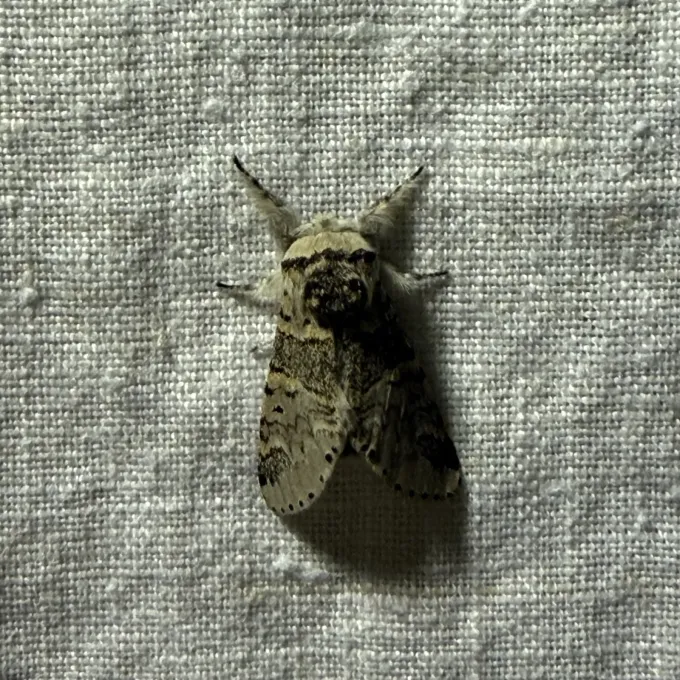
Cerura borealis, commonly known as the willow kitten moth, belongs to the Notodontidae family within the order Lepidoptera. The adult moth features a complex pattern of grey and black markings on its wings, providing exceptional camouflage against tree bark.
The larva of this species has a unique and intimidating appearance. It possesses two long, whip-like filaments at the rear of its body, which can extend bright red threads to deter potential predators when the caterpillar feels threatened.
The caterpillar's body is often brightly colored with contrasting patterns, signaling to birds that it is unpalatable. Its large head often features distinctive markings that resemble eyes, further enhancing its defensive display.
Pupation occurs within thick, durable cocoons constructed from silk mixed with fragments of bark. This allows the pupa to remain well-hidden on trunks and branches throughout the winter months, protecting it from both weather and predators.
The life cycle involves complete metamorphosis, including egg, larva, pupa, and imago stages. Depending on the climatic region, the species may complete one or two generations per year, with development rates driven by ambient temperatures.
What it damages
The larvae are responsible for the damage, exhibiting voracious feeding habits. Cerura borealis primarily feeds on the foliage of woody plants, which can significantly reduce the photosynthetic surface area of the tree canopy.
Preferred hosts include various species within the Rosaceae and Salicaceae families. Cherries, apples, bird cherries, as well as willows and poplars planted near garden areas, are frequently targeted by the larvae.
During outbreaks, this pest can completely defoliate tree branches, which negatively impacts fruit bud formation for the following season. Weakened trees become more susceptible to secondary infections and opportunistic pests.
Young trees in nurseries are at the highest risk, as even partial defoliation can significantly stunt growth. Damage to skeletal branches may lead to premature dieback, particularly in regions with harsh winter conditions.
While the overall economic impact is often moderate, localized population explosions require immediate agronomic intervention to prevent significant yield losses and ensure the long-term health of the orchard.
When it appears
The adult flight period typically occurs from late spring to early summer, once stable and warm nocturnal temperatures arrive. During this time, mating occurs and eggs are laid on the underside of host plant leaves.
Larvae feed actively throughout the summer, reaching their maximum size by late July or August. The second half of summer usually marks the peak period of foliage damage across infested orchards and gardens.
In the autumn, the larvae cease feeding and seek suitable locations for pupation. The species overwinters in the pupal stage, securely hidden within a cocoon lodged in tree bark fissures or on the surface of the trunk.
Development phase durations can fluctuate based on the current season's weather conditions. A prolonged spring may delay the adult emergence cycle, which must be accounted for when scheduling protective treatments.
Monitoring adult emergence using light traps is a critical component of integrated pest management, allowing for precise timing of interventions against the next generation of larvae.
Signs of infestation
The primary visual sign of infestation is the presence of skeletonized or completely consumed leaves on the tips and periphery of the tree canopy. Larvae often perch on leaf stalks in their characteristic defensive posture.
Close inspection often reveals specific insect frass accumulating below the infested parts of the canopy. This serves as an indirect indicator of high caterpillar density in the upper sections of the tree.
Locating cocoons on tree bark during the autumn and winter months confirms that the tree served as a breeding site. These cocoons are expertly camouflaged to match the natural textures and colors of the bark.
Damaged foliage, eaten down to the veins, is highly visible under direct sunlight. In severe cases, the tree canopy acquires a lacy, sparse appearance that stands out in stark contrast to healthy neighboring trees.
The presence of the defensive filaments, which the caterpillar extends when startled, is an unmistakable identifier for this species when surveying the garden.
Control measures
Manual collection of caterpillars is highly effective in small garden plots or on young trees, where the larvae are easily accessible for visual inspection and removal.
Biological control agents based on Bacillus thuringiensis have shown high efficacy against young larvae, providing protection while remaining safe for beneficial entomophagous insects.
When infestation levels exceed the economic threshold, contact-stomach insecticides registered for commercial fruit production are recommended. Strict adherence to pre-harvest intervals is essential for safety.
- Spraying trees during the period of peak larval emergence.
- Encouraging natural predators such as insectivorous birds and predatory beetles in the garden.
- Cleaning tree bark to remove dead wood where pupae may overwinter.
A systemic approach to orchard management, including proper irrigation and fertilization, boosts tree resilience, enabling them to recover more rapidly from damage caused by leaf-eating pests.
Taxonomy
- Latin name
- Cerura borealis
- Order
- Lepidoptera (butterflies)
- Family
- Notodontidae
- EPPO code
- CERUBO
Discussion
No discussions yet — be the first.