
Poplar kitten
Cerura liturata
Description
How to identify
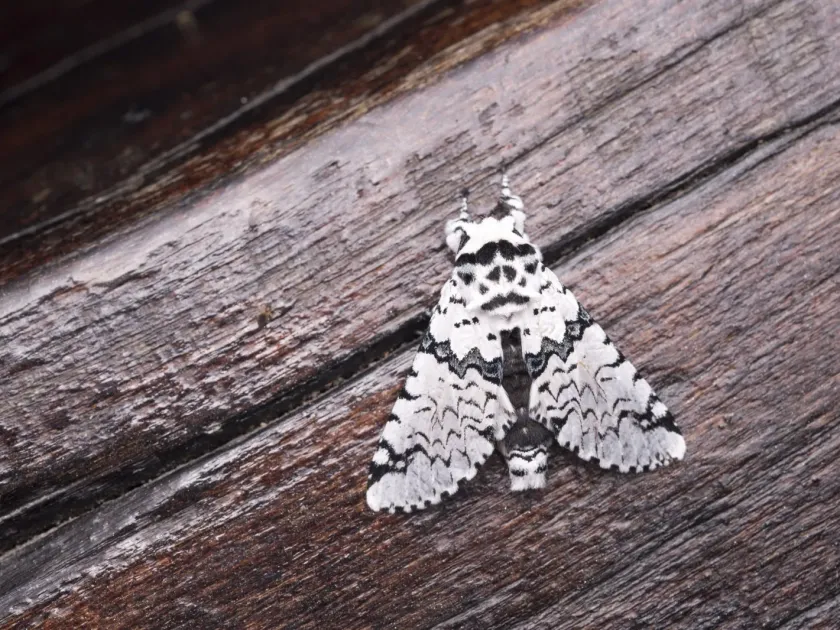
The poplar kitten (Cerura liturata) is a moth species belonging to the Notodontidae family. Adults are characterized by their cryptic coloration, which provides excellent camouflage against tree bark.
The larvae, or caterpillars, are known for their striking appearance. They possess two long, whip-like tails at the posterior end of their body, which are used as a defensive mechanism to deter predators.
Throughout their developmental stages, the caterpillars change in appearance, starting as small, dark larvae and growing into large, brightly patterned individuals in their final instar.
The life cycle includes the egg stage, five larval instars, a pupal stage encased in a tough cocoon, and the adult moth stage. Adults are typically nocturnal, focusing their activity on mating and egg-laying.
Pupae overwinter in hard, bark-colored cocoons that are cleverly hidden in the crevices of tree trunks or branches, making them extremely difficult to detect during dormant inspections.
What it damages
The primary host plants for the larvae include trees of the Salicaceae family, specifically willows (Salix), as well as various species of poplars and aspens.
The damage is caused by the caterpillars feeding on leaves. Young larvae skeletonize the leaf surface, while mature caterpillars consume entire leaves, often leaving only the central midribs.
Severe infestations can lead to significant defoliation of the trees, which slows down growth rates and reduces the tree's vigor. Repeated defoliation over several years can jeopardize the health of the host tree.
In ornamental landscaping, this pest significantly detracts from the aesthetic value of the plantings, especially when large sections of the foliage are eaten away.
Young trees in nurseries are particularly vulnerable; losing a large portion of their leaf area at a critical growth stage can lead to stunted development or mortality.
When it appears
The flight period of adult moths typically commences in late spring or early summer, dictated by local environmental temperatures and the phenology of host trees.
Females deposit eggs on the undersides of leaves, ensuring that hatching larvae have immediate access to succulent young foliage required for their rapid development.
The larval stage generally peaks during mid-summer. This is when the caterpillars are most voracious and noticeable to observers due to their increased size and feeding activity.
Pupation usually occurs toward the end of summer or early autumn. The larvae spin their resilient cocoons and prepare to enter their overwintering state.
In temperate climates, the species typically produces one generation per year, although warmer southern latitudes may occasionally see a partial second generation depending on seasonal conditions.
Signs of infestation
The most evident sign of an infestation is the presence of irregular holes in the leaves or leaves that have been stripped to the veins, characteristic of larval feeding.
Direct observation of the caterpillars is possible during the day, although they often rest on twigs or leaves, blending in with their surroundings despite their intimidating "tail" features.
Frass (caterpillar droppings) found on the foliage or on the ground beneath the host tree is a strong indicator of an active population currently feeding in the canopy.
During the dormant season, the discovery of dense, gray, bark-like cocoons attached to trunks or thick branches serves as a warning of potential future infestations.
Premature leaf drop or localized wilting of branches can suggest high concentrations of larvae feeding in that specific area, necessitating a focused inspection.
Control measures
Manual removal of caterpillars is a practical and effective solution for small-scale infestations on young or easily accessible trees, helping to curb population growth early in the season.
Biological control using Bacillus thuringiensis sprays is highly recommended. It targets the larvae specifically while remaining safe for beneficial insects and the surrounding ecosystem.
Chemical insecticides should be considered a last resort for severe infestations, focusing on systemic or contact treatments that are safe for use in residential or managed forest environments.
- Winter removal of cocoons found on tree trunks to reduce the emerging population next season.
- Encouraging natural predators such as birds and predatory wasps to inhabit the area to help manage caterpillar densities.
Maintaining tree health through proper fertilization and watering helps trees recover more effectively if moderate feeding damage does occur, ensuring long-term resilience.
Taxonomy
- Latin name
- Cerura liturata
- Order
- Lepidoptera (butterflies)
- Family
- Notodontidae
- EPPO code
- CERULI
Discussion
No discussions yet — be the first.