
Puss moth
Cerura
Description
How to identify
The Puss moth (genus Cerura) belongs to the family Notodontidae within the order Lepidoptera. The most common species is the Puss moth (Cerura vinula).
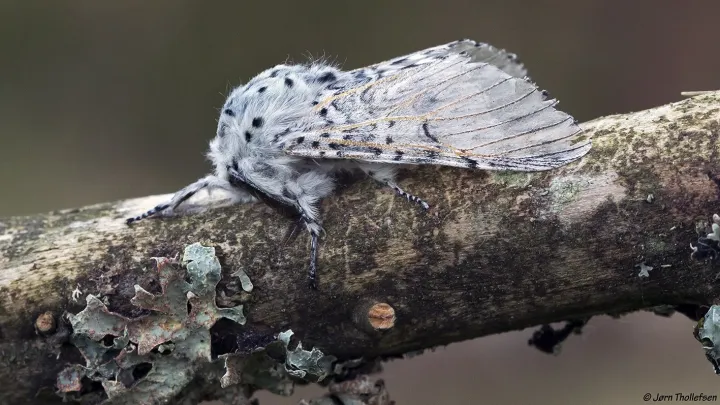
Adult moths are large with a wingspan of up to 80 mm, featuring a greyish-white coloration with distinct dark patterns on the forewings.
The larvae of this pest are highly distinctive: they are bright green with a purple-brown "saddle" on the back and two long tail filaments at the rear.
When threatened, the caterpillar adopts a defensive pose, arching its front section and emitting caustic formic acid from specialized glands.
The pupae of the Puss moth are extremely dense and typically form within hard cocoons, which the insect attaches firmly to tree bark for camouflage.
What it damages
The primary host plants for the Puss moth are members of the Salicaceae family, specifically various species of willow (Salix) and poplar (Populus).
In nursery settings or young plantations, caterpillars can significantly consume foliage, leading to stunted growth and development of the saplings.
Damage to the leaf blade occurs through irregular edge feeding, and in cases of high infestation, the pest can cause partial defoliation of the canopy.
Mature trees usually tolerate damage well, but weakened plants become more susceptible to secondary pathogens following a caterpillar infestation.
The economic impact is most notable in forestry operations, urban park management, and the commercial production of poplar planting stock.
When it appears
The flight period for adult Puss moths typically occurs in late spring and early summer, usually between May and June, depending on local weather.
Females lay eggs singly or in small clusters on the upper side of host plant leaves, making them difficult to spot during initial surveys.
The larval feeding period spans the summer months, from June through August, when they are actively consuming vegetation to prepare for pupation.
Pupation occurs in late summer or early autumn, with the pupa overwintering on tree trunks until the following season.
The Puss moth usually completes one generation per year, which limits the potential for rapid population explosions compared to polyvoltine pests.
Signs of infestation
The first sign of presence is ragged or skeletonized leaves located primarily on the terminal shoots of willow or poplar trees.
Careful inspection of tree trunks often reveals well-camouflaged, bark-colored cocoons that are remarkably resistant to environmental conditions.
Accumulated frass (larval excrement) on the leaves below damaged areas is a strong indicator of active caterpillar feeding hidden in the canopy.
The distinctive defensive display of the larva, which it triggers upon being touched, is a reliable diagnostic feature for identifying the species.
- A pungent, vinegar-like smell of formic acid near the feeding sites.
- Leaves partially consumed down to the central midrib.
- Observation of large larvae with characteristic dual tail filaments.
Control measures
Mechanical control involves the manual removal and destruction of cocoons, which are visible on tree trunks during the late autumn and winter dormancy.
In small gardens, hand-picking the caterpillars in the early morning when they are less mobile is an effective and environmentally friendly strategy.
For high-density infestations, biological insecticides containing Bacillus thuringiensis are recommended, as they are selective and protect beneficial insects.
Chemical insecticides with systemic or contact properties should be reserved for emergency situations where severe canopy loss is imminent.
A preventative approach, such as pruning crowded branches and maintaining tree health, reduces the attractiveness of the site to ovipositing females.
Taxonomy
- Latin name
- Cerura
- Order
- Lepidoptera (butterflies)
- Family
- Notodontidae
- EPPO code
- CERUSP
Discussion
No discussions yet — be the first.