
Oak processionary moth
Thaumetopoea processionea
Description
How to identify
The Oak processionary moth (Thaumetopoea processionea) is a moth species belonging to the family Notodontidae. While the adults are unremarkable, the larvae are notorious pests.
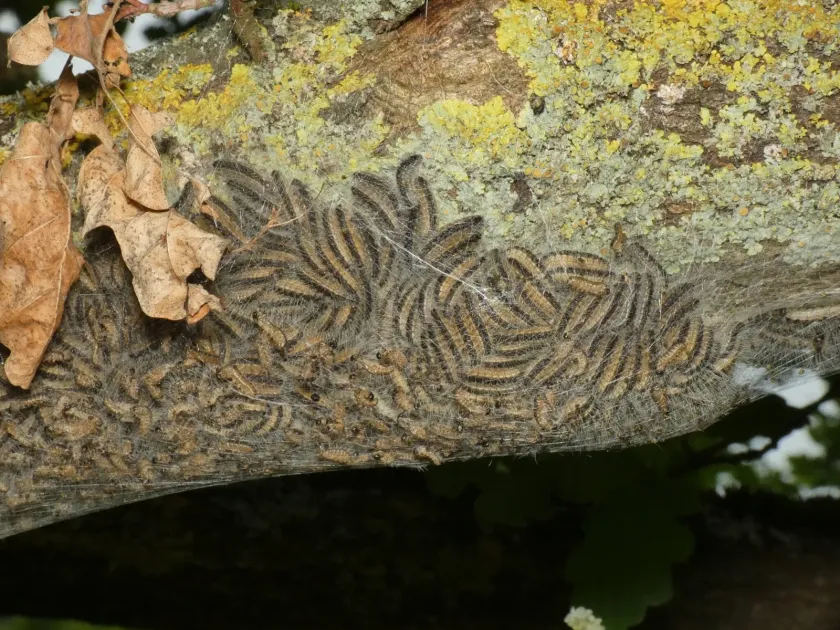
The name comes from the behavior of the caterpillars, which move in long, single-file processions along the trunks and branches of their host trees.
The larvae are covered in thousands of tiny, barbed hairs that contain a potent protein called thaumetopoein, which causes severe allergic reactions in humans and pets.
Eggs are typically laid on the smooth bark of young oak branches and are covered with scales from the female, providing excellent camouflage against predators.
These insects are highly host-specific, primarily targeting oak species and creating a significant challenge for foresters and arborists.
What it damages
The primary food source for this moth is the foliage of oak trees (Quercus spp.). Infestations can affect both young and mature trees significantly.
Caterpillars consume large amounts of leaves, which leads to widespread defoliation of the canopy during the late spring and summer months.
Chronic defoliation weakens the trees, leading to a loss of vigor, reduced annual growth, and increased susceptibility to drought and secondary pathogens.
Stressed trees are often colonized by opportunistic wood-boring insects, which can lead to the eventual death of the affected oak tree.
Beyond forestry, the presence of these caterpillars in urban areas poses a public health risk, leading to the closure of parks and public spaces.
When it appears
The life cycle begins with overwintering eggs, which hatch in early spring, usually around April, coinciding with the bud burst of oak trees.
The larvae go through several developmental stages (instars) while feeding actively from May through July, often forming their characteristic nests.
Pupation occurs within these silk nests in mid-to-late summer, where the caterpillars undergo metamorphosis into the adult moth stage.
Adult moths emerge in late summer, typically August to September, to mate and lay eggs, completing the annual life cycle.
This strict synchronization with the host tree's phenology ensures the larvae have the best possible food supply during their most vulnerable stages.
Signs of infestation
The most visible sign of an infestation is the presence of white, silk-like nests found on trunks or in the forks of branches.
Observing columns of caterpillars moving in processions along the tree bark is a definitive sign of the species' presence.
Extensive stripping of the leaves, where only the midribs remain, is a strong indicator of a high-density population in the canopy.
Dark, granular droppings (frass) accumulating at the base of the tree are a clear indication of active feeding above.
Physical symptoms in people, such as skin rashes or breathing difficulties after being near infested areas, are a dangerous signal that hairs are present.
Control measures
Manual removal of nests is a common approach but must be performed by professionals using specialized PPE to avoid contact with toxic hairs.
Biological control methods, specifically spraying with Bacillus thuringiensis, are highly effective and safer for the surrounding environment.
Pheromone traps are widely used to monitor population levels and can help reduce mating success in localized infestation areas.
Systemic insecticides applied via trunk injection can protect high-value urban trees from further damage during outbreak years.
- Installing signage to warn the public of the risks in infested areas.
- Encouraging natural predators, such as insectivorous birds and parasitic wasps.
- Pruning and destroying heavily infested branches during the dormant season.
Taxonomy
- Latin name
- Thaumetopoea processionea
- Order
- Lepidoptera (butterflies)
- Family
- Notodontidae
- EPPO code
- THAUPR
Discussion
No discussions yet — be the first.