
Pine processionary moth
Thaumetopoea pityocampa
Description
How to identify
The pine processionary moth (Thaumetopoea pityocampa) is a moth species belonging to the family Notodontidae. It is considered one of the most significant pests affecting pine forests in Mediterranean regions.
Adult moths are greyish-brown with camouflaging patterns. The larval stage, the caterpillar, is distinct due to the presence of thousands of urticating hairs containing the protein thaumetopoein.
The life cycle involves complete metamorphosis, where adults emerge in the summer. Females lay their eggs in cylindrical batches wrapped around pine needles.
Larvae are social insects that live in communal nests. These nests, constructed from white silk, serve as shelter for the colony during the cold winter months.
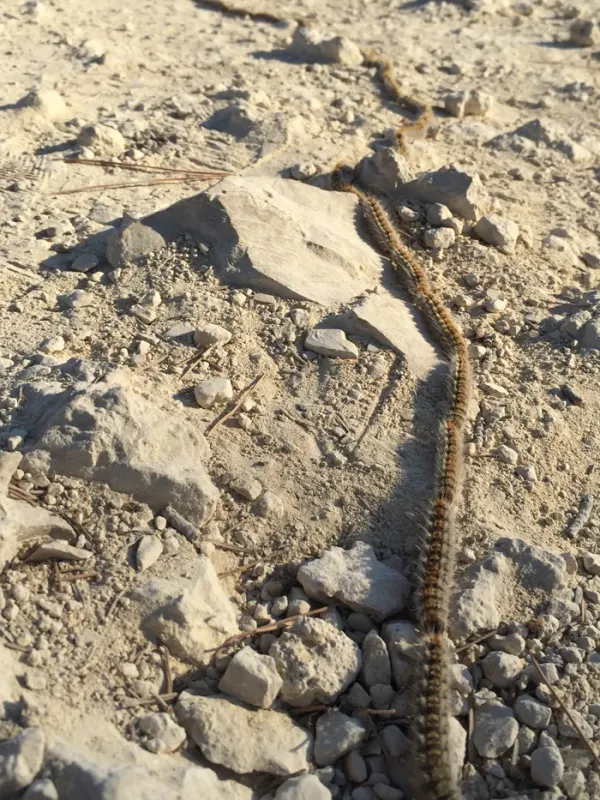
The name "processionary" originates from the larvae's habit of traveling in long, single-file lines when they leave the trees to pupate in the soil.
What it damages
The moth primarily infests various pine species (Pinus spp.), including Scots pine and Aleppo pine. Occasionally, it may also attack cedar trees.
Larvae cause damage by feeding on pine needles. Young caterpillars skeletonize the needles, while older ones consume the entire leaf, leading to significant defoliation.
Severe infestations weaken trees, making them susceptible to secondary attacks by bark beetles and other pathogens, which can ultimately lead to tree mortality.
The presence of this pest poses a significant health risk to humans and pets, as contact with the caterpillars' stinging hairs causes severe dermatitis and respiratory reactions.
In ornamental and urban landscapes, the moth ruins the aesthetic value of trees and restricts the use of public parks during the periods when caterpillars are active on the ground.
When it appears
Adult moths are active during the summer months, typically between June and September, depending on the local climate and temperature.
After mating, females lay eggs, and larvae hatch in the autumn. They immediately begin feeding and constructing their characteristic silken tents on branches.
Larvae remain active throughout the winter, feeding during warmer nights, and grow significantly during the early spring as temperatures rise.
The migration period, where larvae descend from the trees in processions to find suitable soil for pupation, usually occurs between late winter and early summer.
The timing of the life cycle is highly dependent on climate, and global warming has recently caused earlier emergence patterns in many regions.
Signs of infestation
The most visible sign of an infestation is the presence of large, white, silken nests attached to the tips of pine branches, which remain visible throughout winter.
Heavy accumulation of frass (caterpillar excrement) on the ground underneath infected trees is a strong indicator of an active feeding colony above.
The progressive browning and loss of needles starting from the top of the crown indicate that a colony has successfully infested the tree.
Observing "processions" of caterpillars moving along the ground or the bark of tree trunks is a definitive sign that the population is preparing to pupate.
- white silken nests on branches;
- browning of pine needles;
- accumulated frass on the ground;
- caterpillar processions on the move.
Control measures
Mechanical control involves the careful removal and destruction of silken nests during the winter months, ensuring protective equipment is worn to avoid contact with hairs.
Biological control methods, such as spraying Bacillus thuringiensis (Bt) bacteria, are effective during the early larval stages when caterpillars are still small and vulnerable.
Pheromone traps are widely used to monitor moth populations and disrupt mating by trapping males, which helps reduce the total number of eggs laid in the next cycle.
In forest management, selective use of systemic insecticides may be necessary in high-value areas to prevent massive defoliation and tree decline.
Conservation of natural predators, such as birds, bats, and predatory insects (e.g., ants or parasitoid wasps), is crucial for long-term population management.
Taxonomy
- Latin name
- Thaumetopoea pityocampa
- Order
- Lepidoptera (butterflies)
- Family
- Notodontidae
- EPPO code
- THAUPI
Discussion
No discussions yet — be the first.