
Pine Processionary Moth
Thaumetopoea pinivora
Description
How to identify
The Pine Processionary Moth is a member of the Notodontidae family within the Lepidoptera order. Adult moths are characterized by grey-brown wings with a wingspan of approximately 30–40 mm.
The larvae are notorious for possessing urticating hairs that contain toxins. Contact with these hairs causes severe skin irritation and allergic reactions in humans and pets.
The life cycle is generally univoltine, meaning one generation per year. Moths emerge in summer for mating, and females lay egg batches on pine needles protected by scales.
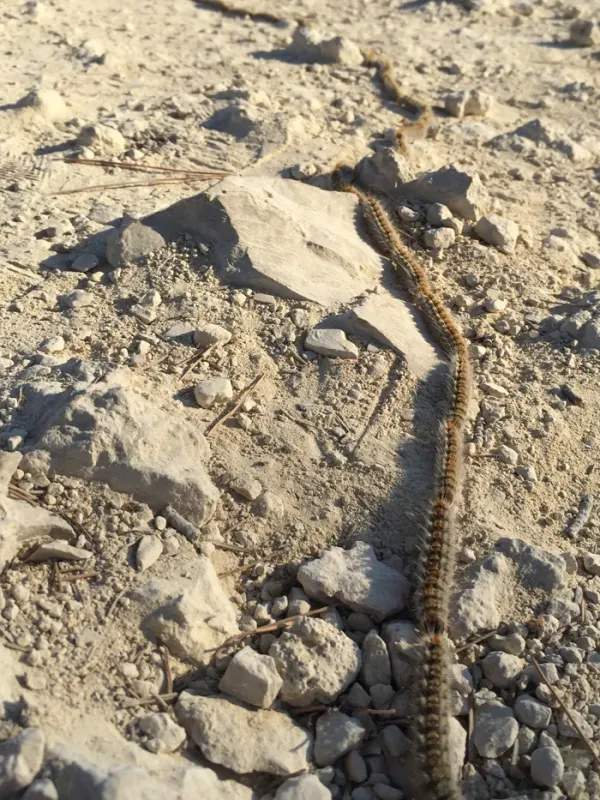
Larvae are social insects that build white, silken nests on branches. They are named for their habit of moving in long, single-file processions when traveling to feed.
They thrive in warm, sunny locations within pine forests, as these conditions are optimal for the development of their larvae during colder seasons.
What it damages
The moth primarily feeds on Pinus sylvestris and other pine species. The damage is caused by larvae consuming large quantities of needles, leading to complete defoliation.
Infested trees lose their photosynthetic capacity, which leads to stunted growth and reduced vigor. Heavy infestations can kill young trees or seriously weaken mature stands.
Weakened trees become susceptible to secondary infections and infestations by bark beetles and other wood-boring insects, which can result in the loss of entire stands.
Economic impact includes significant losses in timber productivity, high costs of pest control, and the degradation of recreational forests where the public cannot safely walk.
The localized nature of the damage can quickly expand into larger areas if environmental conditions favor the proliferation of the pest population.
Signs of infestation
The most visible sign of infestation is the presence of silk nests, which appear like large, white, cloud-like structures attached to the branches of pine trees.
Look for processions of larvae on the ground or tree trunks during the late winter or early spring as they leave their nests to feed or find pupation sites.
Needles on affected branches appear chewed and jagged. As the season progresses, the crown of the tree may show widespread brown discoloration due to excessive defoliation.
Large quantities of granular frass (excrement) falling from the nests accumulate on the ground beneath the infested trees, providing a clear indication of activity.
The trees show signs of stress, including the drying out of branch tips and a general thinning of the overall needle density across the canopy.
Control measures
Chemical control involves the application of selective insecticides or biological sprays, like Bacillus thuringiensis, during the early stages of larval development.
Physical removal of the nests using long poles is effective, but it must be performed with extreme caution, wearing protective gear to prevent contact with toxic hairs.
Biological control methods include promoting the habitat for natural predators such as birds, bats, and predatory insects that feed on the larvae during the growth phase.
Silvicultural measures, such as planting mixed forest stands instead of pine monocultures, help to interrupt the lifecycle and reduce the moth's ability to spread.
Fermone traps are essential for monitoring adult male populations, helping foresters predict outbreaks and schedule necessary interventions more accurately.
Taxonomy
- Latin name
- Thaumetopoea pinivora
- Order
- Lepidoptera (butterflies)
- Family
- Notodontidae
- EPPO code
- THAUPV
Discussion
No discussions yet — be the first.