
Mediterranean pine processionary
Thaumetopoea mediterranea
Description
How to identify
The Mediterranean pine processionary moth (Thaumetopoea mediterranea) is a moth belonging to the family Notodontidae. The adult moth is cryptic, with brownish-grey forewings, which allows it to blend perfectly into the bark of pine trees where it spends its short adult life.
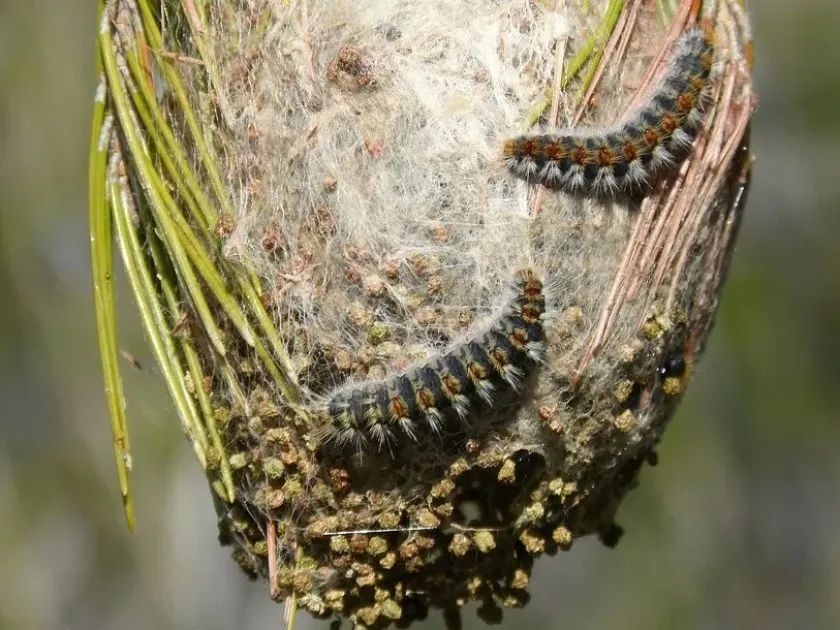
The larvae, or caterpillars, are the most recognizable and notorious stage of this insect. They are covered in thousands of tiny urticating hairs that contain a toxin capable of causing severe skin rashes and allergic reactions in humans and domestic animals.
These insects are famous for their colonial behavior. They live in large groups within communal silken nests, which they construct on the branches of their host pine trees. These nests provide protection against predators and extreme weather during the larval stage.
The life cycle is univoltine, meaning one generation per year. Moths emerge in the summer, mate, and deposit eggs on the pine needles. Larvae hatch in autumn, start feeding, and construct their winter nests to survive the cold months.
Upon the arrival of spring, larvae leave their nests in a characteristic nose-to-tail "procession" to find suitable soil for pupation. They bury themselves in the ground and remain there until the adult moth emerges the following summer.
What it damages
The primary hosts of this pest are various species of pines, including the Aleppo pine and maritime pine. It is a significant threat to forest health in Mediterranean climates, impacting both natural forests and urban landscape trees.
Feeding larvae strip needles from the trees, leading to severe defoliation. A heavy infestation can significantly reduce the tree's photosynthetic capacity, causing stunted growth, weakened immunity to other stressors, and, in severe cases, the death of the tree.
Beyond the arboricultural damage, the pest is a major public health concern. The urticating hairs are easily dislodged and can be carried by the wind or through physical contact, causing dermatitis, eye irritation, and respiratory distress.
The presence of these pests reduces the recreational and aesthetic value of forests and parks. Due to the health risks, affected areas often have to be cordoned off, leading to significant disruption of human activities in pine-dominated regions.
Economically, the pine processionary leads to high maintenance costs for forestry services and urban planners who must implement regular monitoring and suppression programs to protect valuable timber and ornamental trees.
Signs of infestation
The most distinctive sign of infestation is the appearance of white, silken communal nests. These are often situated in the upper, sunny parts of the crown or at the forks of branches, becoming most visible during the autumn and winter months.
Accumulation of larval frass (droppings) on the ground or on lower branches is a strong indicator of an active colony. These droppings appear as small, dark, granular pellets, often found in high concentrations below the infested areas.
Defoliated branches where needles have been consumed or remain hanging in a withered, brown state are signs of feeding. One might notice patches of bare twigs where the foliage has been completely stripped away by the feeding processions.
The "processions" themselves are a clear visual cue in late winter or early spring. Seeing long, single-file lines of caterpillars migrating down the tree trunk to reach the soil for pupation confirms a high level of infestation.
Local reports of skin rashes or irritation among forestry workers, hikers, or park visitors in a specific area often precede visual identification, as the microscopic hairs can affect people before the nests are noticed.
Control measures
Manual removal of nests is a common control measure for small or isolated infestations. The nests are cut and carefully destroyed, preferably by burning, while the operator wears full protective gear to avoid exposure to toxic hairs.
Biological control using Bacillus thuringiensis (Bt) is highly effective and environmentally friendly. When applied to the canopy during the early larval stages, it selectively targets the caterpillars without harming beneficial insects or wildlife.
Chemical control involving insect growth regulators or systemic insecticides may be used in high-density outbreaks. These are usually applied via aerial or ground-based spraying, targeting the larvae while they are still actively feeding.
Pheromone traps are widely used for monitoring adult moth populations. By tracking the number of males caught, forestry managers can determine the timing and necessity of chemical or biological interventions for the next generation.
Promoting local biodiversity, particularly by encouraging insectivorous birds and predatory insects, can help keep processionary moth populations in check. This integrated approach ensures long-term forest resilience against outbreaks.
Taxonomy
- Latin name
- Thaumetopoea mediterranea
- Order
- Lepidoptera (butterflies)
- Family
- Notodontidae
- EPPO code
- THAUME
Discussion
No discussions yet — be the first.