
Greek processionary moth
Thaumetopoea hellenica
Description
How to identify
The Greek processionary moth (Thaumetopoea hellenica) is a member of the Notodontidae family. It is a significant defoliator of pine species, closely related to the well-known pine processionary moth.
Adult moths are nocturnal, exhibiting cryptic coloration that allows them to blend in perfectly with pine bark during their resting period in the daytime.
The larvae are well-known for their urticating hairs, which contain the toxin thaumetopoein. These hairs cause severe skin rashes and respiratory irritation if touched by humans or pets.
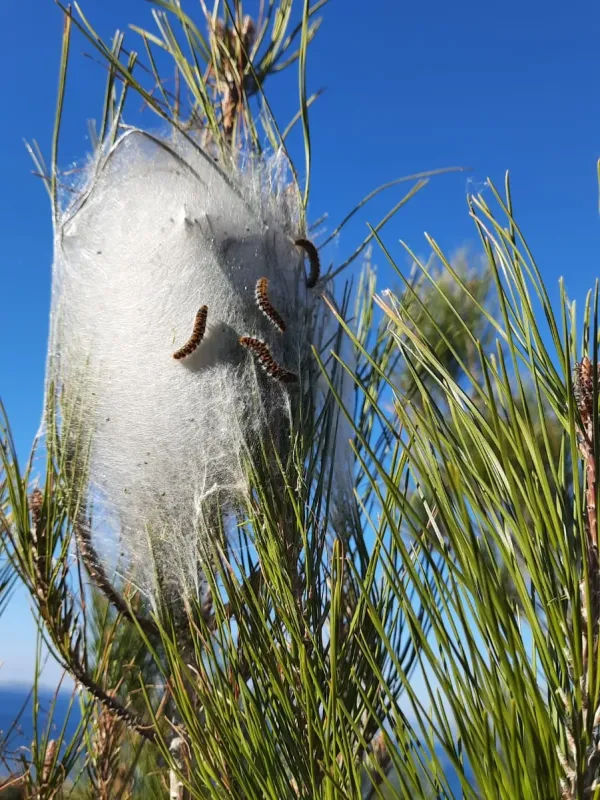
The species is defined by its gregarious nature; larvae live in communal silk nests during their development, providing shelter from adverse weather conditions.
Larval identification is facilitated by their distinct banded patterns and the unique habit of moving in long, single-file processions across branches and trunks.
What it damages
This pest primarily targets pine trees (Pinus spp.), which are widespread in Greece and the Mediterranean basin, posing a risk to both forestry and ornamental plantings.
By consuming pine needles, the caterpillars cause severe defoliation, which directly impacts the tree's photosynthetic capability and overall vigor throughout the growing season.
Repeated or intense infestations lead to reduced annual growth rings and physiological exhaustion, making the affected trees susceptible to secondary wood-boring pests.
Young trees in nurseries are at particularly high risk, as severe defoliation at this stage often leads to tree mortality or permanent deformation of the structure.
The toxic hairs of the larvae also disrupt local ecosystems, as they act as a potent chemical defense against most insectivorous birds, preventing natural population control.
When it appears
The life cycle is perfectly adapted to Mediterranean climates with mild winters, allowing for larval feeding activity during the colder months of the year.
Mating and egg-laying occur in late summer or autumn, after which larvae emerge to construct their signature silk nests for protection against predators.
Feeding intensity peaks during the late winter and early spring months, as the larvae mature through multiple instars, consuming large amounts of foliage.
In mid-spring, the larvae finish their development and migrate down the tree trunk to reach the soil, where they bury themselves to form pupae in the ground.
The pupal stage can last several months, with adult moths emerging during the following summer to repeat the cycle and ensure the survival of the next generation.
Signs of infestation
The most visible sign of an infestation is the presence of large, white, silken nests firmly attached to the terminal ends of pine branches in the canopy.
Accumulation of larval excrement, which looks like dark granular pellets, scattered beneath the infested tree canopy is a strong indicator of active larval feeding.
Needle browning and loss, where needles are eaten down to the needle sheath, creates a patchy, sparse appearance in the foliage of the affected trees.
Witnessing long processions of caterpillars moving in lines along branches or down to the forest floor is a classic sign of the prepupal stage of the species.
Silk webbing remains as a remnant on the branches long after the colony has migrated or been disturbed, marking the location of previous feeding sites.
Control measures
Mechanical removal of the silk nests is highly effective when done early in the season, provided that workers wear full protective gear to avoid contact with toxic hairs.
Biological control using Bacillus thuringiensis (Bt) is recommended as a highly selective and environmentally friendly method for managing large infestations.
Installing physical barriers such as sticky bands around the trunks of infested trees effectively traps caterpillars during their descent, preventing them from pupating in the soil.
Pheromone-baited traps are useful for monitoring the population density of adult moths and timing other management interventions for maximum impact.
Careful preservation of natural predators and parasitoids is essential for long-term population suppression, as chemical broad-spectrum insecticides often exacerbate the problem.
Taxonomy
- Latin name
- Thaumetopoea hellenica
- Order
- Lepidoptera (butterflies)
- Family
- Notodontidae
- EPPO code
- THAUHL
Discussion
No discussions yet — be the first.